Hypertension in Children
Description Diagnostic criteria General and supportive measures ICD-10 code: I10 DESCRIPTION Hypertension is defined as systolic and/or diastolic blood pressure ≥ the 95th percentile for gender, age and height percentile on at least three consecutive occasions. A sustained blood pressure of > 130/90 mmHg in a child older than 13 years is defined as hypertension. Measure blood press
Description
Diagnostic criteria
General and supportive measures
ICD-10 code: I10
DESCRIPTION
Hypertension is defined as systolic and/or diastolic blood pressure ≥ the 95th percentile for gender, age and height percentile on at least three consecutive occasions. A sustained blood pressure of > 130/90 mmHg in a child older than 13 years is defined as hypertension. Measure blood pressure with the child in a sitting or supine position with the entire arm in line with the level of the heart.
In the majority of children, hypertension is due to an identifiable cause. Severe hypertension suggests renal disease.
Hypertensive emergency/crisis exists when CNS signs of hypertension appear, such as encephalopathy, convulsions, retinal haemorrhages or blindness. Great care is required to reduce the blood pressure in a controlled manner to avoid potentially serious consequences of impaired auto-regulation of cerebral blood flow.
Hypertensive urgency is defined as a significant elevation of blood pressure without accompanying end-organ damage. Patients are generally symptomatic with complaints of headache, blurred vision and nausea, despite the lack of end-organ involvement.
A valid assessment of the blood pressure is of extreme importance. The blood pressure is measured by standard auscultation technique in children > 1 year of age.
Measure the BP in at least one limb, preferably the right upper arm. If hypertension is present, measure BP in all four limbs.
One should use the widest cuff that can be applied to the upper arm. The cuff bladder must encircle at least 80% of the upper arm and should cover at least 40% of the distance between the acromion and the olecranon.
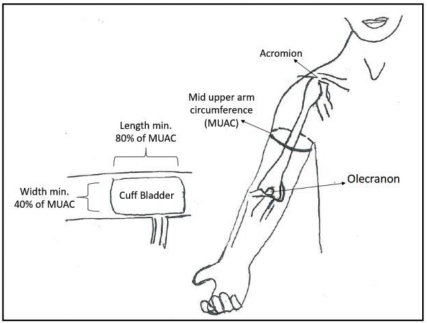
Click on the image to enlarge
- Palpate the boney prominence of the acromion and olecranon posteriorly to determine the mid-upper arm point, where the mid-upper arm circumference (MUAC) is measured.
- MUAC for BP measurement is done on the right arm whereas for malnutrition, use the non-dominant arm.
It is better to use a cuff that is slightly too large than one that is too small. Large cuffs, if covered with linen-like material, can be folded to the appropriate size in smaller infants as long as the bladder encompasses the arm.
DIAGNOSTIC CRITERIA
Clinical
- Symptoms and signs of any of the following systems:
- central nervous,
- cardiovascular,
- respiratory,
- urogenital.
- The most common associated features are:
- oedema, haematuria, proteinuria,
- skin sores (impetigo),
- convulsions, coma and visual symptoms,
- acute heart failure and pulmonary oedema,
- acute respiratory distress, cyanosis and apnoea.
- Some children may be asymptomatic.
- Blood pressure in children correlates with body size and increases with age.
Categories of hypertension
- Normal: below 90th percentile.
- Elevated blood pressure: 90th–95th percentile or BP > 120/80 mmHg.
- Stage 1 hypertension: > 95th–99th percentile plus 12 mmHg.
- Stage 2 hypertension: > 99th percentile plus 5 mmHg.
| Age of child | 95th Percentile of systolic and diastolic blood pressure | |
| First 12 hours | First week | |
| Newborn – preterm | 65/45 mmHg | 80/50 mmHg |
| Newborn – full term | 80/50 mmHg | 100/70 mmHg |
Screening blood pressure values requiring further evaluation19
| Age (years) | Blood Pressure (mmHg) | |||
| Boys | Girls | |||
| Systolic | Diastolic | Systolic | Diastolic | |
| 1 | 98 | 52 | 98 | 54 |
| 2 | 100 | 55 | 101 | 58 |
| 3 | 101 | 58 | 102 | 60 |
| 4 | 102 | 60 | 103 | 62 |
| 5 | 103 | 63 | 104 | 64 |
| 6 | 105 | 66 | 105 | 67 |
| 7 | 106 | 68 | 106 | 68 |
| 8 | 107 | 69 | 107 | 69 |
| 9 | 107 | 70 | 108 | 71 |
| 10 | 108 | 72 | 109 | 72 |
| 11 | 110 | 74 | 111 | 74 |
| 12 | 113 | 75 | 114 | 75 |
| ≥ 13 | 120 | 20 | 120 | 80 |
Note: Blood pressure levels by age and height percentiles. Various growth charts can be obtained from:
https://www.cdc.gov/growthcharts/clinical_charts.htm#Set1
Blood pressure levels for Boys by age and height percentile16
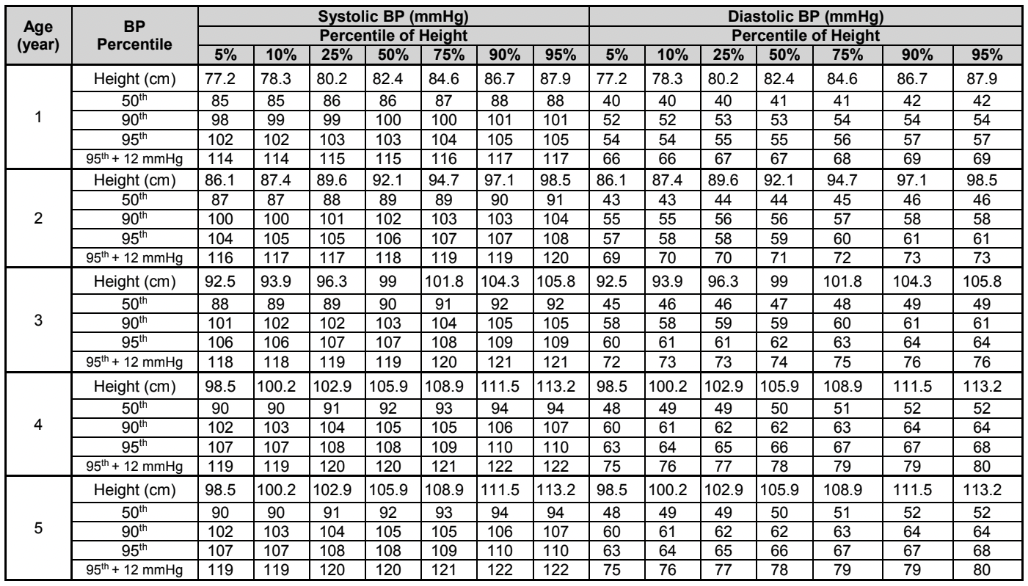 Click on the image above to enlarge to view Blood pressure levels for Boys by age and height percentile age 1-5 years
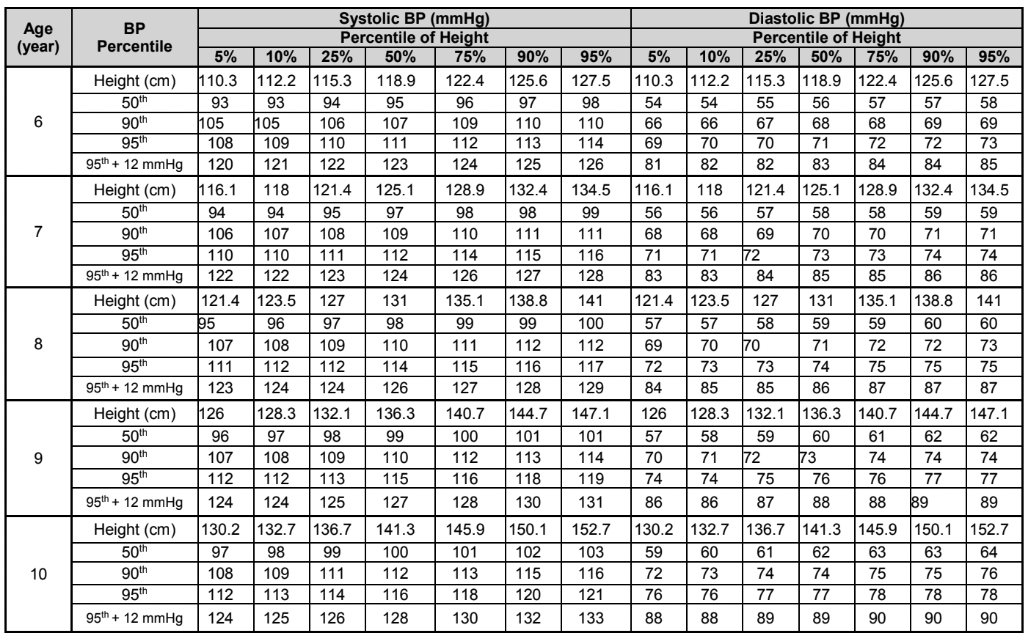
Click on the image above to enlarge to view Blood pressure levels for Boys by age and height percentile age 6-10 years
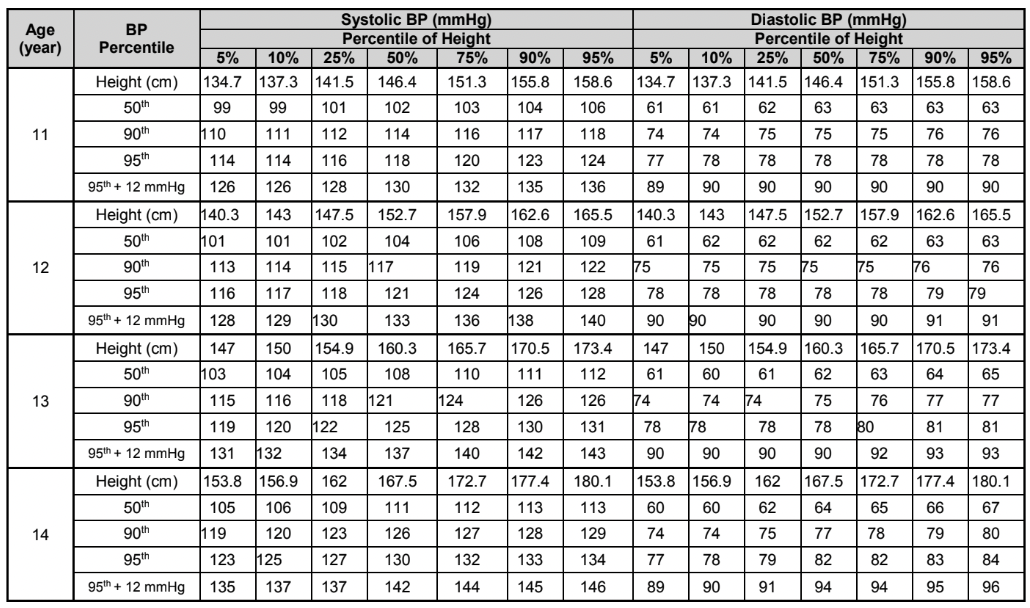
Click on the image above to enlarge to view Blood pressure levels for Boys by age and height percentile age 11-14 years
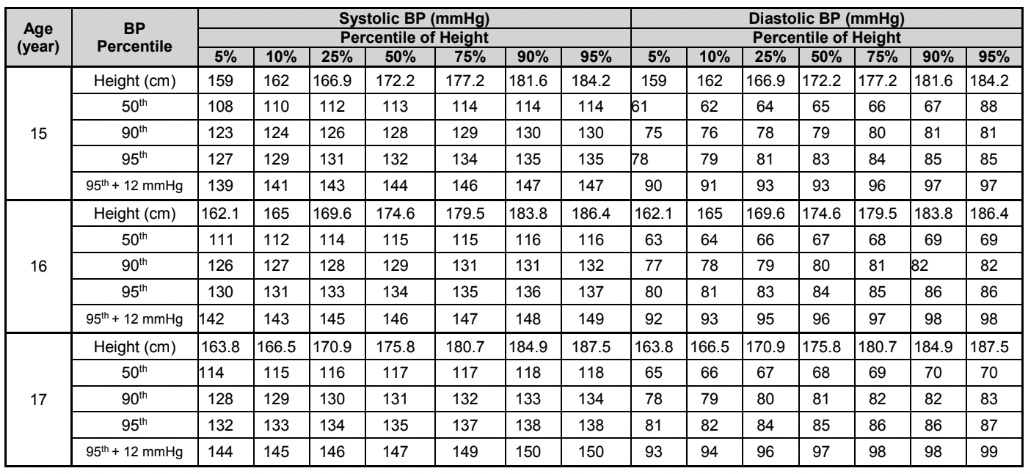
Click on the image above to enlarge to view Blood pressure levels for Boys by age and height percentile age 15--17 years
Blood pressure levels for Girls by age and height percentile17
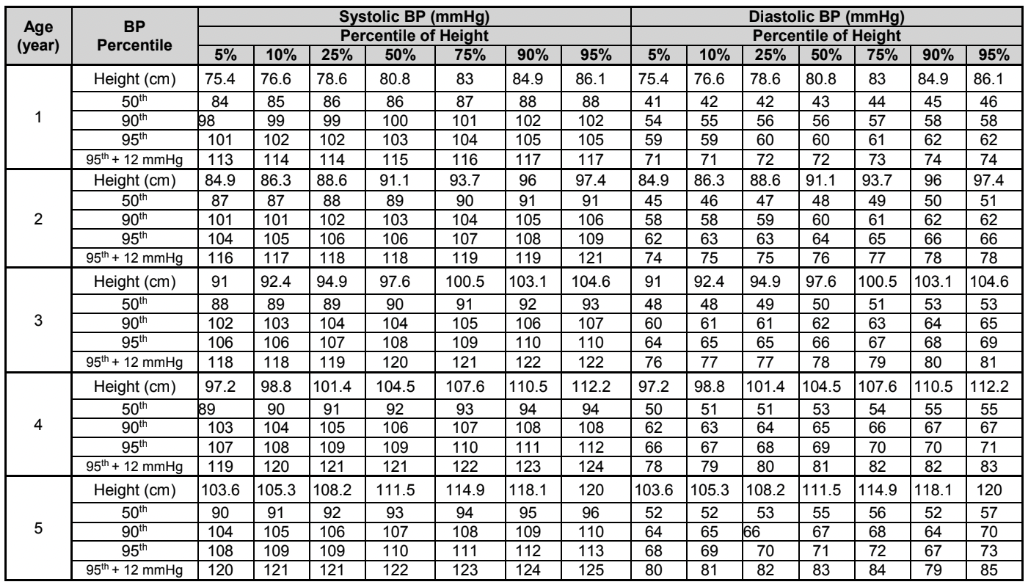 Click on the image above to enlarge to view Blood pressure levels for Girls by age and height percentile age 1-5 years
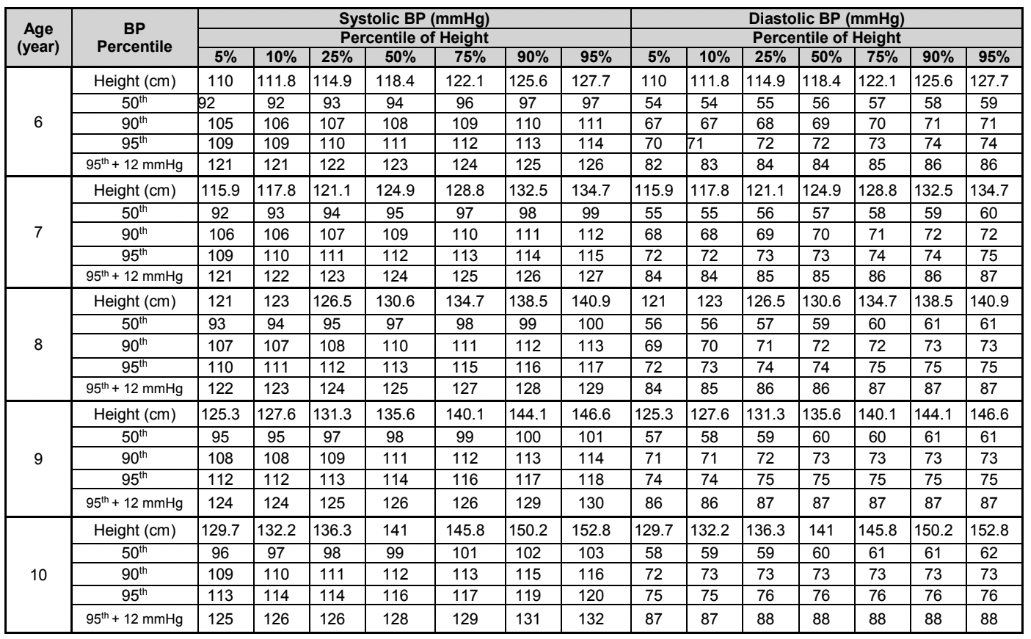
Click on the image above to enlarge to view Blood pressure levels for Girls by age and height percentile age 2-12 years
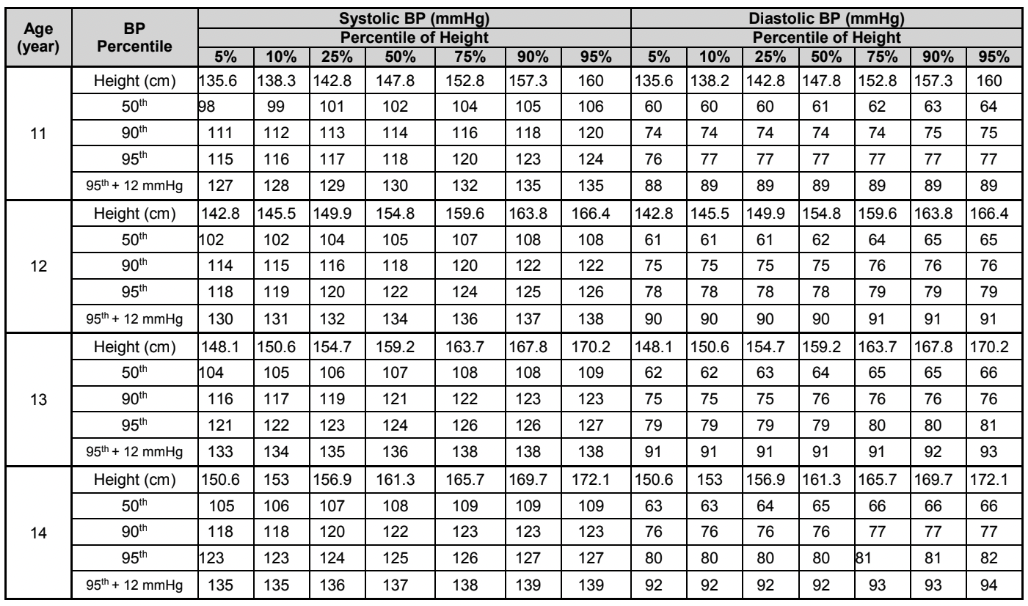 Click on the image above to enlarge to view Blood pressure levels for Girls by age and height percentile age 11-14 years
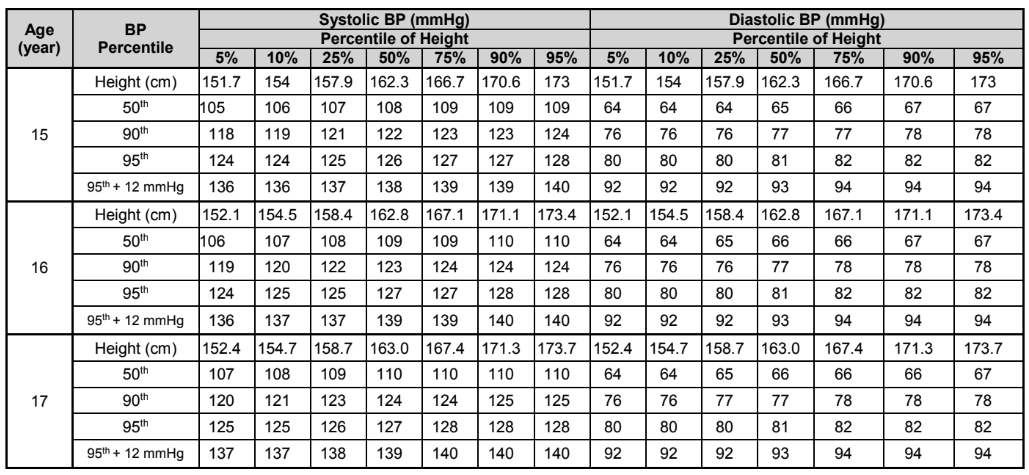 Click on the image above to enlarge to view Blood pressure levels for Girls by age and height percentile age 15-17 years
GENERAL AND SUPPORTIVE MEASURES
- There is a strong association between overweight patients and high blood pressure.The majority of these patients have mild hypertension and usually only need lifestyle modification.
- Acute hypertension:
- Bed rest – Fowler’s position.
- Control fluid intake and output (restriction).
- Restrict dietary sodium.
- Manage end-organ effects.
- Chronic hypertension:
- Advise a change in lifestyle.
- Institute and monitor a weight reduction programme for obese individuals.
- Regular aerobic exercise is recommended in essential hypertension.
- Dietary advice:
- Limit salt and saturated fat intake.
- Increase dietary fibre intake.
Standard Treatment Guidelines And Essential Medicines List For South Africa, Hospital Level, Paediatrics, 2023 Edition
Chapter 4: Cardiovascular System , 4.11 Hypertension in Children
Click here for 4.11.1 Hypertension, Acute Severe
Click here for 4.11.2 Hypertension, Chronic