Immediate Care of the Newborn
The guidelines recommend management of common obstetric conditions at primary and referral level, based on local experience and evidence-based practice. They are not intended as strict protocols nor as standard operating procedures, but rather as a guide to safe effective management of common obstetric problems. The guidelines should be most useful to interns, medical officers and registrars.
Immediate care of the well newborn
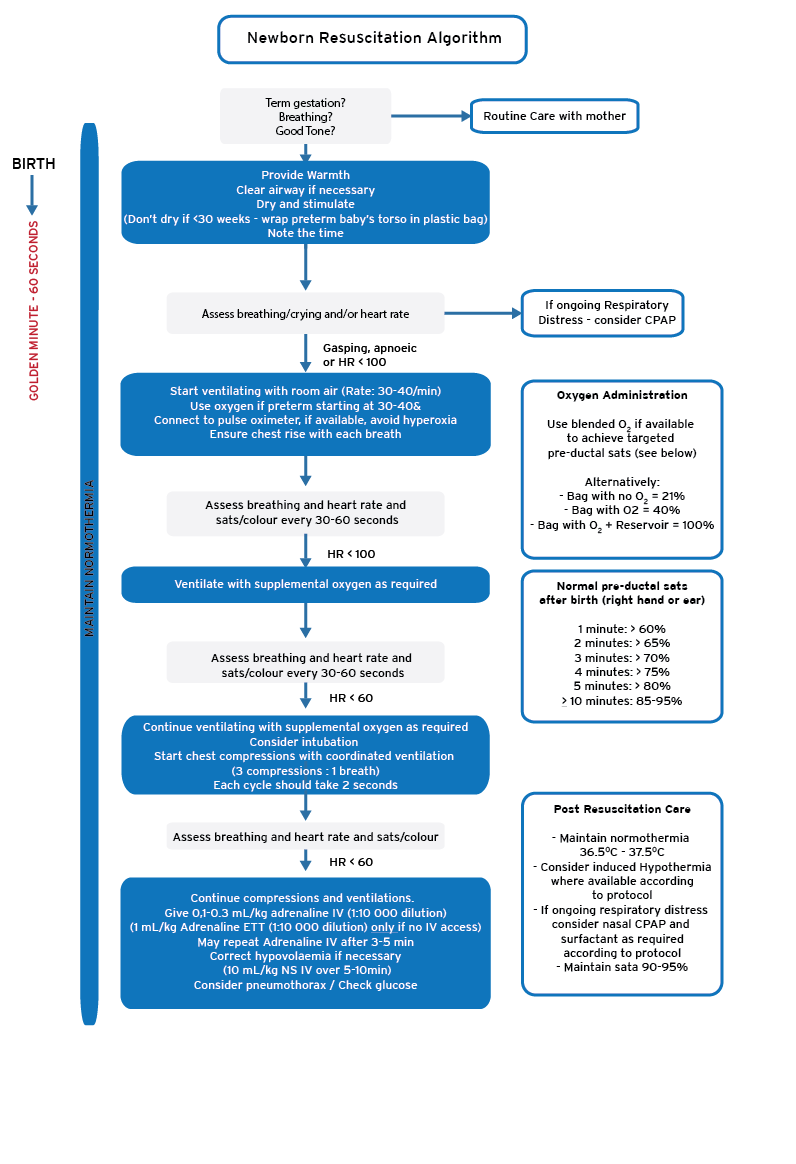
Neonatal resuscitation algorithm
NEONATAL RESUSCITATION
General Principles
Every birth should be attended by at least one person whose sole responsibility is management of the newborn. All staff who conduct deliveries should be able to resuscitate & provide immediate care to newborn infants.
Babies that may require resuscitation
Always ensure that a skilled doctor or nurse is available at birth for the following:
- Meconium-stained liquor or any other evidence of fetal distress
- Prematurity (<36 weeks), Postmaturity (>42 weeks), anticipated small baby (<2 kg) or large baby (>4 kg).
- Multiple pregnancy, major congenital abnormalities or hydrops fetalis
- Cord prolapse
- Abruptio placentae
- Prolonged or difficult labour
- Malpresentation
Apgar scores must be assigned at 1 and 5 minutes. In addition, even before 1 minute, ask yourself the following questions:
- Is the amniotic fluid clear or meconium-stained?
- Is the baby breathing or crying?
- Is there good muscle tone?
- Is the colour pink?
- Was the baby born at term?
If the answer is YES to all these questions, provide routine care:
- Provide warmth
- Clear the airway only if there are secretions, wiping the mouth and nose with gauze, cotton wool or clean linen. Do not suction
- Dry the baby & remove the wet linen
- Maintain warmth by putting the infant directly on the mother’s chest (skin to skin) & covering with dry linen
- Do not separate these babies from their mothers
- Start feeds within an hour after birth, breastfeed unless contraindicated.
If the answer is NO to any of these questions, evaluate & resuscitate:
- Provide warmth
- Place the infant on a flat surface facing up with the head supported in a neutral position (not flexed, not hyperextended)
- Suction the mouth & nose only when necessary – when there are secretions that may obstruct the airway
- Dry the baby & remove the wet linen
- Provide gentle tactile stimulation (slapping the feet or gently rubbing the back) for 2-3 seconds if the infant is not crying.
- Determine the baby’s colour, respiratory effort & heart rate. Listen to the heart rate with a stethoscope over the apex for 6 seconds & multiply by 10
If the infant is not breathing or breathing irregularly or heart rate is <100/ minute, call for help & start resuscitation:
- Airway: Maintain the head in a neutral position, clearing secretions by gentle suction.
- Breathing: Start bag mask ventilation (BMV) using room air at 30-40 breaths/minute. Ensure slight chest rise with each breath. If the chest does not move, check the seal of the mask on the baby’s face, & check for flexion or overextension of the neck. Reassess colour, respiratory effort & heart rate after 30 seconds. Most infants will respond to BMV. Stop bagging only if the infant is breathing regularly, & only give oxygen. If not breathing & heart rate is >60/minute continue ventilating with up to 100% oxygen & reassess every 30 seconds until the infant starts breathing.
- Circulation: Intubate & start chest compressions if the heart rate is <60/minute despite BMV with oxygen. Perform chest compressions using index & middle fingers placed on the lower third of the sternum to depress the chest to about a third of its anterior-posterior diameter. An alternative method can be employed by encircling the infant’s chest with both hands & using both thumbs to compress the chest. Give compressions at a ratio of 3:1 (three chest compressions to one ventilation). Reassess after 30 seconds & if the heart rate is still <60/minute give adrenalin 1:10 000 at 0.1-0.3 mL/kg intravenously. If adrenalin is instilled into the endotracheal tube it is given undiluted at a strength of 1:1000 at 0.1-0.3 mL/kg. This may be repeated every 3-5 minutes. Give naloxone only after establishing good ventilation and only if the mother received narcotics in the last 4 hours of labour.
Babies who require prolonged BMV or more extensive resuscitation are at high risk for developing subsequent complications. These infants must be admitted for ongoing monitoring & support. Keep them warm, monitor temperature, respiration, heart rate, blood pressure, glucose & urine output.
NB
For all newborns with birth weight ≥2.5 kg who required immediate resuscitation at birth, or with 5-minute Apgar <7, send the placenta in 10% formalin for histopathological examination.
IMMEDIATE CARE OF THE WELL NEWBORN
- Wear protective gloves when handling a newborn who has not been bathed
- Maintain the baby’s temperature by warming the environment, drying the infant immediately after birth, & encouraging skin-to-skin contact with the mother
- Assign an Apgar score at 1 & 5 minutes
- Do physical examination to look for congenital abnormalities
- Take measurements (weight, length & head circumference)
- Skin care – use a cloth or cotton wool with tap water to remove blood & meconium. Do not remove the vernix caseosa
- Eye care – apply chloramphenicol or erythromycin ointment within an hour after birth
- Give vitamin K 1 mg IM within an hour after birth
- Start feeds within an hour after birth. Breastfeed unless contraindicated
The Apgar score. Scores for each are added, to a total out of 10.
| Sign | Score | ||
| 0 | 1 | 2 | |
| Colour | Blue or pale | Pink body, blue extremities | All pink |
| Heart rate | Absent | <100 beats per minute | >100 beats per minute |
| Respiratory Effort | Absent | Gasping or irregular | Regular or crying |
| Muscle tone | Limp or floppy | Some flexion of extremities | Active movement |
| Response to stimulation | No response | Grimace | Cry or cough or sneeze |
Newborn Resuscitation Algorithm