Incisional Hernia
Incisional Hernia
Diagnosis
Indications for surgery
Repair technique
- Incisional hernias are a common complication of abdominal surgery
- Incisional hernias can occur many years after the index operation
- Surgical site infection doubles the risk of incisional hernia
Diagnosis
- most incisional hernias can be diagnosed by clinical examination.
- patients typically present with an abdominal bulge in the region of the surgical scar.
- on examination the edges of the fascial defect can often be palpated
- an accurate estimation of the size of the defect may be difficult to discern clinically.
- the size of the peritoneal sac and associated contents is often large, although the fascial defect may be fairly small, particularly in obese patients and after multiple abdominal operations, where there may be numerous small fascial defects.
- skin changes as a result of pressure may occur in large and in long standing hernias
Many incisional hernias are asymptomatic, but 20-50% present with pain.
Asymptomatic, incidental or minimally symptomatic incisional hernias may be safely observed, and need not be referred to SOPD. However, little information is available on the risk of major complications from untreated incisional hernias. Small hernias invariably enlarge with time.
Preoperative investigations should be kept to a minimum.
There is no role for routine imaging tests to confirm the diagnosis of a hernia, but in case of uncertainty, ultrasonography or CT (in overweight patients) can help confirm the diagnosis.
Indications for surgery
Not every patient who presents with an incisional hernia is suitable for surgical repair
The risk of surgery must be balanced against the risk of complications if the hernia is left untreated.
- Symptomatic hernia - elective repair
- Incarcerated hernia - urgent repair
- Obstructed/ strangulated hernia - emergency repair
If high anaesthetic risk or surgical repair difficult, then the size of the fascial defect relative to the hernia, the symptom complex, the patient’s age, and the patient’s preferences must be carefully considered. In such cases conservative management may be more appropriate.
This decision making process is patient specific and therefore we recommend that all patients are referred for a specialist opinion.
Repair technique
- direct suture repair
- small hernia neck <3cm
- gross wound contamination/ bowel infarction
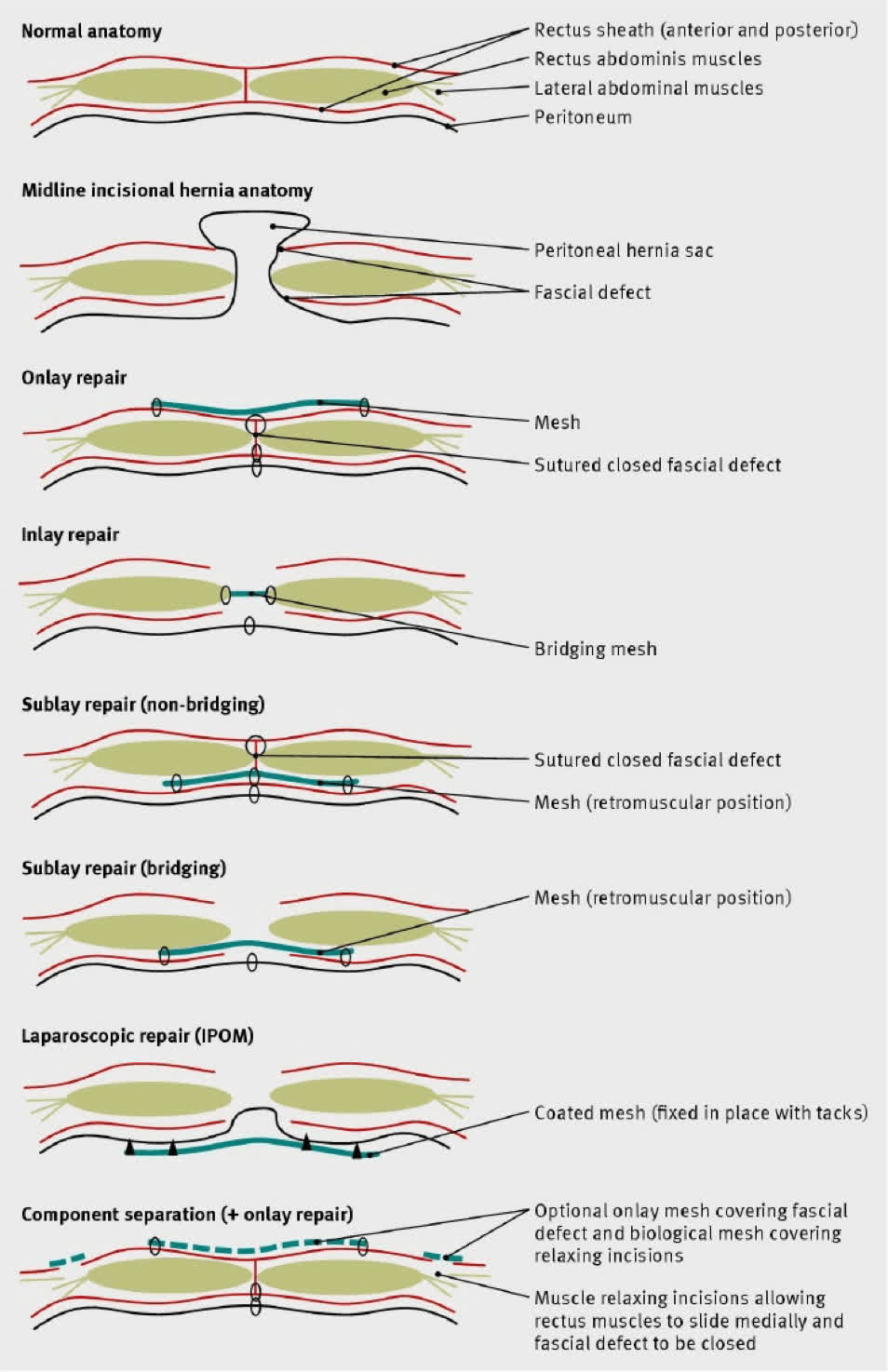
- open mesh repair
- ideal elective repair via sub-lay technique
- inlay/ on-lay technique reasonable alternatives
- laparoscopic repair
- is supported in specific circumstances only
- expertise is essential