Induction of Labour with a Live Baby
The guidelines recommend management of common obstetric conditions at primary and referral level, based on local experience and evidence-based practice. They are not intended as strict protocols nor as standard operating procedures, but rather as a guide to safe effective management of common obstetric problems. The guidelines should be most useful to interns, medical officers and registrars.
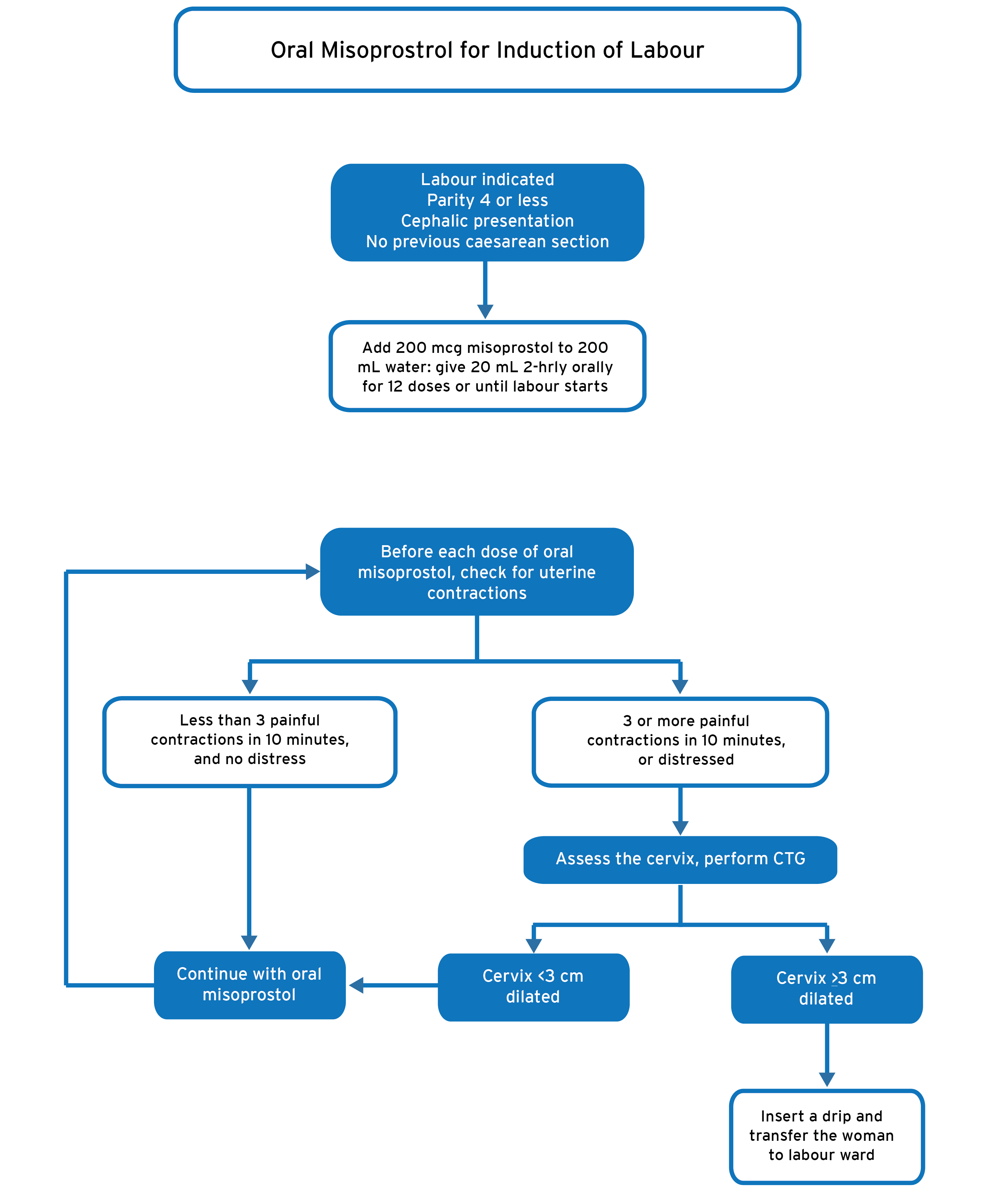
Oral misoprostol for induction of labour algorithm
Preparation of the cervix with a Foley catheter bulb
Induction of labour with oral misoprostol
Frequent indications for induction of labour with a live baby include prolonged pregnancy, hypertension & prelabour rupture of membranes. Contraindications are placenta praevia, breech, transverse lie, fetal distress, previous caesarean section and parity ≥5: elective delivery for these must be by caesarean section.
CERVICAL ASSESSMENT
Prior to induction of labour, the cervix needs to be assessed for favourability. Use the Bishop score – a total ≥7 suggests that induction with amniotomy followed by oxytocin is likely to be successful
Bishop score
| Points: | 0 | 1 | 2 | 3 |
| Cervical dilatation (cm) | <1 | 1-2 | 2-4 | >4 |
| Cervical length (cm) | >4 | 2-4 | 1-2 | <1 |
| Station | -3 | -2 | -1 | ≥0 |
| Cervical consistency | Firm | Average | Soft | |
| Cervical position | Posterior | Mid-position | Anterior |
If the cervix is favourable for induction (Bishop score ≥7):
- Admit the woman to labour ward
- Ensure fetal well-being by NST
- Perform artificial rupture of membranes
- Start oxytocin infusion 2 hours later
- Monitor the fetus with continuous CTG
If the cervix is not favourable for induction (Bishop score <7):
- Admit the woman to the antenatal ward
- Ensure fetal well being by NST
- Start oral misoprostol with/without Foley catheter bulb induction
- If the cervix is not favourable after 24 hours, give prostaglandin E2 1 mg into the posterior vaginal fornix every 6 hours, for 24 hours
- Failed induction after 48 hours may necessitate caesarean section or further expectant management
Preparation of the cervix with a Foley catheter bulb
This is a good non-pharmacological & safe alternative to oral misoprostol or vaginal prostaglandin E2, particularly for women with previous CS or parity ≥5
- Pass a 30 mL bulb Foley catheter through the internal cervical os and inflate the bulb to 50 mL
- Put the bulb on traction by sticking the catheter to the inner thigh
- Check for expulsion of the bulb every 12 hours
- If the bulb won’t expel, consider infusing extra-amniotic saline at 50 mL/hour, for a maximum 24-36 hours (in labour ward)
- When the bulb is expelled, the cervix is favourable for amniotomy
Induction of labour with oral misoprostol
- Presentation must be cephalic
- Parity must be 4 or less
- The cervix must be assessed as unfavourable for induction
- There must be no history of previous caesarean section or uterine surgery
- Make up the misoprostol solution as follows: Dissolve 1 tablet of misoprostol 200 mcg in 200 mL tap water in a clean brown plastic bottle (1 mcg/mL). Shake well before each dose is given. Discard any unused solution after 12 hours
- Give oral misoprostol 2-hourly for up to 24 hours or until labour starts:
- Dose: 20 mL (20 mcg) 2 hourly x 12 doses
- Before each oral dosage, check for contractions. If there are ≥3 painful con-tractions in 10 minutes, or maternal distress, assess the cervix & do a CTG
- If the cervix is ≥3 cm dilated, transfer the woman to labour ward
- If the cervix is <3 cm dilated, continue oral misoprostol 2-hourly & repeat the cervical assessment in 2-4 hours
- Do not give oxytocin <6 hours after the last dose of oral misoprostol
- If the cervix is not favourable after 24 hours, stop misoprostol & consider repeat misoprostol dosage, Foley catheter bulb induction, or other methods
- If tachysystole (≥6 contractions in 10 minutes for at least 20 minutes) or hypertonus (contraction lasting for ≥2 minutes) occurs:
- Place the woman in a left lateral position
- Perform a CTG tracing
- Do not rupture membranes
- If there is evidence of fetal distress on CTG:
- Place the woman in a left lateral position
- Give salbutamol 250 mcg IV over 2 minutes
- Consider emergency caesarean section if there is no improvement
- When the woman is in labour, monitor the fetus with continuous CTG
Medical supervision of labour induction
The woman must be assessed by a doctor at least twice each day in the antenatal ward (morning & evening) during misoprostol or bulb induction
ORAL MISOPROSTOL FOR INDUCTION OF LABOUR