Infection Prevention
This guideline aims to assist healthcare workers with antibiotic prescribing for common clinical syndromes in adult patients in South Africa, utilizing Local and International guidelines, key publications, and expert opinion.
Hand hygiene
Contact precautions
Management of peripheral IV lines
Management of urinary catheters
The most important tools to prevent spread of infection are hand hygiene and contact precautions. Correct management of IV lines and urinary catheters are essential for reducing hospital‐acquired infections.
HAND HYGIENE
WHEN:
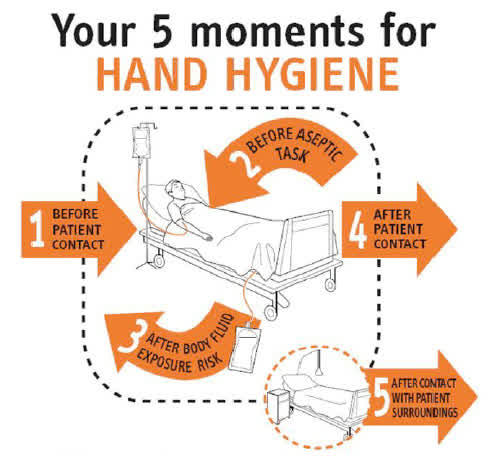
HOW:
Use alcohol‐based solutions for routine hand decontamination.
Indications for soap and water:
|
Indications for gloves:
|
CONTACT PRECAUTIONS

These should be implemented for any patient infected by or colonised with a drug-resistant bacterial pathogen other than tuberculosis (which requires airborne precautions to prevent small droplet spread). Contact precautions involve the following:
- Clear signage indicating that contact precautions are in place
- Patient preferably placed in isolation
- Hand disinfection prior to patient contact
- Mandatory use of apron and gloves when entering the patient’s room, before any contact with the patient or their surroundings and during examination
- Remove apron first, followed by gloves
- Hand disinfection after disposal of apron and gloves (use soap and water for C. difficile exposure)
- Contact precautions remain in place even after treatment with antibiotics and for every hospital or nursing care re-admission for a period of 6 months. For patients with C. difficile associated diarrhoea contact precautions can be withdrawn after completion of treatment and resolution of diarrhoea.
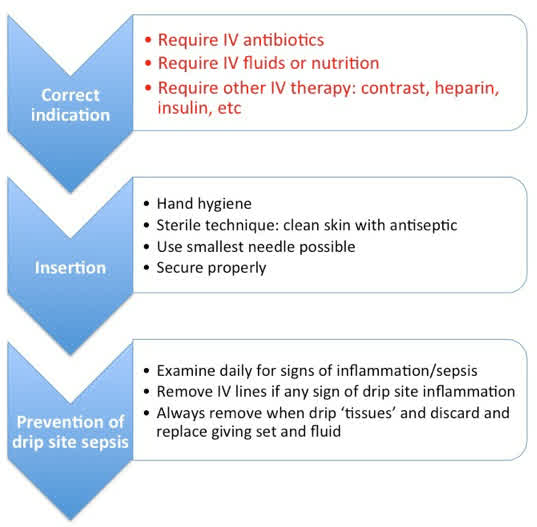
MANAGEMENT OF PERIPHERAL IV LINES
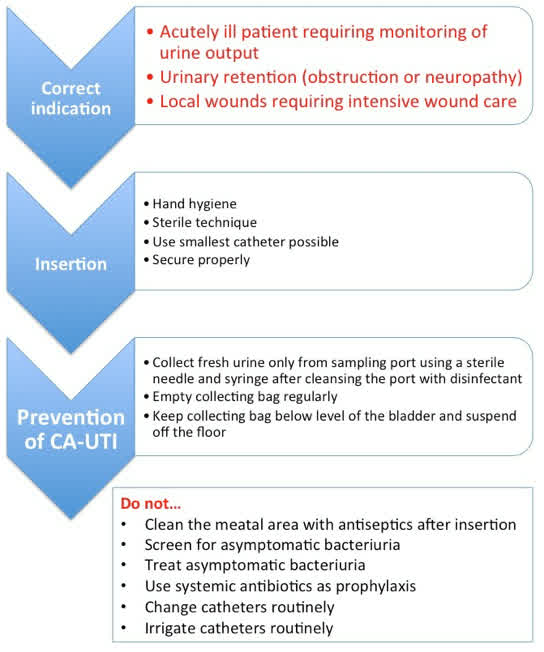
MANAGEMENT OF URINARY CATHETERS
Every time you see a patient you should be asking the questions:
|