Inguinal Pathology
Introduction Background Important details on history Important details on examination Inguinal Hernia Hydrocele Inguinal Sepsis Undescended Testes SETTING Primary and Secondary Healthcare Institutions in the Western Cape which refer to Red Cross War Memorial Children’s Hospital (RCWMCH) FOR STAFF Primary and Secondary Doctors and Nurses who refer patients to RCWMCH PATIENTS Patients under t
Important details on examination
SETTING
Primary and Secondary Healthcare Institutions in the Western Cape which refer
to Red Cross War Memorial Children’s Hospital (RCWMCH)
FOR STAFF
Primary and Secondary Doctors and Nurses who refer patients to RCWMCH
PATIENTS
Patients under the age of 13 years old with inguinal pathology
Introduction
Inguinal pathology in the context of paediatric surgery includes conditions resulting from failure of the processus vaginalis to close. The main concern is inguinal hernias, which may become complicated if they become incarcerated (get stuck) or strangulated (become ischaemic). Other diagnoses that may present with inguinal swelling include hydrocele, inguinal sepsis and undescended testes.
The purpose of this guideline is to assist clinicians and nurses with the management and appropriate referral of patients with inguinal pathology.
Background
When a foetus is developing, their gonads originally develop inside the abdomen. In most boys the testes will come down before the baby is born and go into the scrotum. The passageway through which the testes exit the abdomen is called the inguinal canal.
When the testes come down, they bring a small bit of the peritoneum (inside lining of the abdominal wall) with them. This is called the processus vaginalis and it will obliterate (close) in the majority of patients. If it does not obliterate, surgeons call it a patent processus vaginalis (PPV).
Most of the pathology we see in the inguinal area is related to differences in how the above events occur in patients. Because this is explained by testicular descent and the PPV, it follows that inguinal pathology tends to be more common in boys than girls.
Important details on history
- When did the swelling start?
- Was it present at birth?
- Was this a sudden onset, short history?
- Is the swelling constant or does it disappear and reappear?
- Are there associated symptoms?
- Scrotal or inguinal pain?
- Symptoms of bowel obstruction (vomiting, failure to pass stool, abdominal distension)?
- Is there history of trauma or infection in the area or leg?
- General medical history:
- Was the child born prematurely?
- Does the child have any other medical conditions (eg: cardiac, liver and kidney disease or malnutrition)?
Important details on examination
Look for signs of acute illness
- Tachycardia, tachypnoea
- Dehydration
- Abdominal distension & peritonism
Evidence of general medical conditions
- Fever & signs of sepsis
- Heart murmurs
- Ascites
- Peripheral oedema
- Purpura & petechiae
Inspect the groin
- Is the scrotum obviously swollen or enlarged?
- Is the enlargement unilateral or bilateral?
- Is the scrotal & groin skin erythematous or oedematous?
Palpate the groin & scrotum
- Is there a bulge present at the external ring?
- If the bulge is within the scrotum, can you get ‘above’ of it, or does it extend all the way up to the external ring?
- Can you feel the testicle?
- Is it separate to or attached to the swelling?
- Is the swelling tender, or painless?
- Is the swelling cystic, solid, or just firm?
- Can the swelling be trans-illuminated (If you shine a light through the swelling, does the WHOLE swelling light up?)
Inguinal Hernia
Inguinal hernia in children is the result of a PPV in the majority of cases. Failure of the processus vaginalis to obliterate results in a small opening in the abdominal wall muscle which allows abdominal contents to track down the canal and towards the scrotum. It is this abdominal content that you see as the swelling in the groin.
The characteristics of an inguinal hernia are:
- Seldom noticed at birth
- More common in premature infants
- May not be demonstrable on examination and often the caregiver’s history is diagnostic
- Presents as a bulge at the external ring which may or may not extend into scrotum
- May be reducible (can push back in) or irreducible (not able to push back in)
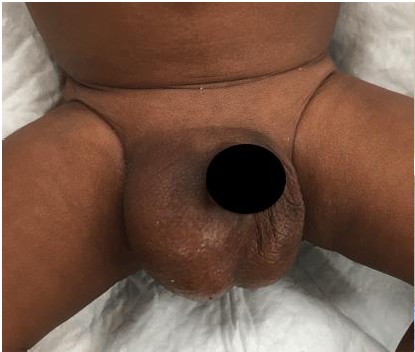
Right inguinal hernia in a 2 month old infant
Click on the image to enlarge.
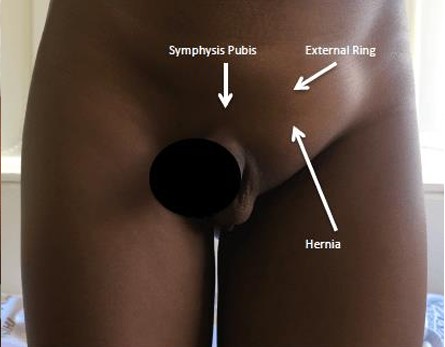
Left inguinal hernia (not extending into scrotum) in a 10 year old male
Click on the image to enlarge.
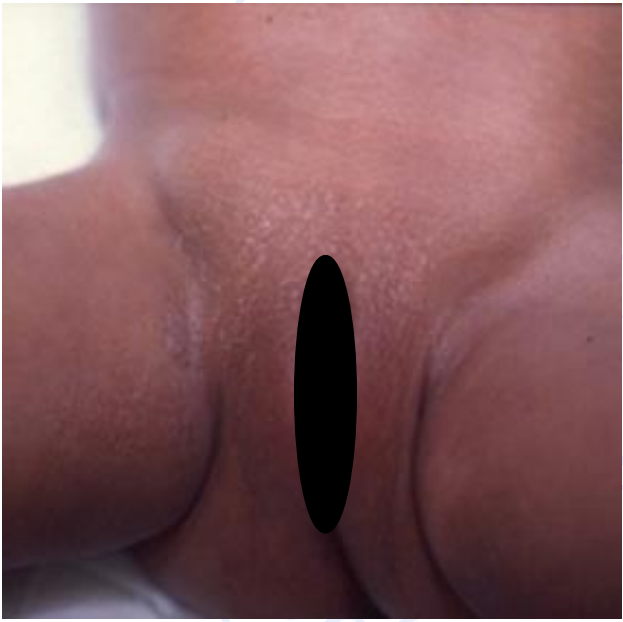
Right inguinal hernia in a female infant
Click on the image to enlarge.
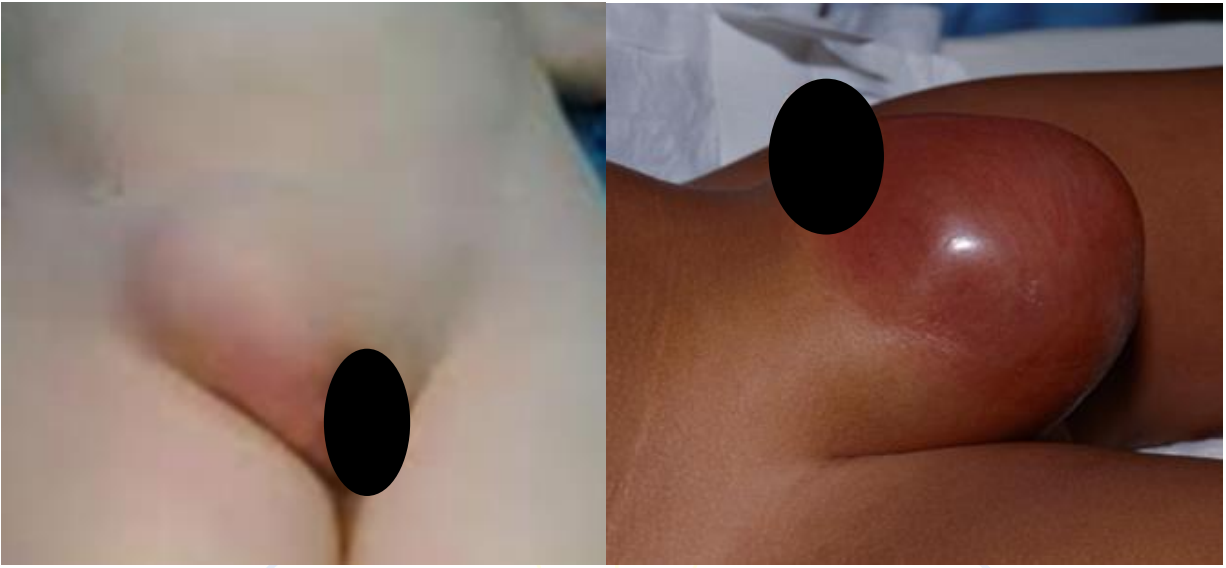
Right inguinal hernia in a female and male infant. Note the erythema and oedema. This is a red flag for strangulation. DO NOT attempt to reduce hernias when you note overlying erythema.
Click on the image to enlarge.
Danger signs
- Irreducibility
- Symptoms of bowel obstruction
- Overlying erythema & oedema
- Systemically ill child (dehydration, sepsis, shock)
Management
Attempt reduction if it is safe:
Do not attempt reduction if:
- If there is significant erythema & oedema overlying the hernia
- If there is any concern that the hernia contents are necrotic
- More than once
You should always give effective analgesia before attempting a reduction but we would not recommend attempting reduction under sedation at a centre that does not offer paediatric surgical services.
Referral guidelines for inguinal hernias:
Signs of systemic decompensation (bowel obstruction, dehydration, shock, sepsis):
- Place IV line & nasogastric tube
- Give appropriate bolus fluid for severe dehydration & shock
- Initiate dextrose-containing maintenance fluids
- Keep nil per os with NGT on free drainage
- Monitor temperature, blood glucose & heart rate
- Administer appropriate antibiotics if signs of sepsis are present
Irreducible:
- Attempt reduction
- If this fails then refer urgently to the paediatric surgeon on call
Reducible:
Premature infant
- paediatric surgery outpatient review within 2 weeks
- counsel parents regarding danger signs and advise to present again if concerns
Term, healthy infant or older child
- non-urgent paediatric surgery outpatient review
- counsel parents regarding danger signs
History suggestive of hernia but not clinically evident when you examine:
- non-urgent paediatric surgery outpatient review
- counsel regarding danger signs
Counselling for danger signs
Patients are to return if there are any of the following danger signs:
- hard inguinal swelling
- redness or oedema over the area
- associated vomiting
- abdominal distension or evidence of obstruction
Hydrocele
A hydrocoele has the same congenital defects as in inguinal hernia - an open processes vaginalis. The opening is much smaller than in a hernia so only fluid can pass into the scrotum but bowel and omentum do not come down. This means that the hydrocele is not at risk of incarceration and thus, is not dangerous.
The characteristics of a hydrocele are:
- May be present since birth
- You can “get above”
- Trans-illuminates
- Non-tender
- May fluctuate in size throughout the day
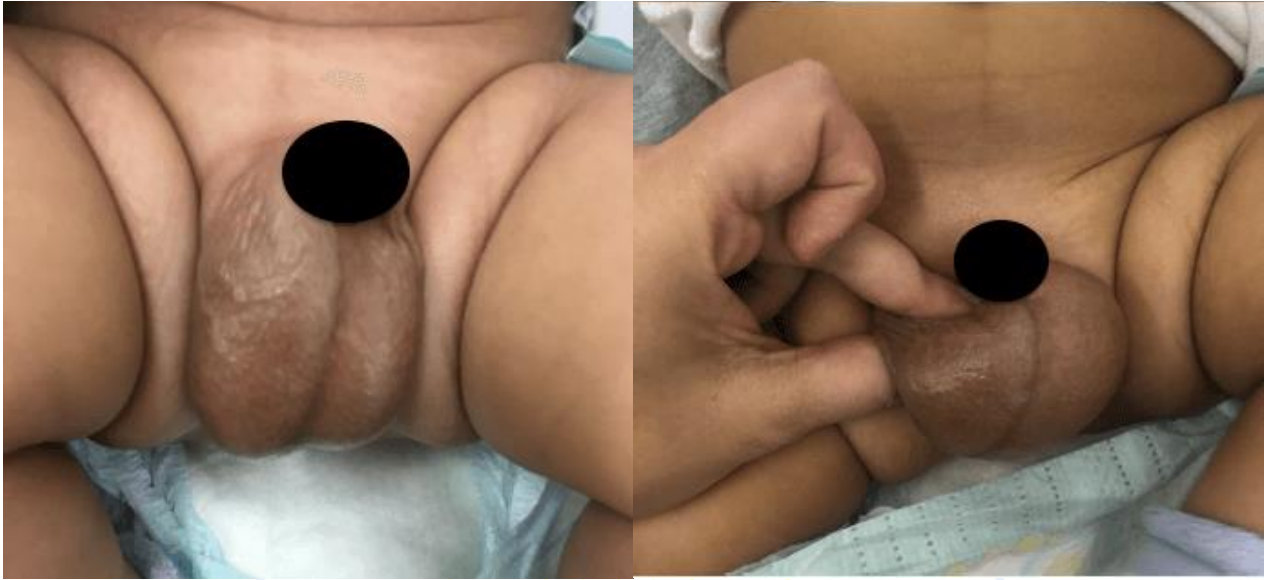
Bilateral hydroceles in a 6 week old infant. Note that the examiner can get “above”the hydrocele with her fingers - the swelling does not extend to the external ring
Click on the image to enlarge.
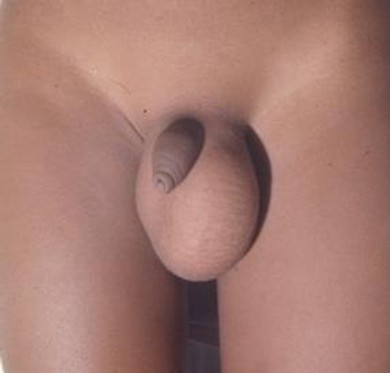
Left sided hydrocele in a child – note that there is no inguinal swelling.
Click on the image to enlarge.
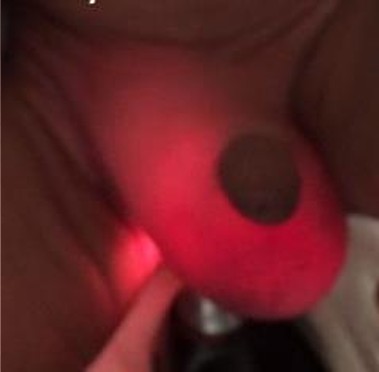
Transillumination of the hydrocele with a torch
Click on the image to enlarge.
Management and referral guidelines:
Patients with symptoms of discomfort or a tense hydrocele can be referred for non-urgent paediatric surgery outpatients review.
Patients who are otherwise asymptomatic:
- Younger than 4 years: Will likely resolve - No need to make a referral.
- 4 years or older: non-urgent paediatric surgery outpatients review.
Inguinal Sepsis
Inguinal sepsis or inguinal lymphadenitis can present with painful swelling in the inguinal area. This is usually associated with a recent infection or injury to the leg on that side. In some cases, the swelling can be difficult to differentiate from an inguinal hernia because it is a hard and swollen mass in the area close to where the inguinal canal is.
Characteristics of inguinal sepsis:
- History is usually over a few days
- The area is swollen, tender, red and hot
- There are NO signs of bowel obstruction EVER
- There is a wound or an infection in the leg on the same side
- The swelling is lateral to the inguinal canal
Management and referral guidelines:
If there is any doubt at all that this cause of the swelling is lymphadenopathy it is better to make an urgent referral for surgical assessment at RCWMCH to exclude a strangulated hernia.
If the diagnosis of lymphadenitis is clear and there is no fluctuance then management with antibiotics and review in 48 hrs is appropriate.
If fluctuance is present, or develops at the time of review in 48hrs, then referral to paediatric surgery on call for incision and drainage of the abscess is needed.
Undescended Testes
Undescended testes present in boys when they undergo their newborn head-to-toe examination or later in life when the parents notice that the scrotum is empty on one (or both) sides.
There are many reasons why this can be: It may be that the testis failed to descend and is somewhere along the path it would have followed. It may be that the testis is in the wrong place somewhere else in the groin or that the testis has been damaged and has already disappeared.
Undescended testes are never an emergency unless they are acutely (suddenly and severely) painful. Please see the separate guideline on the appropriate assessment and referral guideline for undescended testes.
Children's Surgery Network, Western Cape Government, Red Cross War Memorial Children’s Hospital (RCWMCH), Clinical Guideline_Version 1_2025
Inguinal Pathology