Initiating ART in Children
IMCI - Anti-retroviral therapy (ART)
Step 1 : Record Patient Details and History
Step 2: Decide if the Child has Confirmed HIV Infection
Step 3: Decide if the Caregiver is Able to Give ART
Step 4: Decide if a IMCI Nurse Should Initiate ART
Step 5: Assess and Record Baseline Information
Click here to open the above PDF
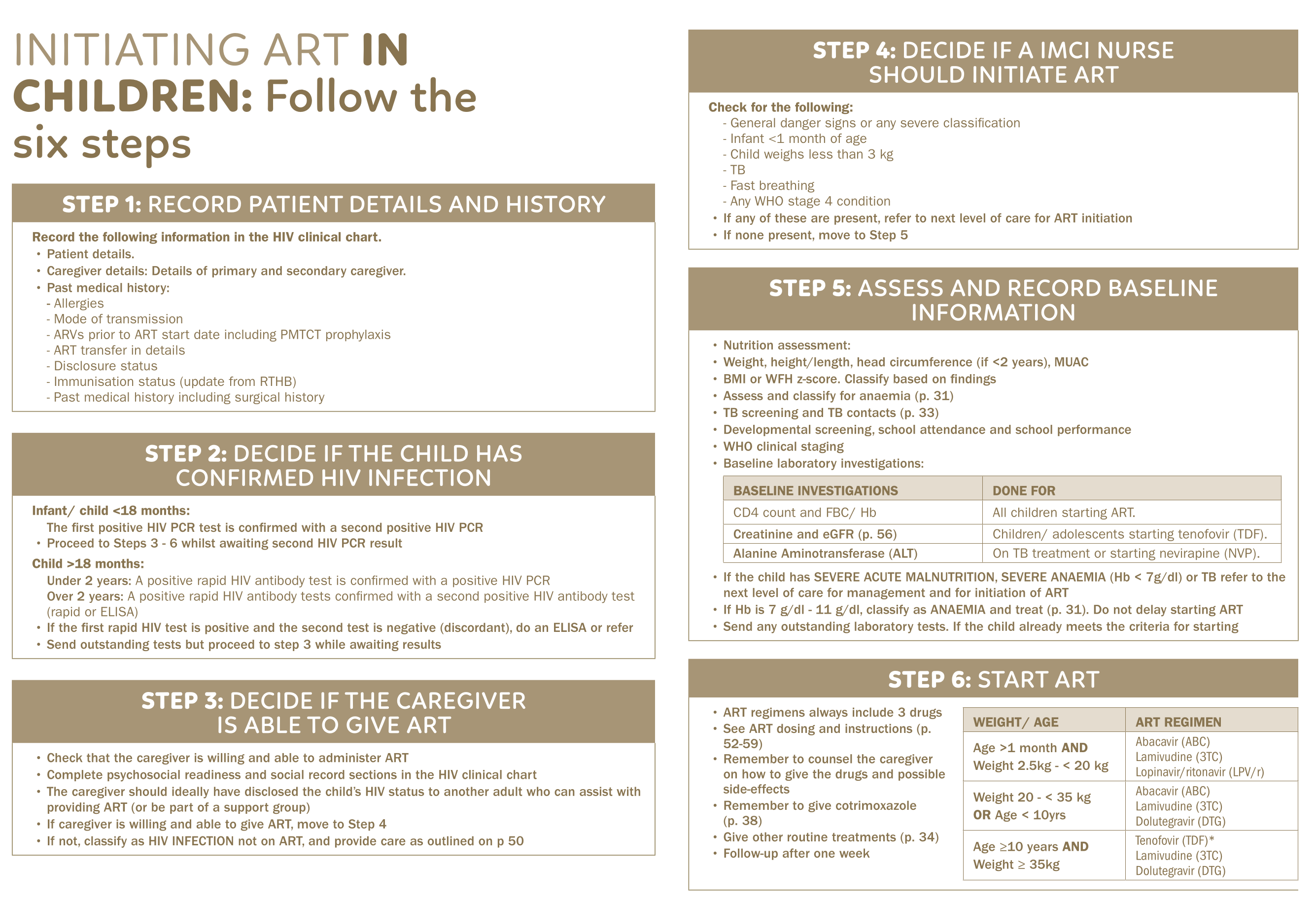
Follow the 6 Steps
Step 1: Record Patient Details and History
Record the following information in the HIV clinical chart.
- Patient details
- Caregiver details: Details of primary and secondary caregiver
- Past medical history:
- Allergies
- Mode of transmission
- ARVs prior to ART start date including PMTCT prophylaxis
- ART transfer in details
- Disclosure status
- Immunisation status (update from RTHB)
- Past medical history including surgical history
Step 2: Decide if the Child has Confirmed HIV Infection
Infant/ child <18 months:
The first positive PCR test is confirmed with a second positive HIV PCR
- Proceed to Steps 3 - 6 whilst awaiting second PCR result
Child >18 months:
Under 2 years: A positive rapid HIV antibody test is confirmed with a positive HIV PCR
Over 2 years: A positive rapid HIV antibody tests confirmed with a second positive HIV antibody test(rapid or ELISA)
- If the first rapid HIV test is positive and the second test is negative (discordant), do an ELISA or refer
- Send outstanding tests but proceed to step 3 while awaiting results
Step 3: Decide if the Caregiver is Able to Give ART
- Check that the caregiver is willing and able to administer ART
- Complete psychosocial readiness and social record sections in the HIV clinical chart
- The caregiver should ideally have disclosed the child’s HIV status to another adult who can assist with providing ART (or be part of a support group)
- If caregiver is willing and able to give ART, move to Step 4
- If not, classify as HIV INFECTION not on ART, and provide care as outlined in HIV- follow-up
Step 4: Decide if a IMCI Nurse Should Initiate ART
- Check for the following:
- General danger signs or any severe classification
- Infant <1 month of age
- Child weighs less than 3 kg
- TB
- Fast breathing
- Any WHO stage 4 condition - If any of these are present, refer to next level of care for ART initiation
- If none present, move to Step 5
Step 5: Assess and Record Baseline Information
- Nutrition assessment
- Weight, height/ length, head circumference (if <2 years), MUAC
- BMI or WFH z-score. Classify based on findings
- Assess and classify for anaemia
- TB screening and TB contacts
- Developmental screening, school attendance and school performance
- WHO clinical staging
- Baseline laboratory investigations:
|
Baseline Investigations
|
Done for
|
| CD4 count and FBC/ Hb | All children starting ART |
| Creatinine and eGFR | Children/ adolescents starting tenofovir (TDF) |
| Alanine Aminotransferase (ALT) | On TB treatment or starting nevirapine (NVP) |
- If the child has severe acute malnutrition, severe anaemia (Hb < 7g/dl) or TB refer to the next level of care for management and for initiation of ART
- If Hb is 7 g/dl - 11 g/dl, classify as anaemia and treat. Do not delay starting ART
- Send any outstanding laboratory tests. If the child already meets the criteria for starting
Step 6: Start ART
- ART regimens always include 3 drugs
- See ART dosing and instructions
- Remember to counsel the caregiver on how to give the drugs and possible side-effects
- Remember to give cotrimoxazole
- Give other routine treatments
- Follow-up after one week
|
Weight/ Age
|
ART regimen
|
| Age >1 month AND Weight 2.5 kg - < 20 kg | Abacavir (ABC) Lamivudine (3TC) Lopinavir/ritonavir (LPV/r) |
| Weight 20 - < 35 kg OR Age < 10 yrs | Abacavir (ABC) Lamivudine (3TC) Dolutegravir (DTG) |
| Age ≥10 years AND Weight ≥ 35 kg | Tenofovir (TDF) Lamivudine (3TC) Dolutegravir (DTG) |
Integrated Management of Childhood Illness 2022; Anti-Retroviral Therapy; Initiating ART in Children: Follow the 6 Steps
Last checked for updates: June 2023