Inotropes And Vasopressors
Choice depends on desired effect. There is no ‘one size fits all’ strategy for inotrope/vasopressor choice. Each agent has dose-dependent effects on inotrope (improved contractility) or vasopressor effect (increasing the SVR). Important components of the cardiovascular system: Preload – is the child pre-load replete (not overfilled and not underfilled) – fluid therapy. Contractility – does the he
- Choice depends on desired effect.
- There is no ‘one size fits all’ strategy for inotrope/vasopressor choice.
- Each agent has dose-dependent effects on inotrope (improved contractility) or vasopressor effect (increasing the SVR).
- Important components of the cardiovascular system:
- Preload – is the child pre-load replete (not overfilled and not underfilled) – fluid therapy.
- Contractility – does the heart need support to pump effectively – inotropic support.
- Afterload – how vasoconstricted or vasodilated is the child – need for vasopressor or vasodilator support.
- Septic shock patients may present in any of the following ways, and may change clinical appearance from hour to hour:
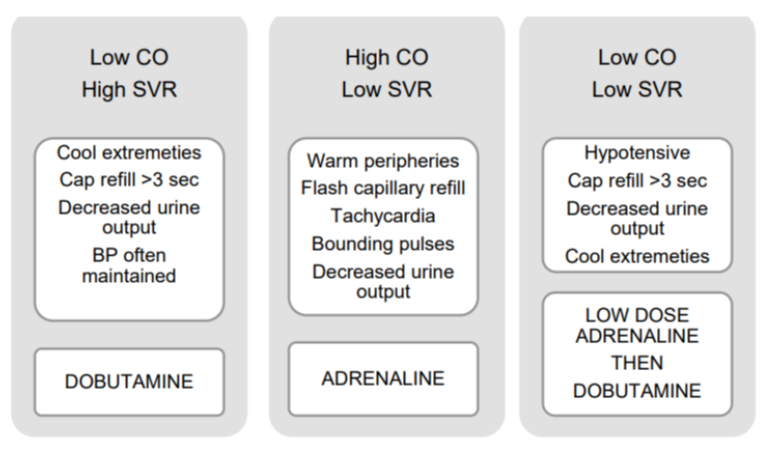
Click on image to enlarge
Paediatric cardiovascular considerations:
- Reduced myocardial mass means that the myocardium is limited in its ability to increase size and contractility, therefore, the main way that children are able to increase CO is by increasing HR, not SV.
- Children start at higher baseline heart rates, therefore, they are limited by how much they are able to increase HR and, therefore, CO.
- Children maintain blood pressure by increasing SVR (systemic vascular resistance). A drop in blood pressure is a late sign in shocked children.
- Vagal parasympathetic tone is most prominent, therefore, they are more prone to bradycardia.
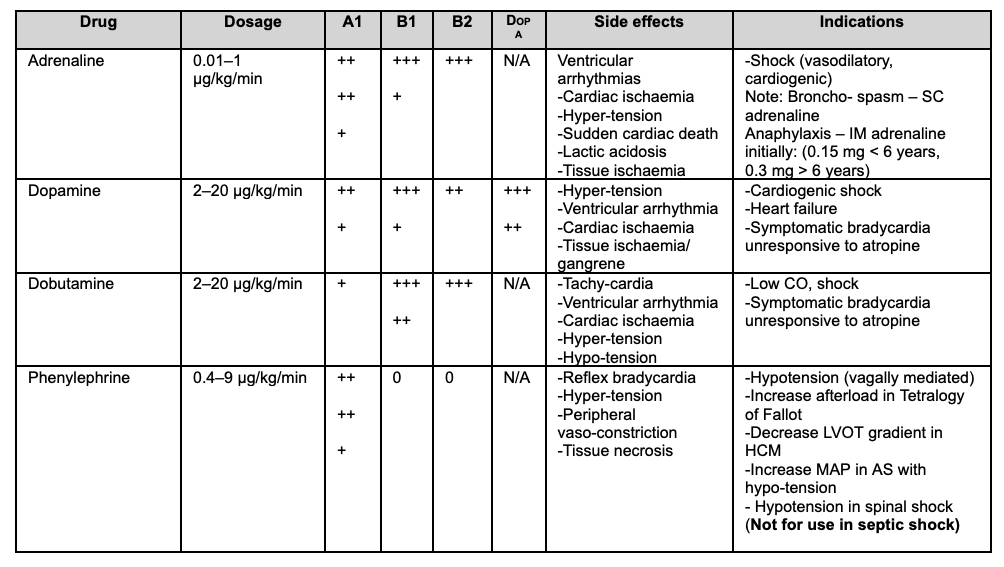 Click on the table to enlarge
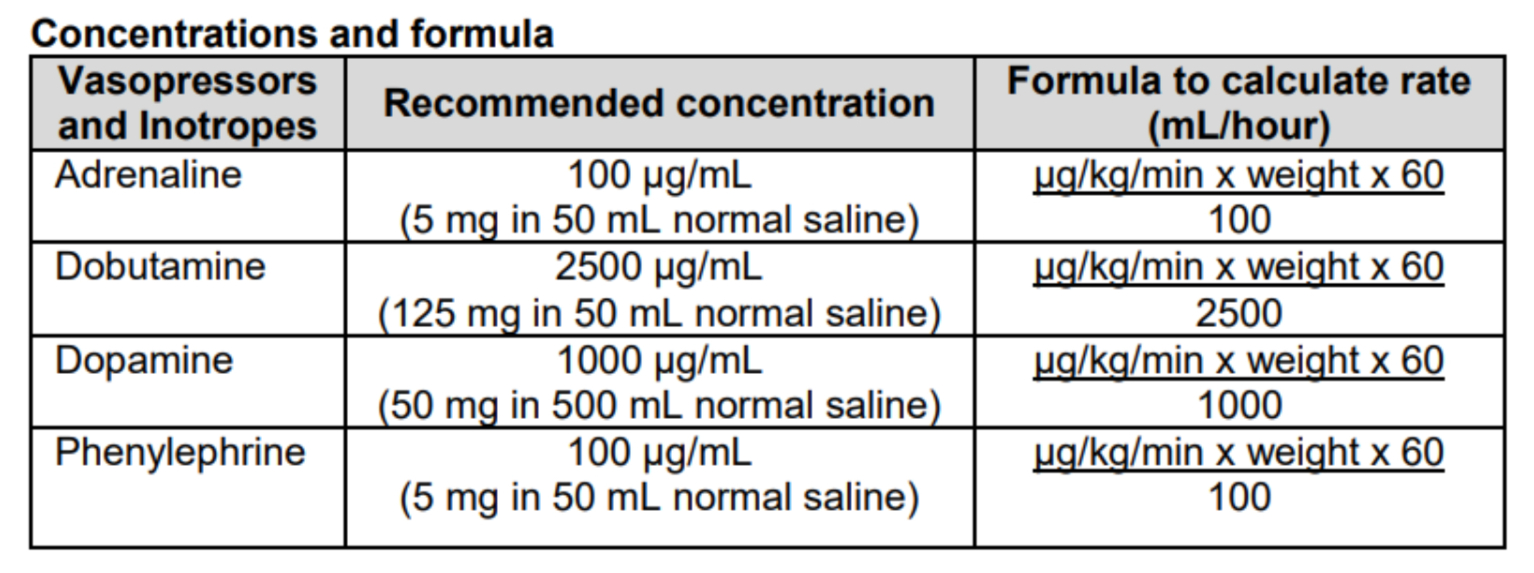
Click on the tableto enlarge
5% Dextrose water to be considered for use in patients where sodium needs to be avoided (e.g. nephrotic syndrome).
Additional medicine therapies:
- Corticosteroids:
- Limit adrenoceptor down-regulation.
- The role of adjunctive hydrocortisone in catecholamine refractory septic shock is unclear. Use is currently not supported by high-level evidence.
- Calcium:
- Use in the setting of hypocalcaemia and hypotension.
- Side effects: cardiac myocyte apoptosis, over constriction, arrhythmias.
- Infusion dose: 0.5–2.0 mmol/kg/day = 0.02–0.08 mmol/kg/hour. Mix 2 mmol/kg of 10% calcium chloride to make a total volume of 100 mL to run at 1–4 mL/hour (0.02–0.08 mmol/kg/hour).
Example:
8 kg child: 2 mmol/kg = 2 mmol x 8 = 16 mmol.
10% calcium chloride is 7 mmol/10 mL. 16 mmol, therefore = 22.8 mL of 10% calcium chloride.
Mix this with 77 mL of normal saline to make a total volume of 100 mL.
Run at 1–4 mL/hour (0.02–0.08 mmol/kg/hour)
- Infusion dose: 0.5–2.0 mmol/kg/day = 0.02–0.08 mmol/kg/hour. Mix 2 mmol/kg of 10% calcium chloride to make a total volume of 100 mL to run at 1–4 mL/hour (0.02–0.08 mmol/kg/hour).
Pearls:
- There is more to fixing shock than fixing the blood pressure.
- All catecholamines alter immune response.
- All catecholamines have short half-lives, therefore, achieve your goal quickly at the bedside and titrate to targeted goals.
- Steady state is achieved after 5–10 minutes.
- Start administering inotrope/vasopressor through a peripheral line but switching to a central venous line is paramount as soon as possible.
- Cardiac output monitoring is the most accurate way to assess the cardiovascular system. Consider in the patient with refractory shock – therefore, the need for possible referral to a tertiary ICU.
- Make sure your patient is adequately ‘filled’ before starting a vasopressor.
- Do not leave the bedside until the patient has improved perfusion markers – improved LOC, adequate urine output, improved skin perfusion, HR normalizing and appropriate BP.
Standard Treatment Guidelines And Essential Medicines List For South Africa, Hospital Level, Paediatrics, 2023 Edition
Chapter 23: Paediatric Intensive Care, 23.8 Inotropes And Vasopressors