Interpreting Test Results
This guideline aims to assist healthcare workers with antibiotic prescribing for common clinical syndromes in adult patients in South Africa, utilizing Local and International guidelines, key publications, and expert opinion.
NON CULTURE-BASED TESTS
Non culture‐based tests such as urinary dipstick, peripheral white cell count (WCC), and C-reactive protein (CRP) confirm the presence of inflammation when positive but do not differentiate bacterial from non-‐bacterial causes. However, presence of nitrites on urine dipstick, high neutrophil count with left-‐shift and CRP >100 mg/ml all suggest bacterial infection. Negative results are generally good at excluding inflammation and therefore bacterial infection.
Procalcitonin (PCT) is more specific for bacterial infection than CRP or WCC but 10 times more expensive. There is high quality evidence for its use in a limited number of infections and its use should be limited to these indications. Specifically, low PCT safely excludes bacterial infection such that antibiotics can be withheld in meningitis, and acute exacerbations of chronic obstructive pulmonary disease (see later sections for details). PCT has no value in differentiating bacterial infection from tuberculosis and has very limited value in sepsis. Its price generally excludes its use in serial measurement to determine when to stop, although some evidence in ICU settings alone, exist.
CULTURES
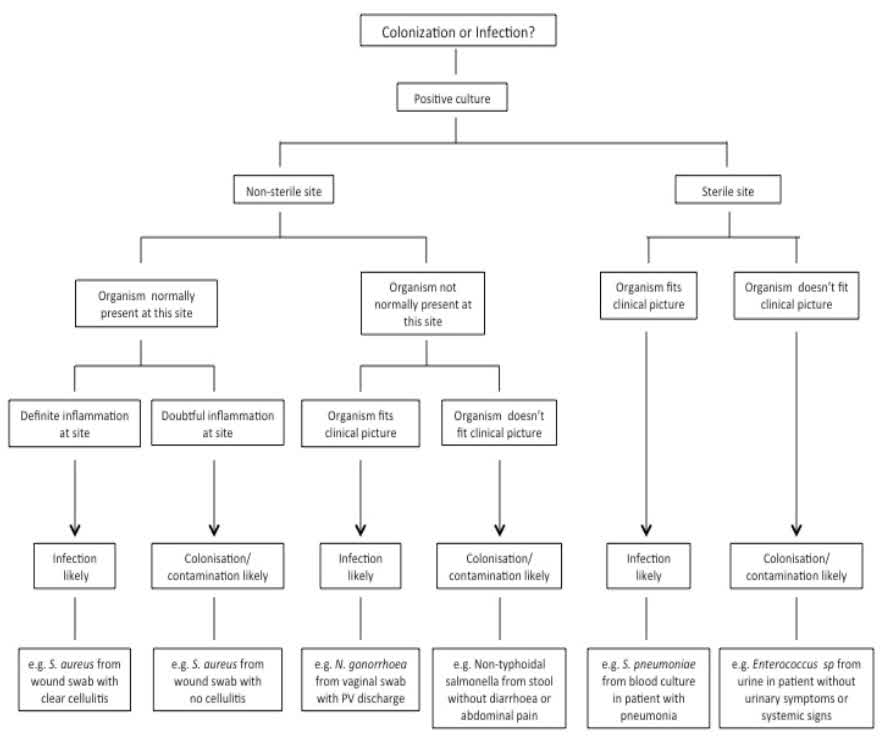
Does this positive culture represent infection, colonisation or contamination?
Infection = the presence of one or more microorganisms with an inflammatory response
Colonisation = the presence of microorganisms without significant inflammation.
Contamination = A culture that contains a microorganism(s) that did not originate from the intended anatomical site
STERILE SITE
Normally sterile sites are CSF, lungs (below the glottis), urinary tract, biliary tract, and blood. Bacteria cultured from these sites are likely to be causing infection but still sometimes represent colonisation or contamination.
Finding bacteria in a sterile site is abnormal but may represent infection, or contamination. Organisms colonising skin such as coagulase-‐negative staphylococci may cause contamination of sterile sites. Colonisation of urinary tract can occur without causing infection. If the organism corresponds with the clinical scenario then this should be considered to be causing infection
NON-STERILE SITES
Non‐sterile specimens include sputum (as it must pass through the mouth), pus swabs from skin, GI tract and vagina. Specimens from these sites are expected to culture bacteria (unless growth is inhibited by laboratory techniques). Interpretation therefore depends on the organism(s) being compatible with the clinical scenario.
Cultures from non‐sterile sites are often much harder to interpret and usually of less value.