Introduction
These are the approved guidelines published by the South African Society of Psychiatrists to provide an overview on treatment and management of commonly diagnosed psychiatric illnesses. The guidelines include consensus recommendations, based on peer contribution and using the international evidence based guidelines that are suitable for the local South African health service.
Please note that parts of this guideline may be out of date, an update will be published as soon as it is available.
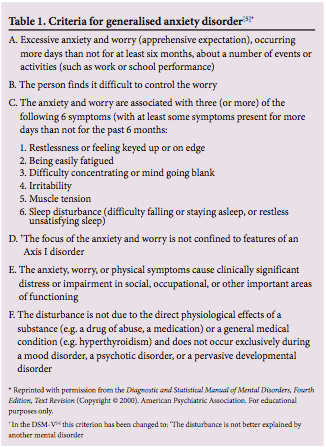
Generalised anxiety disorder (GAD) is a common disorder with a lifetime prevalence of 6.1% and a 1-year prevalence of 2.9% in one large study.[1] It occurs most commonly in the 45 - 55-year age group with women twice as likely as men to have GAD.[1] Although symptoms typically wax and wane in intensity over time, the disorder is characterised by chronicity and is associated with high levels of psychiatric comorbidity (e.g. major depression and other anxiety disorders), physical comorbidity (e.g. gastrointestinal, respiratory, and thyroid disorders) and reduced quality of life.[2] There have been important advances in the nosology and treatment of this disorder. In particular, there is increasing evidence that patients with GAD and mixed anxiety-depression frequently present in primary care settings,[3] and the Diagnostic and Statistical Manual of Mental Disorders, Fifth Edition[4] provides fairly user-friendly criteria for the diagnosis of GAD. Table 1 lists the diagnositic criteria.[5]
A few simple points can perhaps be made to help conceptualise GAD. GAD can perhaps be viewed as a ‘tension disorder’. This is a useful term in so far as it crosses the boundary between psychic symptoms (worries, feeling ‘keyed up’, irritability) and somatic complaints (muscle tension, restlessness, insomnia). While GAD patients may not present with ‘worries’, they often describe themselves as ‘worriers’ – worry may represent an avoidance behaviour that is used to diminish tension (analogous to the way that agoraphobia may develop after panic attacks).
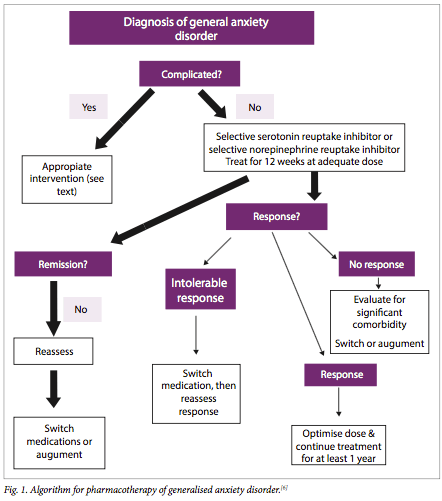
The algorithm presented here (Fig. 1)[6] provides a step-by-step approach to the pharmacotherapy of GAD, based on our reading of there search literature. It is important to mention at the outset, however, that psychotherapy approaches may be a first-line intervention in some GAD patients and should be considered in all patients with this disorder. In addition, psycho-education is of the utmost importance, particularly in the initial stages of treatment, and should address the direct effects of anxiety on the life of the patient, as well as possible effects on family members.