Introduction
SANBS Guideline - Updated August 2023
ABO and RH blood group systems
Blood and blood products available from South African National Blood Service
Introduction
The average adult has approximately 70ml of blood per kilogram body weight; this amounts to about 4-6 litres of blood in the adult body. A blood transfusion is the infusion of whole blood or blood components into the bloodstream of the patient.
Blood transfusion can be lifesaving. It is used in resuscitations such as with massive blood loss due to trauma, to replace blood lost during surgery and in treatment of anaemia and / or thrombocytopenia. Patients may have one transfusion episode or many, depending on their disease (indication).
Nursing staff play a pivotal role in the transfusion of blood and blood products and the guidelines presented here aim to cover all aspects of safe transfusion of blood products along with the associated risks and management of transfusion reactions.
SANBS background
SANBS was established in April 2001 with the merger of seven independent non-profit blood transfusion services from across the country. Chapter 8 of the National Health Act requires the Minister of Health to issue a license to a non-profit organisation for delivering a nationwide transfusion service. This organisation will be regulated by the Minister of Health and must comply with the regulations of the Department of Health and the Standards for the Practice of Blood Transfusion in South Africa.
Our Purpose
Trusted to Save Lives.
Mission
To reliably provide trusted blood products and services to all patients at a world class level of cost and quality while innovating new treatments to enhance human healthcare.
Vision
To be a cornerstone of healthcare services in South Africa, through the gift of life.
Types of blood donation
In South Africa, blood is collected from voluntary, non-remunerated blood donors. All donations are tested using NAT (nucleic acid amplification testing) to detect genetic material of viruses. Donations are tested for HIV, Hepatitis B, Hepatitis C and Syphilis. Cold chain maintenance during the whole vein-to-vein process (from donor to recipient) is essential to ensure the quality, viability, potency and safety of blood products. There are four basic types of blood donations:
1. Whole blood donations
Whole blood donations are the most common and well-known form of blood donation. Each donated unit can be processed into red cells, platelets and plasma components. One donation can help save up to three lives.
2. Apheresis donations
Apheresis equipment collects and centrifuges whole blood, harvests the preferred component red cell concentrate/plasma/platelet and returns the other blood components to the donor. One specific component of blood is donated at a time: e.g. during platelet apheresis, platelets will be collected while plasma and red blood cells are returned to the donor. This process can take up to 2 hours.
3. Autologous donations
Autologous donations entail the removal and storage of blood or blood components from a donor (patient), which is intended for subsequent transfusion back into that person during of after their planned surgery. The patient must be certified medically fit to donate by his physician and must meet all SANBS donation criteria / requirements. The patient may donate one unit approximately every seven days, with a maximum of three units, prior to their surgery/procedure.
4. Directed donations
The patient may request that a specific family member or friend donate blood or a blood component for use by the patient. Directed donations are usually made by parents for minor children, or by relatives of patients with rare blood types. The designated donor’s samples will undergo complete testing for possible transfusion-transmittable infections and compatibility to the patient. This directed donation must be requested from the doctor treating the patient.
ABO and RH blood group systems
|
ABO and RH blood group systems |
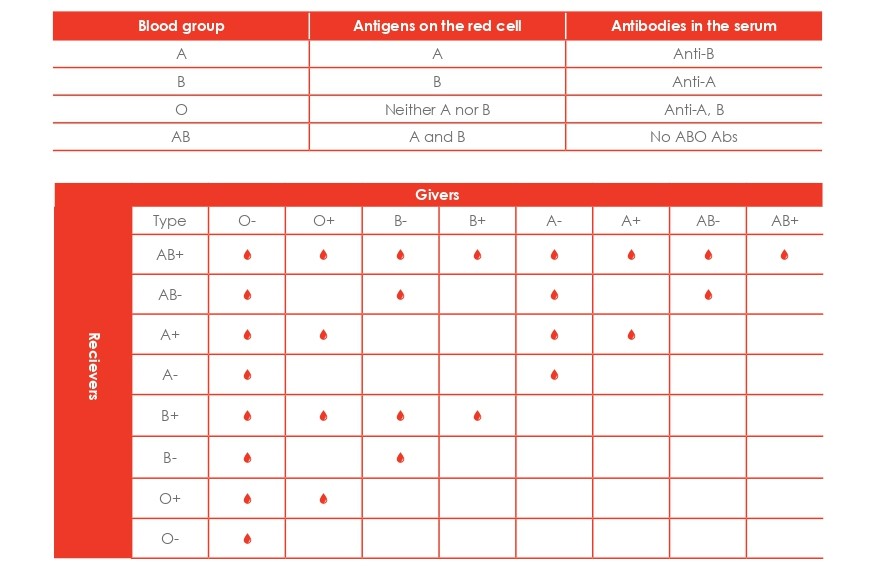 Click on image to enlarge
A person either has (Rh-positive) or lacks (Rh-negative) the D antigen (Rhesus factor) on their red cells. If an Rh-negative person is exposed to the D antigen it will result in the production of anti-RhD antibody. Exposure is usually through:
- Blood transfusion (patient with an Rh-negative blood group is transfused with Rh-positive blood), or
- Placental exposure during pregnancy (mother is Rh-negative and foetus has an Rh-positive blood group).
Production of anti-RhD antibody through exposure can result in:
- The destruction of RhD positive cells during future blood transfusions.
- Haemolytic disease of the newborn in future pregnancies. Anti-D injections are administered to Rh-negative mothers within 48 hours of giving birth to “mop up” any Rh-positive baby cells and thus prevent the mother’s body from producing anti-RhD antibodies.
Available blood products
Donated blood can be used as whole blood or processed into components. Pooled plasma can be sent for fractionation to produce plasma derivatives.
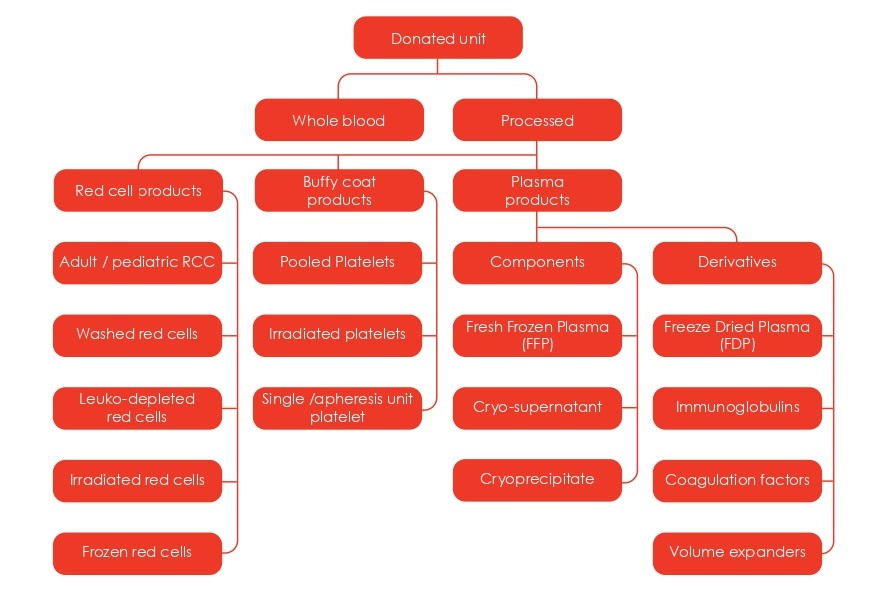 Click on image to enlarge
A clear clinical indication must exist for the transfusion and the choice of products. This must be noted in the patient’s clinical notes. Component therapy enables the physician to replace / replenish specifically needed products and minimize the risk to the patient.
Blood and blood products available from South African National Blood Service
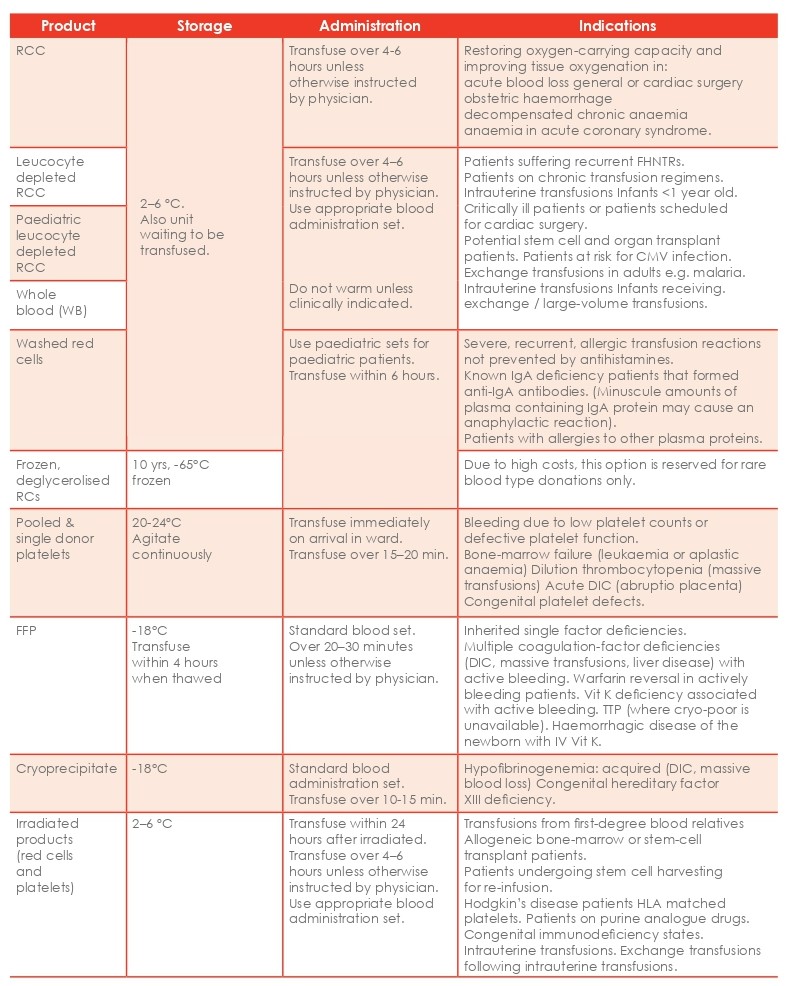 Click on table to enlarge
Irradiated red cells should be transfused within 24 hours of irradiation as an exponential increase in extracellular potassium is noted after irradiation. Should more than 24 hours elapse before transfusing, consider having the product washed.
Washed products should be transfused within 24 hours of preparation to minimize the risk of bacterial infections.
Paediatric products (FFP, red cell concentrate and platelets) are available. This prevents wastage from ordering adult volumes. All paediatric red cell concentrates and platelets are leucodepleted. (As per South African Society of Anaesthesiologists (SASA) guidelines on volume transfused for paeds instead of units).
Navigation to a Safe Blood Transfusion - Updated August 2023