Introduction
These are the approved guidelines published by the South African Society of Psychiatrists to provide an overview on treatment and management of commonly diagnosed psychiatric illnesses. The guidelines include consensus recommendations, based on peer contribution and using the international evidence based guidelines that are suitable for the local South African health service.
By definition, dementia is an acquired global impairment in memory, personality and intellect in an alert patient, that is sufficiently severe to interfere with social and/or occupational functioning. In the absence of a stroke or rapidly growing cerebral tumours (among other causes), the onset is usually gradual and the cognitive decline is always progressive. In the absence of a cure for the disease, non-pharmacological inventions and the judicious use of pharmacotherapy may not only help the patient and alleviate the stress on the caregiver, but can also help in delaying institutionalisation.
Prevalence and burden of disease
The worldwide prevalence of dementia currently approximates 35.6 million people, a figure set to rise to 65.7 million by 2030 and (by doubling every 20 years) to 115.4 million by 2050. Nearly two-thirds of individuals with dementia live in developing countries, where the sharpest increase in numbers is said to occur.[1] The prevalence of dementia is approximately 5 - 7% of the elderly population. Starting at 1% for 60-year-olds, the prevalence doubles every 5.1 years, rising to some 30 - 45% of those aged 85 and older[2,3] in developed countries, while doubling every 7 years in developing countries.[4] Among the South African elderly an estimate would place the number of dementia sufferers at 250 000, with some 35 000 of these suffering from Alzheimer’s disease (AD).
Twenty per cent of AD patients are alive after a 15-year period, the mean duration of illness being some 10 - 12 years.[5] Of the people with late-onset (65 years and older) dementia in developed countries, more than half have AD, some 15% have vascular dementia (VaD), and the remaining 30%, a variety of some 60 other forms of dementia.[6] Many cases of AD exhibit a confluence with cerebrovascular disease (CvD).[7] The total worldwide societal cost of dementia was estimated at US$422 billion in 2009, which included US$142 billion (34%) for informal care.[8] Americans estimate that dementia costs them some US$100 billion per year,[1] and yet a delay in the onset of AD by only 5 years would halve the prevalence of the disease, resulting in enormous savings of human misery and cost to society.[5,9] In all cases there are profound psychosocial effects on the caregiver, in whom the rates of depression, substance abuse, hospitalisation and physical illness are all increased.[9]
Causes and types of dementia
In the South African population, dementia due to the HIV/AIDS complex (affecting mainly the younger age group) is the most common. Among the elderly the most prevalent is VaD, followed by AD, which is on the increase.[7]
Alzheimer’s disease
The neuropathological hallmarks of AD are amyloid plaques, neurofibrillary tangles, and synaptic and neuronal loss with subsequent brain atrophy. Macroscopically, and with neuro-imaging (magnetic resonance imaging (MRI) and computed tomography (CT) scan), this demonstrates as flattening of gyri, widening of sulci, atrophied medial temporal lobes and enlarged ventricles. Pathology at microvascular level has increasingly been implicated in the aetiology of AD, blurring the boundaries with VaD in many cases. AD and possibly most other dementias tend to follow a sinusoidal course in that the initial slow, progressive deterioration accelerates rapidly before flattening out towards the end – in keeping with the 3 stages of mild, moderate and severe.[10]
The duration of illness may be as short as 6 months or as long as 20 years, with an average of 12 years. Neurochemically there are deficits in neurotransmitters including acetylcholine, noradrenaline, serotonin, and somatostatin. Specific mutations on chromosomes 21, 14 and 1, inherited as familial autosomal dominant traits with full penetrance, are found in some 1% of all AD patients. Here the illness usually presents itself in the 40s or early 50s and is essentially ‘pre-senile’ in onset (i.e. before the age of 65 years). More than 90% of cases of AD occur in individuals older than 60 years. Individuals carrying one or both alleles coding for apolipoprotein E-4 (APOE4) on chromosome 19 bear an elevated risk for late-onset AD, although this gene is not itself a cause of the disorder.[11] Fig. 1 represents the course of AD.
Vascular dementia – with or without stroke
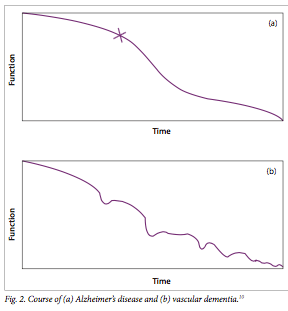
Among the VaDs, multi-infarct dementia associated with multiple areas of cortical infarction, patchy cognitive impairment, focal neurological signs and a ‘stepwise’ rather than a steady, continuous deterioration as in AD is more easily diagnosed than dementia due to vascular damage of the deep white matter.
After each shower of ‘mini strokes’, which produce a sudden deterioration in the individual’s functioning, there is a partial recovery which stabilises within approximately 3 - 12 weeks until the next stroke or ‘step’ occurs several weeks or months later. It is hypothesised that in both vascular and alcohol-induced dementias, temporary vascular spasms may result in intermittent or fluctuating intellectual and personality changes, with unpredictable bouts of irritability and mood swings. In all types of VaDs the risk factors for stroke such as hypertension, arrhythmias, hypercholesterolaemia, diabetes, smoking and alcohol need to be assessed. Fig. 2 represents the course of multi-infarct dementia compared to AD.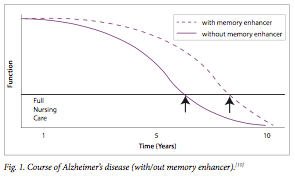
Combination of Alzheimer’s disease and vascular dementia
This is referred to as AD with CvD.
Dementia with Lewy bodies
Dementia with Lewy bodies usually exhibits as fluctuations in cognition (mimicking a sub-acute delirium) with pronounced variation in attention and alertness, recurrent well-formed visual hallucinations (especially sun-downing), and motor features of Parkinsonism. The course of the illness tends to be rapidly progressive, interspersed with repeated falls, syncope, transient loss of consciousness, other hallucinations and congruent delusions. These patients tend to be sensitive to the side-effects of neuroleptic agents (requiring utilisation of drugs like clozapine or newer neurolepticagents). They may be responsive to cholinesterase inhibitors.
Pick’s disease and frontotemporal dementia
Pick’s disease (PD) is a progressive dementia that chiefly affects the frontal cortex. PD most commonly manifests between the ages of 50 and 60 years and is distinguished from frontotemporal dementia by the presence of characteristic intraneuronal argentophilic Pick inclusion bodies found at autopsy. Patients present with prominent personality changes and impaired executive function. In frontotemporal dementia diagnostic criteria range across 4 domains:
- Behavioural disorder: insidious onset and slow progression; early loss of personal and social awareness; early signs of disinhibition; mental rigidity and inflexibility; and hyperorality, stereotyped and perseverative behaviour.
- Affective symptoms: depression and anxiety; somatic preoccupation; emotional unconcern.
- Speech disorder: reduction and stereotypy of speech; echolalia and perseveration.
- Physical signs: early primitive reflexes and incontinence; late akinesia, rigidity and tremor.
Substance-induced persisting dementia
Paramount are deep white-matter changes blurred with alcohol-induced vasculopathy, clinically often indistinguishable from VaDs and with the same risk factors as precipitating and perpetuating causes. Note that both vascular and alcohol-induced dementia patients have relatively well-preserved personalities, compared to the degree of dementia present. Their excellent social skills or verbal ability may be misleading unless one screens for dementia using the Mini Mental State Examination (MMSE).
Huntington’s disease
Huntington’s disease is an inherited disease (autosomal dominant gene on chromosome 4) characterised by degeneration of the basal ganglia and cerebral cortex. Age of onset is between 15 and 50 years, when choreiform movements and progressive dementia are noted. The dementia initially presents as a sub-cortical dementia before affecting the cortex as the illness progresses. No cure is currently available and death results within 15 - 20 years. Psychiatric disorders, especially depression, may be the presenting feature.
Parkinson’s disease
The primary features are tremor, muscular rigidity, hypokinesia and postural abnormality. Although a movement disorder, cognitive impairment occurs in 10 - 40% of patients during the course of the disease, known as Parkinson’s disease dementia.
Creutzfeldt-Jakob’s disease
Creutzfeldt-Jakob’s disease is brought about by a virus-like infective agent called a prion. It causes a rapid progressive dementia also affecting the pyramidal and extrapyramidal systems. A new variant of Creutzfeldt-Jakob’s disease, described in England in 1995, appears to express itself under certain conditions in individuals under the age of 40 years, leading to death within a year. This variant is associated with bovine spongiform encephalopathy or ‘mad cow disease’.
Dementia associated with normal pressure hydrocephalus
Normal pressure hydrocephalus occurs in the elderly and is characterised by a triad of ataxia (wide-based, shuffling gait), urinary incontinence and dementia. CT scans of the brain show prominent enlargement of the ventricles out of keeping with the widening of the sulci. Ventricular peritoneal shunts may improve cognitive functions in 10 - 30% of patients. Usually a demented person only becomes incontinent on attaining an MMSE score of 8 - 10/30.
Dementia secondary to head injury
This is lesion-location- and severity-specific, and diagnosed and treated accordingly. It may manifest with 2 distinct symptom clusters, namely cognitive impairment (i.e. decreased information processing speed, decreased attention, increased distractibility) and behavioural disturbances. The behavioural disturbances may involve personality changes, impulsivity and depression, all of which can be exacerbated by substance misuse.
AIDS dementia complex/HIV dementia
HIV infection currently affects 5 million people in South Africa and is set to reach a steady state of 32% within less than a decade. The course of the illness may vary considerably but in general the patient converts to AIDS after 9 years of illness and dies a year later from systemic complications. Nearly 90% of AIDS brains are histopathologically abnormal, more than half of them uniquely due to HIV infection. Referred to as the AIDS dementia complex, this condition contributes significantly to the morbidity of HIV patients, causing varying degrees of cognitive, motor or behavioural impairment, known as HIV-associated neurocognitive disorders (HAND).
Other less common causes of dementia
• Endocrine states (hypo- or hyperthyroidism, hyperparathyroidism)
• Deficiency states (B complex vitamins)
• Intracranial space-occupying lesions (subdural haematomas, tumours)
• Post-irradiation dementia
• Demyelinating disorders
• Neurosyphilis