Introduction and Rationale
Background TB Preventive Treatment (TPT) Tests of TB infection: Tuberculin Skin Tests (TST) and Interferon-Gamma Release Assays (IGRA) Background South Africa, with 13 other countries, carries the major triple burden of drug-susceptible TB (DS-TB), multidrug-resistant TB (MDR-TB) and TB co-infected with HIV (TB/HIV), and is among the top 30 high TB burden countries identified by the World Health
Tests of TB infection: Tuberculin Skin Tests (TST) and Interferon-Gamma Release Assays (IGRA)
Background
South Africa, with 13 other countries, carries the major triple burden of drug-susceptible TB (DS-TB), multidrug-resistant TB (MDR-TB) and TB co-infected with HIV (TB/HIV), and is among the top 30 high TB burden countries identified by the World Health Organization (WHO). The WHO estimated that, in 2019 there were 360 000 new people with TB disease in South Africa, of whom 58 per cent were living with HIV 2. TB is the leading cause of death in South Africa 3.
The COVID-19 pandemic has put the gains made for TB at risk. Not only does SARS-CoV-2 pose an increased risk to people with TB, but it has severely disrupted services. An estimated 1.4 million fewer people received care for TB last year – 21 per cent less than in 2019. The Director-General of the WHO announced in June 2021 at the WHO high-level event on a global drive to scale up TB prevention that the disruption of TB services could cause an additional half a million deaths 4. He reiterated the urgency to preventive treatment for household contacts of people with TB, including children, alongside efforts to find people with TB disease among people living with HIV.
Significant exposure to TB in all age groups, people living with HIV (PLHIV), miners, inmates, pregnant women, immunocompromised individuals, those with silicosis and healthcare workers are at especially high risk of developing TB disease – with reported rates of infection ranging from 26 per cent up to 89 per cent. 5-11
Prevention of TB disease is enshrined in South Africa’s National Strategic Plan for HIV, TB and STIs (Sexually Transmitted Infections) 2017-2022 12. It is a critical component of the WHO End TB Strategy, which together with the United Nations (UN) Sustainable Development Goals (SDGs), commits to end the global TB epidemic by 2030 or sooner 13. This commitment was endorsed at the first UN High Level Meeting (HLM) on TB in New York, also attended by representatives and the President of South Africa in September 2018. The meeting set a target of 30 million people (including PLHIV and household contacts) to be provided with TPT between 2018 and 2022. From estimates computed by the Stop TB Partnership, South Africa’s contribution to this global target is 2 572 100 people.
TB Preventive Treatment (TPT)
TPT is an effective and safe intervention to reduce the risk of developing TB disease for all age groups with TB exposure. TPT is also an effective intervention to reduce the risk of developing TB disease amongst PLHIV 14 and those with silicosis 15, regardless of documented TB exposure.
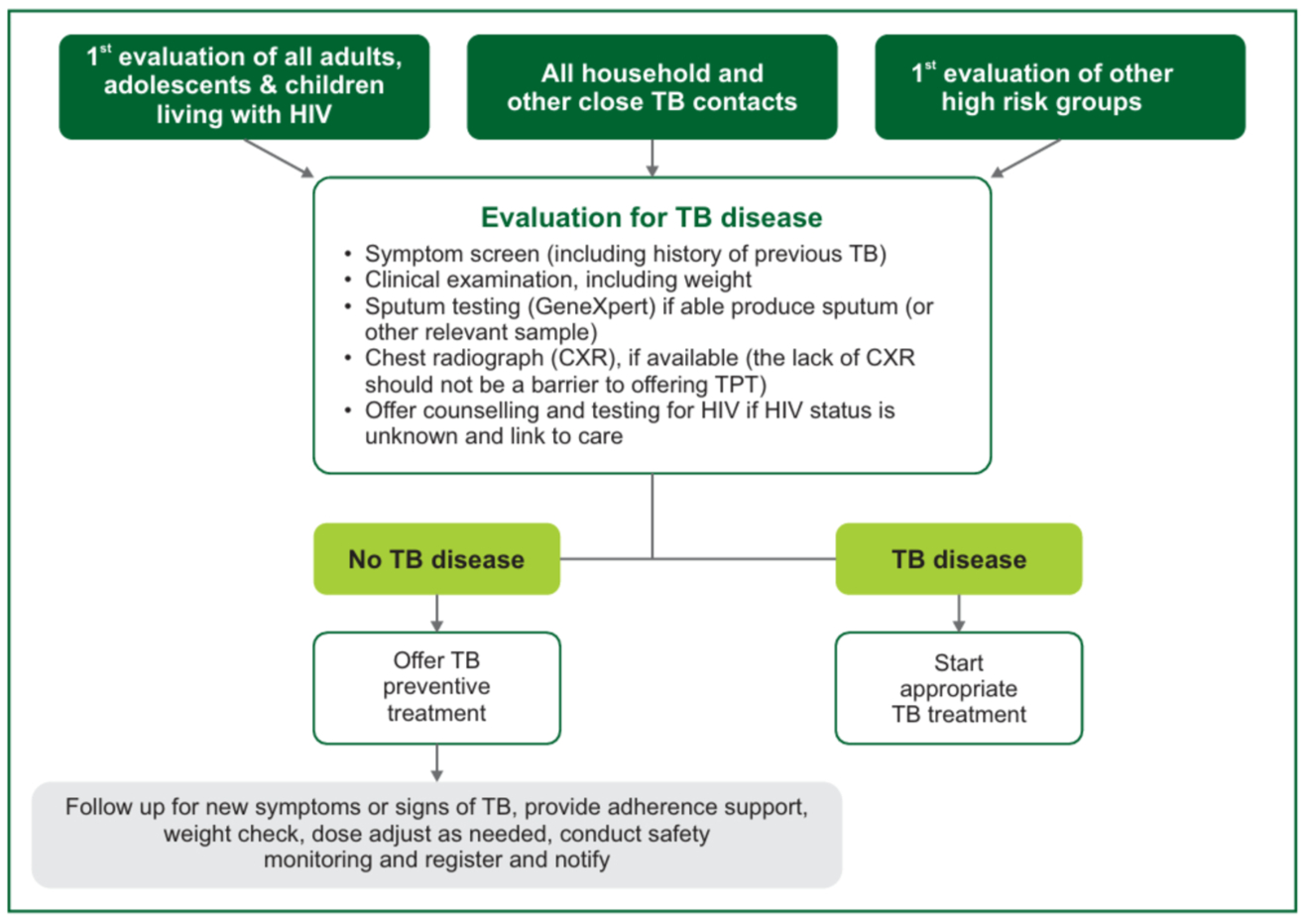
The overall guiding principle is therefore that: TPT should be offered to all people (regardless of age and HIV status) after significant TB exposure and those who are immunocompromised (regardless of known exposure), after TB disease has been ruled out, i.e., a TB test and treat approach. Figure 1 describes the overall principle of eligibility for TPT.
Even those who previously completed TB treatment may experience multiple significant exposures or acquire/develop immunocompromising conditions over their life course. TPT is indicated at each new TB exposure or each period of immunocompromise.
The TPT regimen chosen will depend on the weight (for children), the HIV status, the type of patient and their circumstances, household or family considerations, other medications including ART, the availability of formulations and current evidence. Where possible, individuals in one household or group should receive the same type of TPT regimen to lessen the burden and complexity of TPT on the individuals and family/group, reduce the chances of being stigmatised and facilitate support, monitoring and evaluation.
In South Africa, the current TPT options include:
- 3HP: three months of isoniazid and rifapentine given once weekly
- 3RH: three months of daily rifampicin and isoniazid
- 6H: six months of daily isoniazid
- 12H: 12 months of daily isoniazid
The 3HP regimen is as safe and effective, achieves significantly higher treatment completion rates and has a significantly lower risk of hepatotoxicity than 6H 16,17. It is therefore the preferred option if there are no contra-indications. The isoniazid-only regimens (6H and 12H) also have very low rates of adverse events 18 and do not lead to isoniazid resistance 19.
In asymptomatic children, sputum testing or CXR is NOT a requirement to start TPT. Tests of TB infection (tuberculin skin test/TST or IGRA) are not required to initiate TPT.
Once the dolutegravir levels from trials like the DOLPHIN-2, DOLPHIN-kids and Tuberculosis Trials Consortium (TBTC) Study 35 trials are known and a child-friendly rifapentine formulation is available, 3HP will likely be the preferred option in all PLHIV, regardless of age and weight. In general, in PLHIV, if 3HP is not suitable, use either 6H (children) or 12H (adults).
Options for TPT regimens will be revised as new evidence regarding safety, efficacy, appropriate dosing and patient friendly formulations become available in South Africa. Table 1 summarises the current treatment options and their duration. Where possible, shorter TPT regimens should be prioritised.
Figure 1. General algorithm for provision of TB preventive treatment using the test and treat approach
Click on the image to enlarge.
Tests of TB infection: Tuberculin Skin Tests (TST) and Interferon-Gamma Release Assays (IGRA)
It is important to recognise the difference between testing for TB infection (e.g., tuberculin skin test; TST, interferon-gamma release assay; IGRA) and testing for TB disease (Xpert/culture, chest x-ray, Urine LF-LAM). Tests for TB infection are useful to detect TB infection but are not a requirement to starting TPT. A positive test of infection means that the person is (or was previously) infected with M.tb, but does not indicate (or exclude) TB disease. Also, a negative test of infection does not mean that the person is not actually infected with M.tb or is not at risk for developing TB disease in the near future. Therefore, tests for TB infection are no longer listed in these algorithms and any lack of availability should not impact whether somebody is offered TPT or not. Tests of TB infection may be used in individual care settings at clinician discretion.
TPT should be offered to all people after significant exposure to an adult or adolescent with active pulmonary TB disease (TB contacts) or if the individual is immunocompromised (regardless of known M.tb exposure). In the past, the lack of TST or IGRA availability was a barrier to TPT access – this requirement has now been replaced with testing for TB disease, before disease can be ruled out and TPT started. Xpert should be available at all healthcare facilities as a minimum with or without urine LF-LAM and chest x-rays.
Table 1. Summary of TPT regimen options by patient type
| PATIENT CATEGORY | WHAT TO DO | REGIMEN | |
| Adults and adolescents including children ≥25kg | HIV-positive | PLHIV: Test for TB regardless of ART status and give TPT once TB disease is excluded. If newly diagnosed with HIV, start ART immediately and TPT within the next two weeks. | 3HP* or 12H |
| Post TB treatment: Offer TPT to all PLHIV ≥25 kg after successfully completing treatment for TB disease, after active TB disease has again been excluded. | |||
| Previously treated with TPT: If re-exposed to any close contact with TB, retest for TB and give TPT once TB disease has been excluded. | |||
| Evaluate all HIV-positive pregnant women regardless of CD4 count and give TPT once TB disease has been excluded. | 12H | ||
| HIV-negative | Contacts: Evaluate all HIV-negative adults, adolescents and children ≥25kg in close contact with people diagnosed with TB and start TPT once TB disease has been excluded. | 3HP, 3RH or 6H | |
| Evaluate all HIV-negative at-risk groups (on anti-TNF treatment, on dialysis, diabetes, preparing for organ or haematological transplant, or with silicosis). Once TB disease is excluded, start TPT. | |||
| Evaluate HIV-negative adults and adolescents who previously received TPT, if re-exposed to a close contact with TB and start TPT once active TB has been excluded. | |||
| Evaluate all TB exposed HIV-negative pregnant women and give TPT once TB disease has been excluded. | 3RH or 6H | ||
| Infants and children <25kg | HIV -positive | Children living with HIV (CLHIV): Evaluate all children older than 14 weeks of age living with HIV for TB and start TPT once active TB has been excluded. ART should be started immediately if newly diagnosed with HIV. TPT should be started within two weeks of ART initiation. | 6H** |
| Contacts: Evaluate all TB-exposed CLHIV and start TPT after TB disease has been excluded, regardless of previous treatment or TPT. | |||
| HIV-negative | Contacts: Evaluate HIV-negative children in close contact with a TB patient and start TPT after active TB disease has been excluded. | 3RH | |
| Test other HIV-negative at-risk children (weakened immune system e.g., cancer, diabetes, autoimmune diseases, transplant patients on immunosuppressive drugs, receiving dialysis, or inherited immunodeficiencies) for TB and start TPT once TB disease has been excluded | |||
* For adults, adolescents and children ≥25kg initiating a dolutegravir-containing ART regimen, 12H is preferred. For PLHIV who are virally suppressed (VL<50 copies/mL) on a dolutegravir-containing regimen, 3HP is preferred.,
** In children <25kg initiating a dolutegravir-containing ART regimen, 6H is preferred.
Once the dolutegravir levels from the DOLPHIN-2, DOLPHIN-kids and TBTC Study 35 trials are available, 3HP will likely be the preferred option in all PLHIV. If 3HP is not available, use either 6H (children<25kg) or 12H (adults, adolescents and children ≥25kg).
National Guidelines on the Treatment of Tuberculosis Infection, February 2023
Introduction and Rationale