Introduction to Contraception
Contraceptive methods Effectiveness of family planning methods For comprehensive guidance, consult the most recent National Contraception Clinical Guidelines (especially for women with medical conditions), the National Clinical Guidelines for Safe Conception and Infertility, as well as the WHO Medical eligibility criteria for contraceptive use and the WHO family planning handbook for providers. L
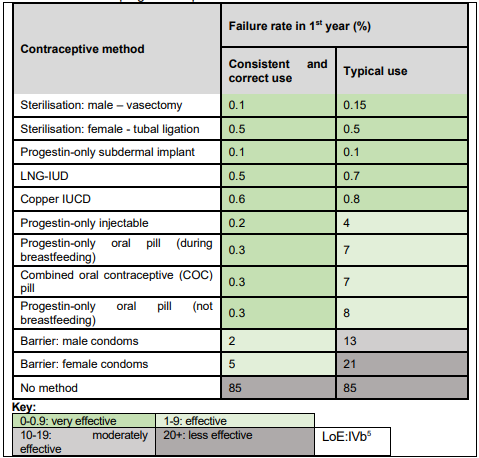
Effectiveness of family planning methods
For comprehensive guidance, consult the most recent National Contraception Clinical Guidelines (especially for women with medical conditions), the National Clinical Guidelines for Safe Conception and Infertility, as well as the WHO Medical eligibility criteria for contraceptive use and the WHO family planning handbook for providers.
LoE:IVb1
Women should decide their own family planning method in consultation with their healthcare professional, taking into account the individual considerations of safety, efficacy, acceptability, and access. Always obtain a complete medical and sexual history and perform an appropriate physical examination to ensure that there are no contra-indications to using a particular method. Provide counselling and always exclude pregnancy before commencing contraception.
Contraceptive methods
| Hormonal contraception and IUCDs do not prevent sexually transmitted infections (STIs), including HIV. Dual protection i.e. the use of a condom in combination with another contraceptive method is recommended to reduce the risk of STIs, including HIV. |
| Contraceptive method | Advantages include: | Disadvantages include: |
| Copper IUCD (See Intrauterine contraceptive copper device (IUCD)) |
- Suitable for most women, including nulliparous women - Provides long-term protection, i.e., 5 years - Convenient, does not require frequent follow-up - Works immediately upon insertion - Non-hormonal, therefore no interaction with other medication and no hormonal side effects - Fertility returns immediately upon removal of IUCD in women of childbearing age - Can be used for emergency contraception (See Contraception, emergency) - Safe to use during breastfeeding |
- Some discomfort or cramping during, and following insertion - IUCD must be inserted or removed by a trained healthcare professional - Should not be used in women with menorrhagia, high risk of STIs, active STIs and active pelvic inflammatory disease (PID), purulent cervicitis, unexplained uterine bleeding, cervical and endometrial cancers or other uterine abnormalities |
| Levonorgestrel Intrauterine device (LNG-IUD) (See Levonorgestrel intra-uterine device (LNG-IUD) (contraception, hormonal)) |
- Suitable for most women, including nulliparous women - Provides long-term protection (up to 5 years). - Convenient, does not require frequent follow-up. - Works immediately upon insertion - Immediate return to fertility upon removal - Reduces menstrual cramps, heavy menstrual bleeding, and symptoms of endometriosis - Similar to the Copper IUCD, can be inserted at the time of a caesarean section and postpartum (within 48 hours after delivery) LoE:IIb2 |
- Bleeding changes are common but not harmful. Typically, lighter and fewer days of bleeding, or infrequent or irregular bleeding - LNG-IUD must be inserted or removed by a trained healthcare professional - Should not be used in women with active PID LoE:IIIb3 |
| Hormonal subdermal: progestin-only implant (See Subdermal implant (contraception, hormonal)) |
- Provides long-term protection, i.e., 3 years (etonogestrel) or 5 years (levonorgestrel) - Convenient, does not require frequent follow up - Can also be used in women >35 years who are obese, who smoke, or who have diabetes, hypertension, or a history of venous thromboembolism - Fertility returns upon removal of the implant in women of child-bearing age |
- Frequent bleeding irregularities - Implant must be inserted or removed by a trained health care professional under aseptic conditions to prevent infection - Incorrect insertion and removal techniques may result in complications |
| Hormonal injectable: progestin-only (See Injectable (contraception, hormonal)) |
- Daily adherence is not required - Long-acting, i.e., given every 8 or 12 weeks - Interactions with other medicines do not lower the contraceptive effect - Can be used postpartum - Can also be used in women >35 years who are obese, who smoke, or who have diabetes, hypertension, or a history of venous thromboembolism |
- Delayed return to fertility of up to 9 months after the last injection - Frequent bleeding irregularities (irregular, prolonged and/or heavy bleeding, or amenorrhoea) - Associated with a possible weight gain LoE:IIIb4 |
| Hormonal oral: progestin-only (See Oral (contraception, hormonal)) |
- Fertility returns within 3 months of discontinuing the pill - Can be used postpartum - Can also be used in women >35 years who are obese, who smoke, or who have diabetes, hypertension, or a history of venous thromboembolism |
- Daily adherence is required - Interactions with other medicines can lower contraceptive effect - Lower efficacy compared with COC - Frequent bleeding irregularities |
| Hormonal oral: combined oral contraceptive (COC) (See Oral (contraception, hormonal)) |
- Non-contraceptive benefits, e.g.: alleviation of dysmenorrhoea, premenstrual syndrome, and menorrhagia - Fertility returns after discontinuation of COC but can take up to 3 months |
- Daily adherence is required - Interactions with other medicines can lower contraceptive effect - Cannot be used in women with venous thromboembolic disease - Cannot be used immediately postpartum |
| Barrier: male and female condoms (See Contraception, barrier methods) | - Protects against STIs, including HIV |
- Possibility of breakage or slipping off - Possible allergic reaction to latex - Lower efficacy than other contraceptive methods, therefore advised as dual contraception - Consistent and correct use is required to prevent pregnancy |
Refer to the most recent SAHPRA registered professional information for detailed information.
Effectiveness of family planning methods
Rates of unintended pregnancies per 100 women:
Click on image to enlarge
Standard Treatment Guidelines and Essential Medicines List for South Africa, Primary Healthcare, 2020-2024_Version 1.0_ April 2025
Chapter 7: Family Planning_Introduction to Contraception