Investigations to Exclude a GMC in Behaviorally Disturbed Patients
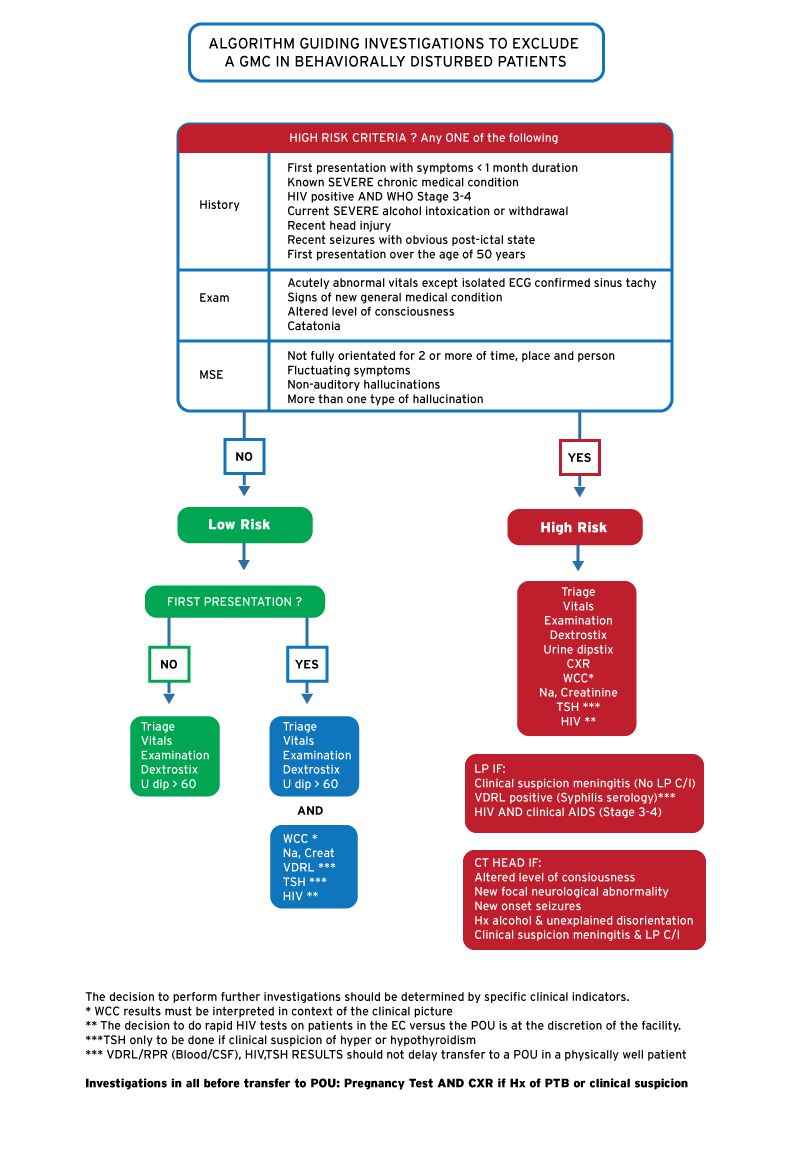
Algorithm Guiding Investigations to Exclude a GMC in Behaviorally Disturbed Patients
Reasons or Review of Protocol 4
Responsibilities of ECs and POUs
Flow of behaviourally disturbed patients along the care continuum
Definitions of low and high risk criteria for GMC
Assessment and investigations required to exclude a GMC in ECs
Investigations to exclude a GMC in patients meeting low risk criteria in the POU
Algorithm guiding investigations to exclude GMC in behaviourally disturbed patients
Reasons for Review of Protocol 4
- Routine testing without indication has poor detection rate (Assessment of routine laboratory screening of adult psychiatric patients presenting to an emergency centre in Cape Town. Crede A, Geduld H, Wallis L. S Afr Med J 2011; 101:891-894.) In addition, the tests are costly.
- Completion of tests is currently being used as a prerequisite before transfer from the Emergency Centre (EC) to POUs. The consequence of this is delayed treatment and increased length of stay.
- Another consequence is the contribution to EC overcrowding, which has been shown to be associated with increased mortality. (Association between Length of Emergency Department Boarding and Mortality. Singer A, Thode H, Viccellio P et al. Acad EM 2011. 10:1553-2712.)
- Clarity of definition of roles and responsibility of ECs and POUs is needed.
Purpose of this Guideline
Any admission to a psychiatric hospital or unit is strictly defined in terms of the Mental Health Care Act (MHCA) 17 of 2002 and Regulations, both with regard to the patient’s consent to admission and capacity to give consent, as well as with regard to the nature of the illness, which should be psychiatric in origin and primarily due to a General Medical Condition (GMC). This guideline will assist the physician in assessing the risk for an underlying GMC and specify the required investigations.
The portal of entry for the behaviourally disturbed patient in need of exclusion of a GMC is through the EC. The responsibility of the EC is to exclude a GMC as a primary cause and to provide initial containment. Once a GMC is excluded, the patient is to be transferred to a POU. The EC is an unsuitable location for a behaviourally disturbed patient, in terms of containment as well as safety issues for the patient, staff members and other patients and their visitors.
In any case of disagreement over the suitability of referrals, the matter must be referred to the relevant consultants and negotiated at consultant-to-consultant level.
This guideline will:
- Outline the flow of behaviourally disturbed patients through care continuum.
- Clarify the roles and responsibilities of ECs and POUs.
- Define the low and high risk criteria for a GMC.
- Outline investigations required to exclude a GMC in ECs.
- Outline investigations required to exclude a GMC in patients meeting low risk criteria in the POUs.
This guideline conforms to the following principles:
- Care should be centred around the patient. Every patient accessing emergency care has the right to quality emergency care. Every mental health care user has the right to be managed in a safe, secure space that is conducive to their recovery.
- The 72-hour psychiatric observation process should take place in a dedicated in-hospital space, the POU, which by definition, excludes the EC.
- The Psychiatry and Emergency Medicine Provincial Governance Committees agree that the EC is the least optimal clinical space in the hospital for continued psychiatric containment.
- Completion of forms and awaiting tests results should not delay movement of a patient from the EC to POU or acute in-patient ward within the hospital itself.
- Responsibility for the care of a patient admitted under the MHCA for 72-hour assessment falls to the admitting team regardless of physical location of the patient.
- In the case of co-existing chronic non-stabilised medical illness, the medical illness must be controlled and an appropriate management plan be determined and agreed upon with the admitting doctor providing the psychiatric service.
The following issues are not covered by this policy:
- Referral pathways.
- EMS Inter-hospital transport logistics.
- Sedation guidelines.
- Security requirements in EC and POU.
- Infrastructure of EC “Secure Examination Room” and POU.
- Escalation policies in the event of EC and POU access block and overcrowding.
- Community-based Crisis Intervention Teams.
- Special groups: Adolescents; Geriatrics; Forensics.
- Direct referral to psychiatric hospitals in the case of relapsed patients discharged from a psychiatric hospital within 3 months and aggressive patients despite adequate sedation.
- Roles of POUs in terms of Level 1 and 2 services at District and Regional Hospitals
- Equitable access to specialist psychiatric beds with the GSA.
Responsibilities of ECs and POUs
An EC is any facility that provides, and has infrastructure for, emergency care, and here includes all hospital-based ECs and the 24 hour Primary Health Care Community Health Centres. With respect to behaviourally disturbed patients, the EC’s role is to screen for GMC as the primary cause of the behavioural disturbance. This screening takes the form of a thorough history, examination, mental state examination and special investigations of a patient at high-risk for GMC. Simultaneous to this screening, initial containment of the patient also occurs, including the sedation and institution of treatment as appropriate.
The EC is responsible to ensure that the MHCA Form 4 and one of the required Form 5’s are completed in patients who need involuntary admission. This process should take no more than 6 hours from arrival to admission. Governance is under Family Medicine at PHC facilities and small District Hospitals, Emergency Medicine at large District Hospitals and Regional Hospitals, and General Medicine at Central Hospitals.
The POUs are in-patient areas providing 72-hour psychiatric assessment of behaviourally disturbed patients. These units are responsible for the care of the patient from referral to the psychiatry service until transfer to a Psychiatric Hospital or discharge back into the community. The POU is responsible for the 72-hour psychiatric observation (as outlined by the MHCA), the definitive treatment of the psychiatric illness, further investigations that may be required in patients who are low-risk for a GMC and completion of relevant MHCA forms. These forms are to be completed within 24 hours of arrival.
The presence of a significant GMC that may be the cause of the disturbed behaviour is an EXCLUSION criterion for admission through the MHCA. In cases of significant psychiatric and medical co-morbidity the decision to admit into a medical ward with consulting psychiatry versus the POU is a joint decision between the inpatient teams of psychiatry and medicine.
Should a patient be referred from EC incorrectly to an inpatient team, such as a medically ill patient to psychiatry or vice versa, those inpatient teams are to co-ordinate care further, and the patient is not to be referred back to the EC. The matter must then be discussed with the EC in line with correct clinical governance feedback practice.
Flow of Behaviourally Disturbed Patients Along the Care Continuum
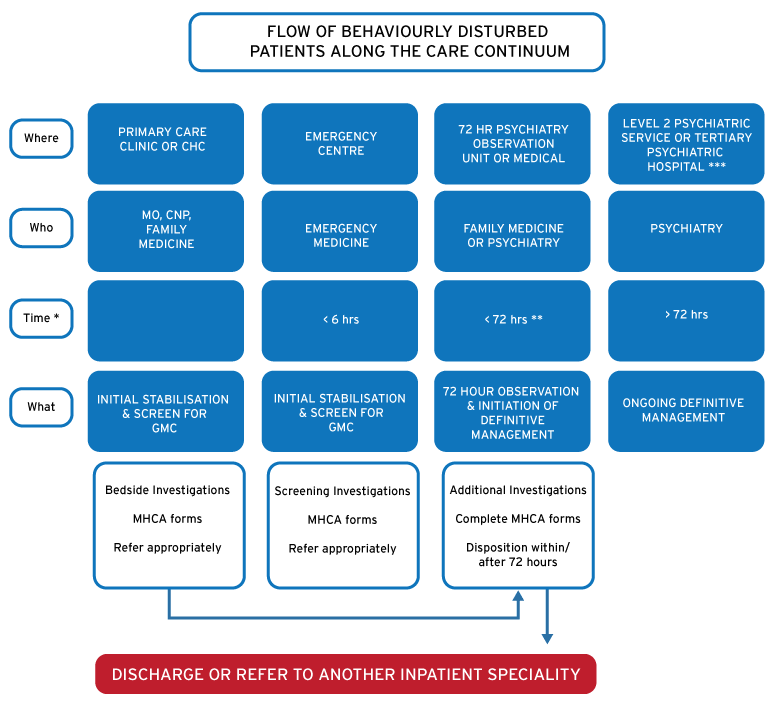
* All time frames expressed are ideal as per international standards.
** This recommends the time frame as per the MHCA regulations, not the provincial policy that refers to a 72 + 48 hour time-frame.
*** The division and location of levels of psychiatry services is outside the scope of this document, hence reference to psychiatry services above the 72-hour assessment period.
Definitions of low and high risk criteria for GMC
Low Risk: Absence of high risk criteria.
High risk: any one or more these criteria are present:
History:
- First presentation with symptoms < 1 month duration.
- Known SEVERE chronic medical condition.
- HIV positive AND WHO Stage 3 – 4.
- Current SEVERE alcohol intoxication or withdrawal.
- Recent head injury.
- Recent seizures with obvious post-ictal state or delirium.
- First presentation over the age of 50 years.
Examination:
- Acutely abnormal vital signs.
- Excluding isolated ECG confirmed sinus tachycardia.
- Signs of a new general medical condition.
- Altered level of consciousness.
- Catatonia.
Mental State Examination (MSE):
- Not fully orientated for 2 or more of time, place and person.
- Fluctuating symptoms.
- Non-auditory hallucinations.
- More than one type of hallucination.
Assessment and investigations required to exclude a GMC in ECs
Assessment and investigations in low risk cases with psychiatric history:
- Triage and Vital Signs.
- Thorough physical examination.
- Dextrostix.
- Urine dipstix > 60 years old.
Additional investigations in low risk cases with first presentation (no psychiatric history):
- WCC *
- Na, Creatinine.
- VDRL.****
- TSH *** (if clinical suspicion of hypo- or hyperthyroid).
- HIV. **
Assessment and investigations in high risk cases:
- Triage and Vital Signs.
- Thorough physical examination.
- Dextrostix
- Urine dipstix.
- CXR.
- WCC. *
- Na, Creatinine.
- TSH. ***
- HIV. **
Lumbar puncture (LP) is indicated in:
- Clinical suspicion of meningitis (no contraindication to LP).
- Known VDRL positive (send for Syphilis serology).***
- HIV positive AND clinical AIDS (Stage 3 – 4).
CT head is indicated in:
- Altered levels of consciousness.
- Any new focal neurological abnormality.
- New onset seizures.
- History of alcohol abuse and unexplained disorientation.
- Clinical suspicion of meningitis with contraindication to LP.
- The decision to perform further investigations should be determined by specific clinical indicators.
* WCC results must be interpreted in context of the clinical picture.
**The decision to do rapid HIV tests is done based on clinical suspicion, and the decision whether to do this in the EC versus the POU is at the discretion of the facility. These patients do not have capacity to consent, so capacity is waivered.
***The results of VDRL/RPR (Blood of CSF), HIV and TSH should not delay transfer of the patient to the POU in a physically well patient, and the results can be sourced there. The decision whether to initiate these tests in the EC or POU is at the discretion of the facility.
Investigations in all patients before transfer to the POU:
- Pregnancy test in all females of child-bearing age.
- CXR if a history of current or previous PTB, or constitutional symptoms OR if known HIV positive.
Investigations to exclude a GMC in patients meeting low risk criteria in the POU
Any further investigations in addition to those outlined above, are to be done within the 72-hour observation ward. This includes awaiting VDRL (blood or CSF), HIV, and TSH that may have been done in the EC, in a physically well patient.
Algorithm Guiding Investigations to Exclude a GMC in behaviourally disturbed patients