IPC Measures Using a Multimodal Approach
Supporting the Antimicrobial Resistance Strategy Framework and the Guidelines on Implementation of the Antimicrobial Strategy in South Africa: One Health Approach and Governance, 2018
IPC measures using a multimodal approach
System changes
Education and training
Monitoring
Reminders in the workplace
Culture change
Overview of the key strategies to reduce the incidence of HAIs and prevent their spread
A key step to mitigate AMR is to prevent HAIs from occurring. In the setting of a healthcare facility this is relevant on a day-to-day basis and impacts ALL health care workers and support staff who are in contact with patients or each other.
The prevention of infection is everyone’s responsibility and must be overseen by a healthcare worker, ideally with infection prevention and control expertise and training.
IPC measures using a multimodal approach
The five most common multimodal components for infection prevention include:
- System change: availability of the appropriate infrastructure and supplies to enable the implementation of infection prevention recommendations.
- Education and training of HCWs and key players.
- Monitoring infrastructure, practices, processes, outcomes and providing data feedback;
- Reminders and communication improvements in the workplace.
- Culture change within the establishment or the strengthening of a safety climate.
Multimodal strategies have shown to be effective in bringing about change and reduction in infections because safe patient care is implemented using different components with the same goal in mind: to introduce a change in culture thereby reducing infection.
A multimodal strategy is comprised of several elements or components implemented in an integrated way with the aim of improving an outcome and changing behaviour. It includes tools such as bundles and checklists, which are developed by multidisciplinary teams that take into account local conditions. For more details on the multimodal approach please refer to Annexure A.
Prevention of HAIs includes the following multimodal aspects:8
System changes
- Healthcare facility managers need to engage and commit to reducing infection rates.
- There must be a ring-fenced budget for IPC equipment and investigation of outbreaks.
- Infrastructure to support IPC must be in place including procurement and supplies.
- Access to microbiology laboratory support for aetiological diagnosis of infection and antimicrobial resistance testing at least to secondary level hospitals with a referral system in place for remote facilities.
Education and training
- All healthcare facilities need to have trained infection prevention professionals who have dedicated time for IPC as part of their job description.
- They must be trained in evidence-based IPC processes and act as a resource for other HCWs.
- The recommended minimum ratio is at least one trained full-time IPC practitioner per 250 acute care beds as per the World Health Organization (WHO) guidance.9
- IPC practitioners in healthcare facilities will be responsible for training other HCWs in evidence-based IPC practices.
- IPC practitioners will attend regular inservice training and scientific meetings of the National Infection Control Societies, such as the Infection Control Society of Southern Africa (ICCSA), to keep abreast of recent developments.
Monitoring
- Annual assessment to monitor improvement in IPC standards from baseline using the Infection Control Assessment Tool (ICAT).10
- The simplest and most effective way to implement this would be regular point prevalence survey (PPS) of HAIs including appropriate antibiotic usage.
- A risk assessment is recommended to develop clear objectives that evaluate and contribute to prevention of HAIs and the prevention of the spread of AMR.
Reminders in the workplace
- Posters and visible reminders in the workplace.
- An IPC manual with the essential IPC practices should be available as a reference in each clinic area of the healthcare facility.
- An application which can be downloaded to the HCW mobile phones should be considered.
Culture change
- Feedback from the monitoring of IPC practices and appropriate use of antibiotics will result in change in practice.
- IPC practitioners must be supported by management to have the authority to support and train all categories of staff (including non-medical staff) in IPC at healthcare facility level.
Although many of these aspects are already dealt with in other guidelines (see Annexure A for a summary of the most important components), it is important that HCWs are reminded of the key principles and important concepts and actions that each hospital should take to prevent HAIs as part of the AMR prevention strategy.
The sections below provide an overview of the key strategies to reduce the incidence of HAIs and prevent their spread:
Hand hygiene
The most common route of transmission of HAI pathogens is through direct contact between healthcare professionals and patients, thus hands are the main route of transmission in healthcare facilities. Hand hygiene is the most important evidence-based intervention for the prevention of transmission of organisms following direct contact with patients, other HCWs or contaminated equipment such as bedpans or urinals.11 Hand hygiene is a general term referring to “any action of hand cleansing” including hand washing with plain or antimicrobial soap and water and hand cleansing which is for the purpose of “physically or mechanically removing dirt, organic material, and/or microorganisms”.6
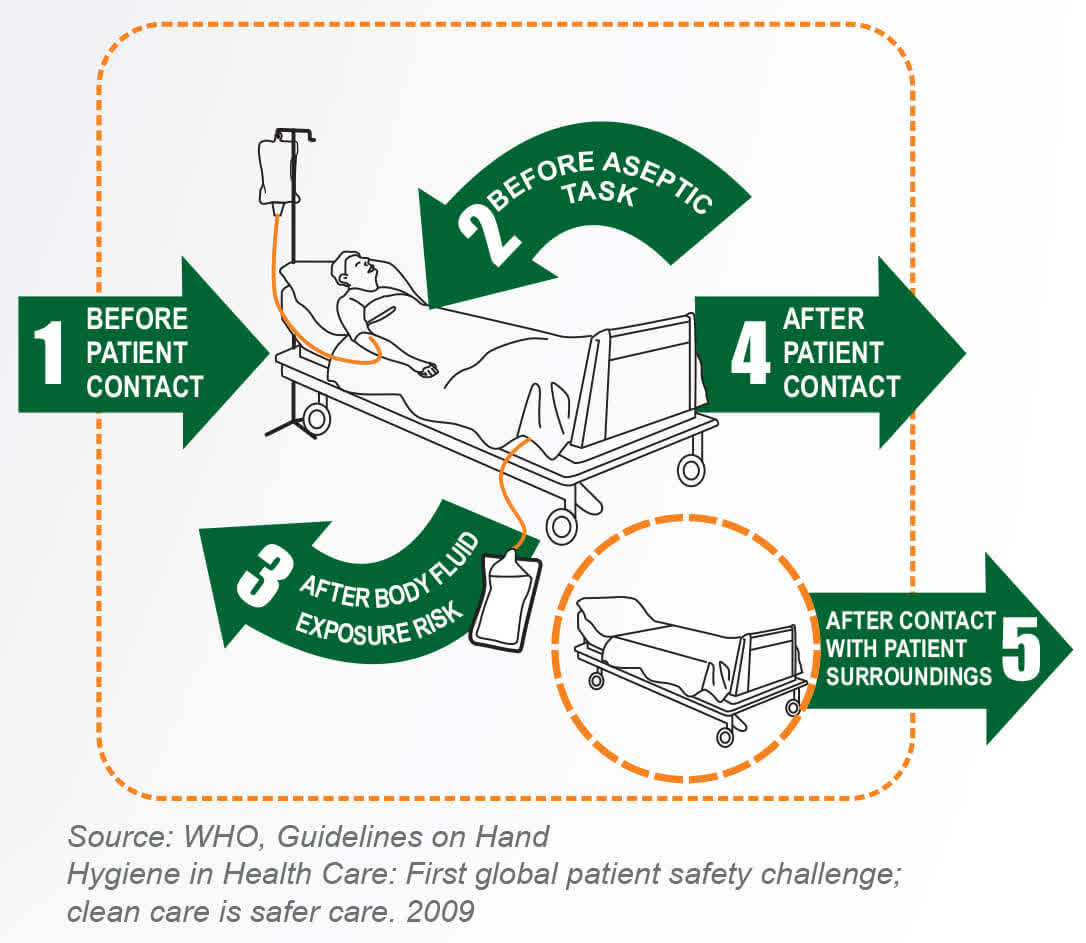
When hands need to be cleaned depends on the activity and associated risk of transferring microbes to or from a patient. Generally, hand hygiene is carried out after performing any activity that may contaminate the hands and transfer microbes to the patient. The WHO defines 5 moments for hand hygiene which should be practiced (see The WHO 5 moments for hand hygiene):12
- Before patient contact: clean hands before every direct contact with a patient.
- Before any task requiring asepsis: clean hands immediately before any task requiring an aseptic approach. Examples include the insertion of indwelling urinary catheters, central intravascular catheters, peripheral vascular catheters, or other invasive devices that do not require a surgical procedure.
- After body fluid exposure: clean hands immediately after any exposure to body fluids (i.e. excretions, mucous membranes, broken skin, and wound dressings), even if there was no noticeable contact, and after any glove removal.
- After patient contact: clean hands when leaving the patient if you have touched her/ him in any way, e.g. when taking a pulse or blood pressure or lifting a patient.
- After contact with patient surroundings: when leaving a patient, clean hands even if the patient has not been touched directly, e.g. after touching inanimate objects (including medical equipment, patient files etc.) in the immediate vicinity of the patient.
The WHO 5 moments for hand hygiene
Click on image to enlarge
Recommendations
- Hand washing is recommended when hands are visibly soiled; wash hands with soap and water and dry thoroughly.
- The use of alcohol-based handrub is for hands that are visibly clean but have been in contact with patients or potentially contaminated surfaces.
- Alcohol-based handrub is inactivated by organic matter and therefore will not remove organic material or dirt.
- Alcohol-based handrub is usually preferred by healthcare professionals because it is quick, easy to use and usually kinder to the hands.
The table below summarises the methods of hand hygiene, the aim thereof, what product is to be used and the main indications for using that hygiene method. For more details on hand hygiene methods and products please refer to the Cleanliness Guidelines for Health Workers.13
Summary of hand hygiene methods
|
Method
|
Aim
|
Products
|
Main indicators
|
|
Social hand hygiene
|
Remove transient microbes
|
Wash with plain liquid soap and water and dry thoroughly with a paper towel
|
- When visibly soiled
- After personal hygiene processes
- After handling disposable waste
|
|
Aseptic hand hygiene
|
Destroy or remove transient microbes
|
Wash with antiseptic liquid soap (chlorhexidine) or alcohol-based handrub |
- Before aseptic procedures or insertion of sterile devices
|
|
Surgical hand hygiene
|
Reduce resident microbes on skin for prolonged time
|
- Three-minute washing with antiseptic agents (2% or 4% chlorhexidine) - NO SCRUBBING/ NAIL BRUSH - Alcohol-based handrub can be used between patients |
- Starting operating sessions or between procedures when contact with patient’s bacteria occurred
- Use alcohol-based handrub between cases
|
Standard precautions
Standard precautions are designed to reduce the risk of transmission of microorganisms from both recognized and unrecognized sources of infection in healthcare settings.
Standard precautions are the basic level of infection control precautions which are to be used, as a minimum, in the care of all patients.14 They apply to ALL patients and in all situations, regardless of diagnosis or presumed infection status because all patients can serve as reservoirs for infectious agents.
Standard precautions apply to most contacts with the patient particularly if there is the risk of exposure to:
- blood;
- body fluids, secretions, and excretions except sweat, regardless of whether they contain visible blood;
- non-intact skin; or
- contact with mucous membranes.
Standard precautions for prevention of HAIs include:
- Hand hygiene by all HCWs and staff;
- Appropriate use of personal protective equipment (PPE);
- Use of transmission-based precautions including patient placement;
- Environmental cleaning to ensure a safe and clean environment;
- Cleaning and decontamination of medical devices;
- Healthcare waste management and correct disposal according to colour coding;
- Laundry;
- Cleaning of patient items between each patient use such as bedpans and urinals;
- Safe disposal of sharps;
- Injection safety;
- Occupational health; and
- Respiratory hygiene.
(See Annexure A for more details).
Environmental cleanliness
Definitions of patient ‘environment’ which requires environmental cleaning vary widely, however the definition within the healthcare context includes high-touch surfaces on the ward and treatment areas, floors, walls, bedside lockers, bed-curtains. It may also include some parts of medical devices that have patient contact such as blood pressure cuffs as well as items that have prolonged patient contact (mattress/pillow covers, curtains).
The routes of infection may be short (e.g. source to patient to staff hand to susceptible patient) or multi-step (e.g. source to patient to air to surface to staff hand to susceptible patient). A classic example is the communal use of bedpans and urinals that are not properly cleaned and disinfected.
Hand wash basins and sinks have recently been shown to be a major source of multi-drugresistant organisms (MDROs) because of their ability to produce biofilm and survive in the presence of disinfectants. By tipping contaminated fluids down the sink, the risk is increased not only because of encouraging growth but also splashing and contamination of the HCWs. Regular cleaning is essential.
The environment of the hospital must always be clean and dry, with intact surfaces to reduce harbouring of dirt and pathogens. There must be clear instruction and training for the teams who carry out environmental cleaning and a robust but simple means of evaluating cleanliness other than by visual assessment must be established.
Different staff groups may be responsible for cleaning different environmental items (e.g. floors, bed-curtains, blood pressure cuffs, monitoring equipment) and this must be clearly defined in a Standard Operating Procedure for the hospital.
The environmental surfaces must be cleaned at least daily, and more frequently in high risk areas. Routinely, cleaning with water and detergent is sufficient - no disinfectant is required as these promote AMR. However, for terminal cleaning, disinfection of the environment AFTER thorough clean is recommended. Again, the appropriate disinfectant must be used in the correct dilution and for the recommended contact time with the surface to be disinfected.
All reprocessed medical devices intended for use on patients must be thoroughly cleaned prior to either disinfection or sterilization - there are NO exceptions.
Disinfection and decontamination
The WHO Decontamination Guidelines (2016)14 clearly outlines and emphasises the need for optimal cleaning, disinfection and sterilization of reprocessed medical devices that are used for patient care. The WHO Decontamination Guidelines make use of Spaulding’s classification, which divides medical devices into categories based on the patient’s risk of infection due to contact with the various types of devices. This is summarised in the table below.
Spaulding’s classification for decontamination
|
Risk classification
|
Type of decontamination required
|
|
Critical high risk
|
Any reprocessed medical device (such as surgical devices) used to enter a sterile cavity (e.g. abdominal cavity, cranium, joint cavity) will require sterilization either by steam (if heat stable) or by chemical means (if heat sensitive).
|
|
Semi-critical medium risk
|
Medical devices that come into contact with non-intact skin and mucous membranes will require high level disinfection or, rarely, sterilization. Examples include endoscopes (gastroscopes, bronchoscopes) and respiratory devices.
It is recommended that one ventilator tubing be used per patient and not to be reused between patients, because the tube is long, coiled and can neither be cleaned nor disinfected properly.
|
|
Non-critical low risk
|
Devices that come into contact with intact skin, environmental surfaces or other areas which pose a low risk will require thorough cleaning and drying, with low level disinfection if indicated. Examples include blood pressure machine cuffs and thermometers.
|
For further guidance on the required infrastructure and standard procedures for effective sterilisation and decontamination reprocessing of medical devices, please refer to Decontamination and Reprocessing of Medical Devices for Healthcare Facilities (WHO).15
8 World Health Organization. 2018. Improving infection prevention and control at the health facility: interim practical manual supporting implementation of the WHO Guidelines on Core Components of Infection Prevention and Control Programmes.
9 World Health Organization. Core components of IPC. NCS regulations on Quality of care in Health Establishments. Geneva; 2016.
10 National Department of Health. Infection Control Assessment Tool: A Standardized Approach for Improving Hospital Infection Control Practices. Pretoria; 2012.
11 World Health Organization. WHO guidelines on hand hygiene in health care. Geneva; 2009.
12 World Health Organization. 5 moments for hand hygiene. http://www.who.int/gpsc/5may/background/5moments/en/
13 National Department of Health. Draft, Cleanliness Guideline for Health Workers. Pretoria; 2015.
14 World Health Organization. Decontamination and Reprocessing of Medical Devices for Health-care Facilities. Geneva; 2016. http://www.who.int/infection-prevention/publications/decontamination/en/
15 Guidelines on core components of infection prevention and control programmes at the national and acute health care facility level. Geneva: World Health Organization; 2016.