Key Components of an AMS Programme
Supporting the Antimicrobial Resistance Strategy Framework and the Guidelines on Implementation of the Antimicrobial Strategy in South Africa: One Health Approach and Governance, 2018
Antimicrobial stewardship (AMS) has been defined as a multi-disciplinary, systematic approach to optimising the appropriate use of one or more antimicrobials to improve patient outcomes and limit emergence of resistant pathogens whilst ensuring patient safety. The key aims of AMS are to improve patient outcomes and to reduce the unintended consequences of antimicrobial use, including toxicity and selection of resistant organisms.22,23
Key components of an AMS programme
All AMS programmes require four components as part of their basic structure: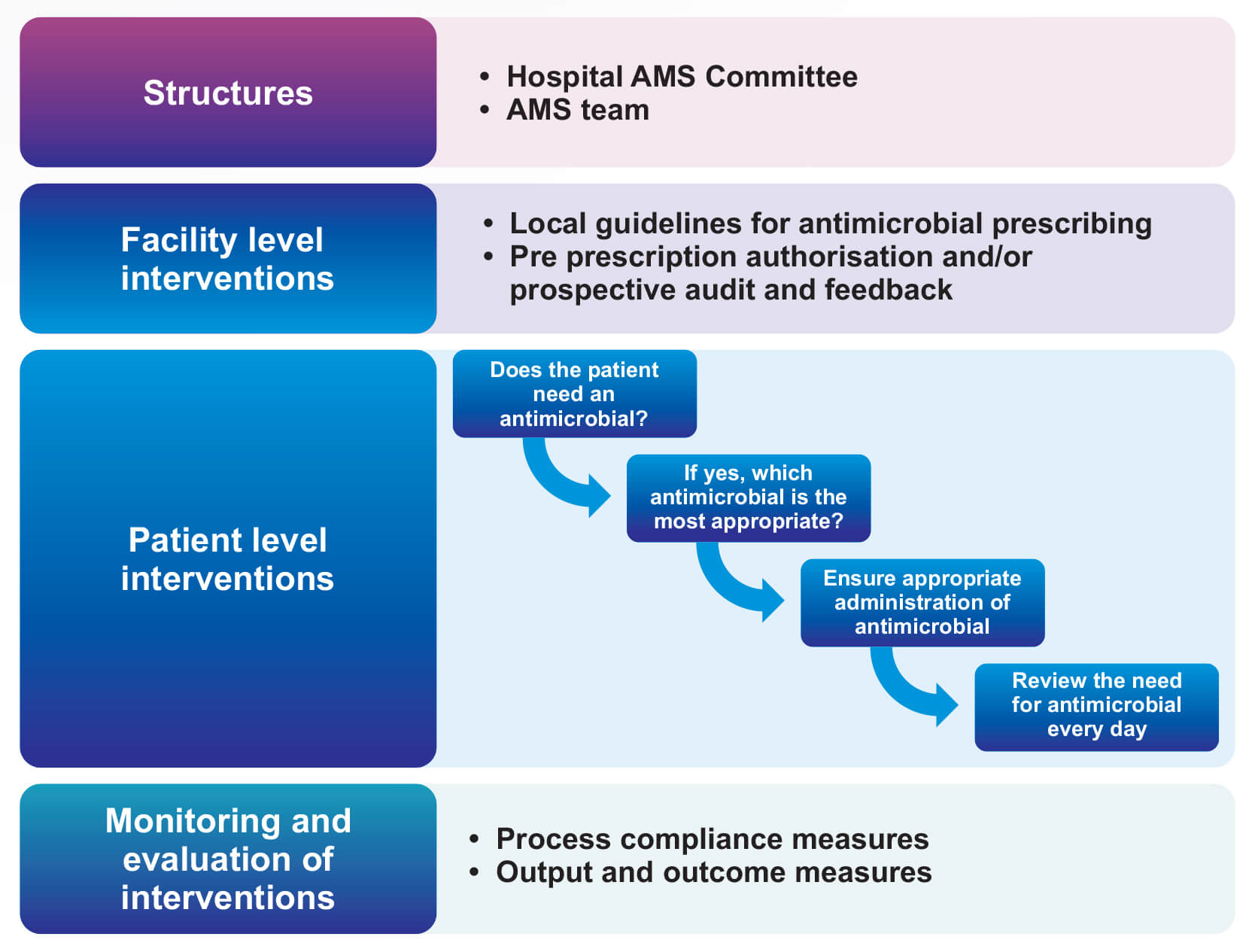 Click on image to enlarge
- Structures including a Hospital Antimicrobial Stewardship Committee (HAMSC) and an AMS team;
- Facility-level interventions which include the use of local guidelines for antimicrobial prescribing and pre-prescription authorisation and/or prospective audit and feedback systems;
- Patient-level interventions for implementation of AMS activities (4 steps flow);
- Monitoring and evaluation of AMS activities and progress.
22 Baur, David et al. Effect of antibiotic stewardship on the incidence of infection and colonisation with antibiotic-resistant bacteria and Clostridium difficile infection: a systematic review and meta-analysis. The Lancet Infectious Diseases. 2017; 17(9):990 – 1001.
23 Schuts, Emelie C et al. Current evidence on hospital antimicrobial stewardship objectives: a systematic review and meta analysis. The Lancet Infectious Diseases. 2016;16(7):847 – 856.