Laboratory Diagnosis
Laboratory Diagnosis Laboratory testing of uncomplicated illness (patients who fit the ILI case definition) is NOT routinely recommended, as it provides no advantage in the management of individual patients. Testing can be considered for the following patients: Patients who meet the criteria for complicated or severe influenza, where a laboratory diagnosis will assist in patient management.
Laboratory Diagnosis
Laboratory testing of uncomplicated illness (patients who fit the ILI case definition) is NOT routinely recommended, as it provides no advantage in the management of individual patients. Testing can be considered for the following patients:
- Patients who meet the criteria for complicated or severe influenza, where a laboratory diagnosis will assist in patient management.
- Clusters of cases where a diagnosis of the cause of the outbreak is needed (e.g. within institutions such as healthcare facilities, nursing homes). First 2-3 cases to be tested, thereafter testing not required.
Important note: Initial treatment decisions should be based on clinical presentation and should NOT be delayed pending laboratory confirmation of influenza.
These recommendations for laboratory testing do not apply to surveillance activities (e.g. Viral Watch, pneumonia surveillance programme), and testing should continue as guided by those individual surveillance programmes
1. Laboratory testing for influenza
2. Diagnosis of influenza and COVID-19 when SARS-CoV-2 and influenza viruses are co circulating
3. Specimen collection, storage and transportation
3.1 Additional considerations for sample collection
3.2 Procedure for sample collection
1. Laboratory testing for influenza
The NICD no longer offers routine diagnostic testing, including for influenza, outside of established surveillance programmes at specific sites. Diagnostic capacity to test for influenza viruses has now been established in various National Health Laboratory service (NHLS) and private-sector laboratories throughout the country. Under special circumstances (e.g outbreak investigation), NICD will provide support for testing. Requests for testing at NICD should be discussed with the doctor on call, through the NICD Hotline – 082 883 9920 before samples are collected.
In line with WHO recommendations, molecular diagnostics (real-time multiplex PCR for influenza A and B virus or Gene Xpert® for influenza A and B virus) are currently the method of choice for influenza virus detection. While specificity is high, the sensitivity of currently available rapid-point of-care or immunofluorescence tests designed for direct detection of influenza A viruses is low (59%- 93%) and therefore they are not recommended for diagnostic purposes. A negative Rapid Influenza Diagnostic Test (RIDT) result does NOT exclude influenza and should not preclude starting empiric antiviral treatment where sound clinical indications exist.
Where both influenza and COVID-19 coinfection is suspected in a hospitalised patient, multiplex assays for simultaneous detection of influenza viruses and SARS-COV-2 may be used when available. For patients presenting with mild symptoms, only testing for SARS-CoV-2 is required. Current testing guidelines for SARS-CoV-2 require that all patients suspected of COVID-19 be tested irrespective of clinical severity using either a rapid antigen test or PCR, follow links, Testing and COVID-19-Antigen Testing-Guidelines, and public health response be instituted as per COVID-19 management of cases and public health response guidelines, follow link guidelines-for-case-finding-diagnosis management-and-public-health-response.
2. Diagnosis of influenza and COVID-19 when SARS-CoV-2 and influenza viruses are co circulating
Because COVID-19 and influenza may present the same way, during the expected influenza season, it may be necessary to do an influenza test in addition to SARS-CoV-2 test if influenza test results would inform clinical management and public health response. In addition, among hospitalised patients, depending on clinical presentation testing for other viral and bacterial pathogens causing severe respiratory illness should be considered, in particular in patients with influenza in whom bacterial superinfection is a well-described complication.
3. Specimen collection, storage and transportation
Combined nasopharyngeal and oropharyngeal swabs in universal transport medium (UTM) are the preferred specimens for testing. However, during the SARS-CoV-2 pandemic when aerosolisation of respiratory samples is to be avoided and swabs are limited, a mid-turbinate nasal swab or oropharyngeal swab in place of a nasopharyngeal swab can be used. Flocked swabs should be used to collect specimens as they provide a better yield on PCR [31]. Dacron or rayon swabs may be used if flocked swabs are not available. Cotton wool budded swabs are not recommended. Once collected, these samples should be placed in viral or universal transport medium and transported on ice to the testing laboratory. The specimens must be refrigerated at 2-8°C if transport is expected to be delayed. If the specimen(s) cannot be shipped within 72 hours of collection, they should be kept frozen at -20°C. Avoid repeated freezing and thawing of specimens.
For specimens submitted to NICD, completed specimen request form (Appendix 1) with patient name, health facility (where appropriate), healthcare worker’s name and contact numbers, laboratory name, contact person, telephone, fax number and email address for receipt of results, and clinical details should accompany the sample. Click link submission form
3.1 Additional considerations for sample collection
- Specimens for virus isolation or for detection of viral nucleic acids or antigens should preferably be collected within three days of onset of symptoms, but may be taken up to a week after onset or even later in children, severely ill or immunocompromised patients.
- Specimens should preferably be taken prior to commencement of antiviral therapy but can still be taken a few days after initiation, especially in patients who are deteriorating on antiviral treatment. In these cases, antiviral resistant infection should be considered and testing for oseltamivir resistant virus may be considered.
- In addition to swabs from the upper respiratory tract, invasive procedures such as bronchoalveolar lavage/bronchial aspirate or lung biopsy can be performed for the diagnosis of influenza where clinically indicated. Expectorated and induced sputum can also be tested. However, it is important to note that aerosolising procedures should be avoided, where possible during the SARS-CoV-2 epidemic.
- Results of all diagnostic tests for influenza are dependent upon several factors (including specimen type and quality of specimen collection, timing of collection, storage and transport conditions), such that false-negative results may be obtained. When clinical suspicion is high, clinicians can consider repeat/serial testing. Lower respiratory tract specimens may yield the diagnosis when testing of upper respiratory tract specimens is negative. Multiple respiratory tract specimens collected on different days can be tested if influenza infection is strongly suspected.
3.2 Procedure for sample collection
A respiratory specimen (ideally, combined nasopharyngeal swab and oropharyngeal swab or aspirate but mid-turbinate nasal or oropharyngeal swabs are advisable during the SARS-CoV-2 epidemic) should be collected. In small children it may be easier and less traumatic to collect an aspirate rather than nasopharyngeal swab but both specimen types are acceptable and have similar diagnostic yield.[32]
Nasopharyngeal swabs (NPS) - Not advisable during SARS-CoV-2 epidemic
- Carefully label the vial of UTM with patient identification information and date of specimen collection
- Gently insert the flocked swab through one nostril beyond the anterior nares along the floor of the nasal cavity, until the pharyngeal wall is reached (swab to reach depth equal to distance from nostril to outer opening of ear)
- Do not use more than minimal force if any obstruction is encountered
- Rotate the swab three times against the nasopharyngeal wall and then withdraw the swab slowly
- Place the swab into UTM without touching it, snap off the tip at the marked break point
- Secure the cap
- Transport the labelled swab to the laboratory
Nasopharyngeal aspirates (NPA) - Not advisable during SARS-CoV-2 epidemic
- Fill 5ml syringe with saline; attach catheter tubing to syringe tip
- Slowly insert the catheter into one nostril until the pharyngeal wall is reached
- Quickly inject saline into nostril and then aspirate the recoverable nasopharyngeal specimen
- Withdraw the catheter under suction, being careful not to touch the tip
- Inject the aspirated fluid into labelled UTM and transport to the laboratory
Mid - turbinate nasal swab
• Open nasal swab: remove the nasal swab from the wrapper by pulling the two ends of the wrapper apart. Be careful to only touch the handle, not the tip (Figure 1).
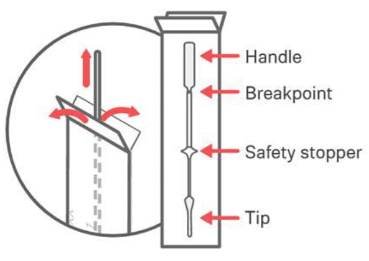
Figure 1: Nasal swab
• Loosen cap on tube: slightly loosen the cap from the tube so it’s easier to open later. Place it in a safe location where it won’t spill – there is liquid inside (you’ll be putting your swab into this tube when finished) (Figure 2).
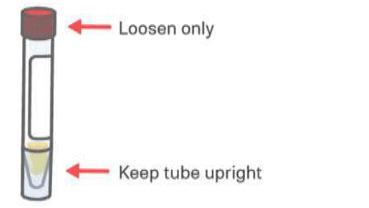
Figure 2: Specimen collection tube
• Swab nose: Tilt head back to look at ceiling, and gently insert the soft tip of the swab into one nostril until the safety stopper touches the edge of the nostril. Gently twist the handle in a circular motion for 15 seconds. Next, gently insert the same swab into the other nostril and repeat the same 15-second procedure (Figure 3).
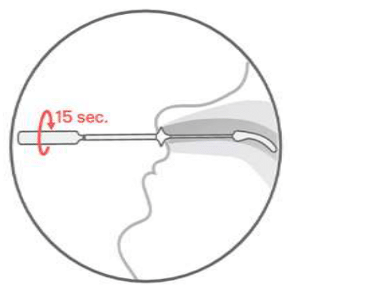
Figure 3: Sample collection
• Put swab in tube: Lower the swab, tip first, into the provided tube. Once the tip is at the bottom, break the swab handle at the swab breakpoint by bending back and forth. Screw the cap on tightly and hand it to the study staff (Figure 4).
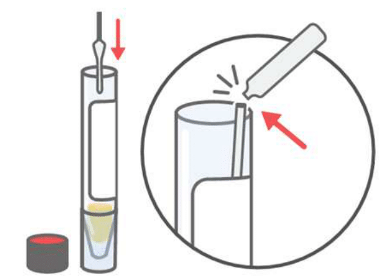
Figure 4: Putting swab in tube
• Transport of samples to NICD
For samples that are going to be tested at NICD (see section 1) specimens should be transported within 24 hours to the Centre for Respiratory Diseases and Meningitis (CRDM) Virology Laboratory, National Institute for Communicable Diseases (NICD), 1 Modderfontein Road, Sandringham, 2131. Please complete specimen submission form: click link submission form
Influenza: NICD recommendations for the diagnosis, management, prevention and public health response, National institute of communicable diseases, 2021