Leucocyte Depletion and Irradiation of Blood Components
SANBS Clinical Guideline, 6th Edition, 2023
Leucocyte depletion of blood products
Clinical indication for irradiated blood components
In certain circumstances, blood products may require further processing in the interests of patient safety. Residual leucocytes and lymphocytes in blood products are associated with complications, which may be mitigated by either leucocyte depletion and/or irradiation of blood products prior to transfusion.
Transfusion-related immunomodulation (TRIM) refers to the well-documented laboratory evidence of immune alterations following allogeneic blood transfusions, e.g. clonal deletion or anergy, induction of suppressor cells, production of anti-idiotype antibodies, suppression of natural killer (NK) cell activity.
There are also clinical effects that may be the result of TRIM, such as:
- Enhanced survival of renal allografts
- Increased risk of post-operative bacterial infections and recurrence of resected cancers
- Increased short-term mortality from all causes in transfused versus non-transfused patients
- Activation of pre-existing CMV or HIV infection in transfused versus non-transfused patients
TRIM is probably mediated by:
- Allogeneic mononuclear cells that remain viable for at least 2 weeks in stored RBC concentrates
- Pro-inflammatory soluble mediators released from white cells, which accumulate in the supernatant of red cell concentrates during storage
- Soluble class I HLA molecules in allogeneic plasma
Leucocyte depletion of blood products
Leucocytes appear to be the prime mediators of the pro-inflammatory and TRIM effects. Filters capable of removing them by several orders of magnitude are readily available and effectively reduce the number of white cells in a red cell concentrate product to <1 x 10⁶.
A less efficient, but also less costly, process for removing white cells from blood components is to remove the buffy coat layer from red cell concentrates and to prepare random donor platelet concentrates from the buffy coats. The resulting red cell and platelet concentrates contain leucocytes intermediate in number between filtered components and those where the buffy coat is retained.
A number of well-resourced countries (e.g. the United Kingdom), have adopted a policy of universal pre-storage leucocyte depletion using the filters described above, while others have recommended a policy of selective leucocyte depletion of blood components.
The costs associated with universal leucocyte depletion are significant, amounting to approximately 24% of the total annual turnover of the blood services. Given the competing health priorities in South Africa as a middle-income developing country, there needs to be convincing evidence that universal leucocyte depletion of blood products is clinically beneficial and cost-effective.
Having reviewed the literature, we conclude the following:
- There is good evidence to support the avoidance of FNHTRs by using leucocyte-depleted components
- Administering leucocyte-depleted platelet concentrates reduces the incidence of refractoriness to platelet transfusions
- Administering leucocyte-depleted components significantly reduces the risk of transfusion-ransmitted CMV infection in susceptible recipients (e.g. neonates)
- The evidence for reduction of the incidence of post-operative bacterial infection and recurrent cancer following resection is not consistent
- Evidence to support an increase in short-term mortality using non-leucocyte-reduced components is inconsistent; however, subgroup analyses do suggest a benefit for cardiac surgery and critically ill patients
- An association with reactivation of viral infections (HIV and CMV) and survival has not been demonstrated
- Sensitisation to transplant antigens can be lessened by administering leucocyte-depleted products where HLA-alloimmunisation is important
- Using leucocyte-depleted products may reduce potential prions in blood components, but there is as yet no evidence that this will avoid transmission of variant Creutzfeld Jakob disease (vCJD) by transfusion
The blood services in South Africa have therefore adopted the following policy with respect to leucocyte depletion of blood components:
- All standard red cell concentrates are buffy coat depleted
- Random donor platelet concentrates are prepared from buffy coats
- Single donor platelet concentrates collected by apheresis must incorporate a leucocyte-depletion process (standard practice with current apheresis technology)
- The following patients should receive leucocyte-depleted components:
- Patients on chronic transfusion regimens
- Those at risk for CMV infection
- Infants <1 year old
- Critically ill, cardiac surgery and trauma patients (particularly those requiring massive transfusion)
- Pre-storage (<48 hours after donation) leucocyte depletion in blood-processing laboratories is recommended.
If this is unobtainable, the freshest components available may be filtered in the blood bank for immediate use (24-hour expiry). Bedside leucocyte-depletion filters are not recommended unless neither of the former 2 options is available.
It is emphasised that the above are guidelines in a subject where there is some controversy.
If individual clinicians wish to use leucocyte-depleted products outside the guidelines, they should order them and the blood banks will issue if they have stock. By continually monitoring the usage and gearing up accordingly, the services should be in a position to meet such demands.
Irradiation of blood products
TA-GvHD is an extremely rare but often fatal complication which may follow the transfusion of lymphocyte-containing blood components. Under certain conditions (e.g. immunosuppression or when donor and patient share HLA haplotype) the infused lymphocytes engraft and proliferate in the recipient. Cellular interaction between donor T lymphocytes and recipient cells leads to cellular damage (particularly in the skin, thymus, gastro-intestinal tract, liver and spleen) very similar to GvHD seen after allogeneic stem-cell transplantation.
An additional specific feature of TA-GvHD is severe bone marrow hypoplasia.
Where patients require irradiated cellular blood components, components must be requested and clearly prescribed as irradiated. Specific requirements, including the need for irradiated blood components, must be part of the bedside check prior to administration of all blood components. Checks must be documented.
X-ray or gamma irradiation by validated systems are currently the only recommended method for prevention of TAGvHD. There is insufficient evidence to recommend only leucocyte-depleted components use to prevent TA-GVHD in susceptible patients.
TA-GvHD has been reported following transfusion of whole blood, red cell concentrates, platelets and granulocytes. It has not been reported following transfusion of cryoprecipitate, FFP or fractionated products.
The minimum dose achieved in the irradiation volume is 25 Gy, with no part receiving >50 Gy.
Red cell concentrates can be irradiated up to 14 days after collection and stored for a further 14 days without significant loss of viability, but irradiating red cells leads to an accelerated leakage of potassium and an increase in extracellular levels of potassium.
Hyperkalaemia may be a potential complication in rapid, large-volume transfusions, e.g. intrauterine transfusion or neonatal exchange transfusion. In these at-risk transfusion settings, it is recommended that irradiated red cells are transfused within 24 hours of irradiation. If the unit is <5 days old, this complication is unlikely.
If fresh blood is not available, washing of the red cells will prevent hyperkalaemia in the recipient. If washed red cells are irradiated, they should be transfused as soon as possible.
Platelets can be irradiated at any stage during storage and can thereafter be stored up to their normal shelf life after collection.
All granulocytes for transfusion should be irradiated before issue. They should be transfused with minimum delay. For allogeneic sources, it is not necessary to irradiate FFP, cryoprecipitate or fractionated plasma.
All transfusions of cellular components and fresh plasma from first- or second-degree relatives should be irradiated, even if the patient is immunocompetent. All HLA-selected components should be irradiated even if the patient is immunocompetent.
Clinical indication for irradiated blood components
Table 1
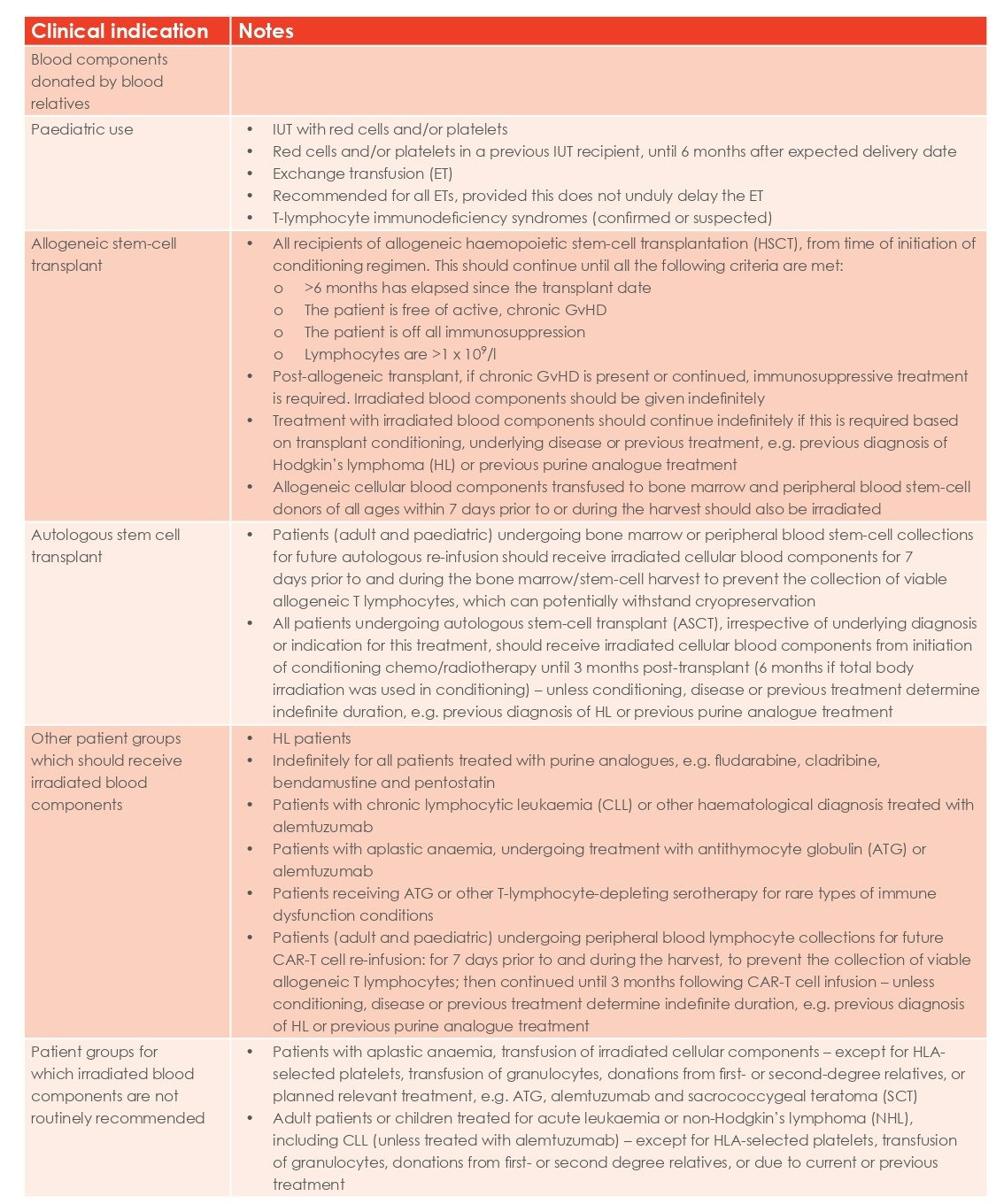
Click on table to enlarge
Further reading
- Blajchman MA, Vamvakas EC. Transfusion related immunomodulation. In Murphy MF, Pamphilon DH, eds. Practical Transfusion Medicine. 3rd ed. Wiley-Blackwell; 2009
- Bird A, Crookes R. Leucocyte depletion of blood components -- guidelines of the Blood Transfusion Services of South Africa. S Afr Med J. 2006;96(5):395-396
- Blumberg N. Deleterious clinical effects of transfusion immunomodulation: proven beyond a reasonable doubt. Transfusion. 2005;45(2 Suppl):33S-39S; discussion 39S-40S. doi:10.1111/j.1537-2995.2005.00529.x
- Vamvakas EC. Deleterious clinical effects of transfusion immunomodulation: proven beyond a reasonable doubt. Transfusion. 2006;46(3):492-494. doi:10.1111/j.1537-2995.2006.00748.x
- Foukaneli T, Kerr P, Bolton-Maggs PHB, et al. Guidelines on the use of irradiated blood components. Br J Haematol. 2020;191(5):704-724. doi:10.1111/bjh.17015
- X-ray irradiation of blood components. Joint United Kingdom Blood Transfusion and Tissue Transplantation Services Professional Advisory Committee. 2020. Accessed March 7, 2023. https://www.transfusionguidelines.org/document-library/documents/x-rayirradiation-of-blood-components
Clinical Guidelines for the Use of Blood and Blood Products in South Africa, 6th Edition, 2023