Lower Gastrointestinal Bleeding
Surgical Emergencies - Lower Gastrointestinal Bleeding
Cape Metro lower GI bleeding algorithm
Further considerations about management
Major bleeds are uncommon. Usually the bleeding is mild to moderate and self-limiting. Resuscitation and aggressive management is mandatory in cases only if the bleeding is severe (more than 500ml). Additional important investigations in these patients include a rectal examination (to exclude anal origin of bleeding), proctoscopy and sigmoidoscopy in the emergency department to rule out perianal causes of haemorrhage. These can usually be done without any bowel preparation in this setting. Most of these patients will need Barium enema or colonoscopy electively.
Cape Metro Lower GI bleeding algorithm
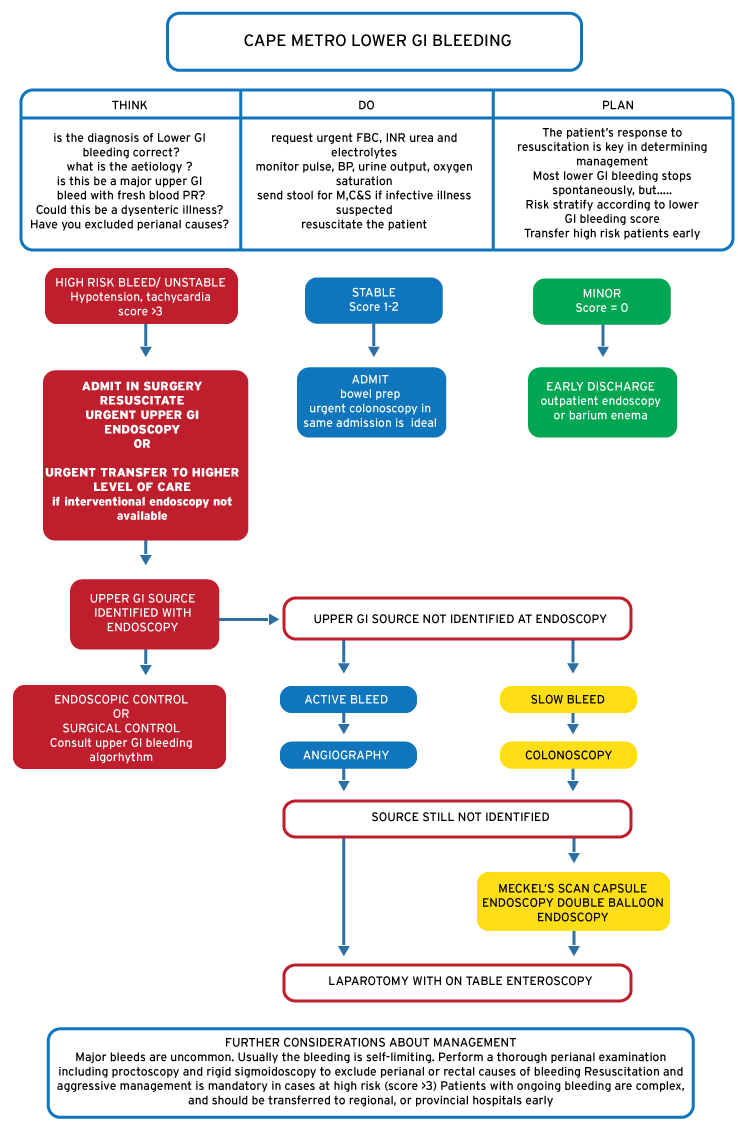
Further considerations about management
- Major bleeds are uncommon. Usually the bleeding is self-limiting.
- Perform a thorough perianal examination including proctoscopy and rigid sigmoidoscopy to exclude perianal or rectal causes of bleeding
- Resuscitation and aggressive management is mandatory in cases at high risk (score >3)
- Patients with ongoing bleeding are complex, and should be transferred to regional, or provincial hospitals early