GuidelinesOther guideline
Major Incident Management: Command and Control
CSCATT = "ABC's" of a Major Incident
Deal with any scene in the following sequence
Responsibilities of medical personnel on scene
Deal with any scene in the following sequence:
- Command & control
- Safety
- Communication
- Assessment
- Triage
- Treatment
- Transport
Command and Control
- Command and control are the cornerstones of Major Incident Management.
- SCENE CONTROL is usually a POLICE responsibility.
- INCIDENT MEDICAL COMMANDER takes overall MEDICAL CONTROL at the scene
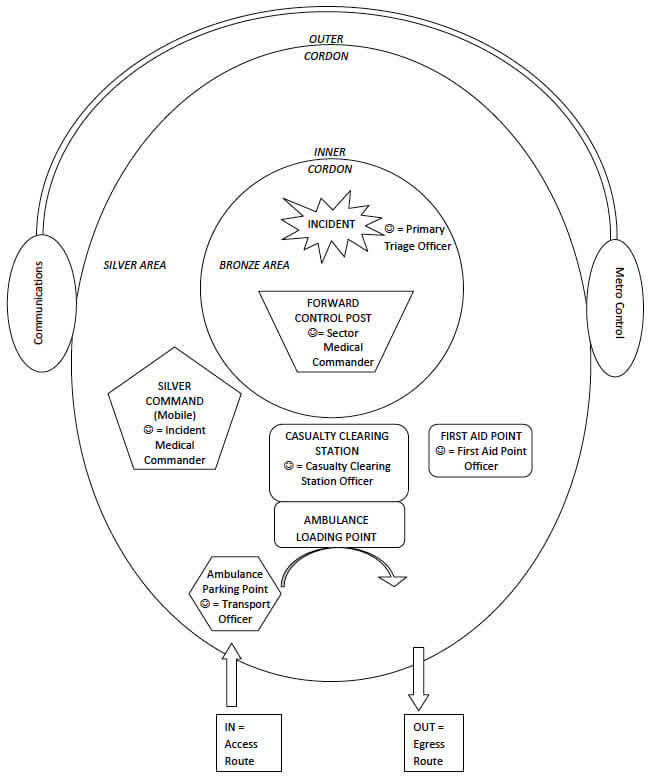
Tiers of Command:
- Operational area = “HOT Zone”
- Immediate hazard and casualty rescue area
- Boundary is the Inner Cordon
- Each Service designates a Bronze Commander (EMS = Forward Medical Commander)
- In large incidents there may be multiple forward commanders appointed – these are then designated SECTOR medical commanders
- Each service’s Bronze (Forward ) Commander reports to their Service’s Incident Commanders
- Forward Commanders from different services must also communicate with each other
- BRONZE CONTROL may be a FIRE responsibility if there is a specific hazard (eg. Fire or hazardous materials)
- Not always physical barrier
- Controlled by police
- Access may be strictly limited if hazard on scene
- Tactical Command = Entire scene area
- Boundary is the Outer Cordon
- Each Service designates a Silver Commander (EMS = Incident Medical Commander)
- Incident commanders form “Silver Control”
- Incident Commanders may move physically into Bronze Areas
- The first Vehicle on scene from each service becomes the Initial Incident Command unit
- Controlled by police
- Physical cordon
- Restricts general access
- Highest level of command
- (Strategic) Often remote from the scene
- Chief Officers of Emergency Services (& local Authorities & other representatives)
- The site where patients are taken to from the incident for emergency treatment
- Must be SAFE from the “hot zone”; SHELTERED, FLAT ground, UPSLOPE and UPWIND.
Responsibilities of medical personnel on scene
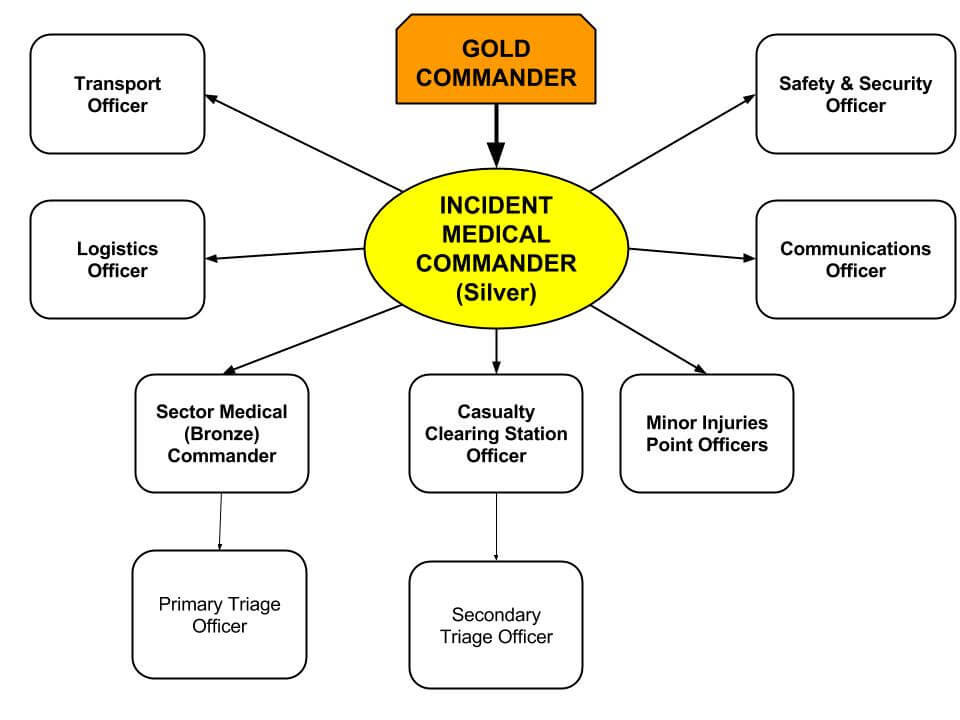
- Overall Scene Medical Command
- Liaise with other agency Commanders
- Activate Incident Command System
- Appoint relevant Tasks
- Liaise with Media
- Overall Sector Medical command (bronze area)
- Coordinate Medical Rescue Operations
- Appoint Primary Triage Officer
- Liaise with Incident Medical Commander
CASUALTY CLEARING STATION OFFICER
- Accept patients
- Coordinate secondary triage and advanced life support treatments
- Liaise with transport officer for movement of patients
- Liaise with Incident Medical Commander
- Primary triage of patients in Bronze Area
- Feedback to Sector Commander
- Organise and direct Transport
- Establish Holding Area, access and egress routes
- Load patients
- Assess situation for safety of staff, patients and bystanders.