Malnutrition in Children in Emergency Centres
Guideline on Malnutrition in Children in Emergency Centres
Lead Authors: Hiliary Goeiman, Luzette van Niekerk, Dr Elmarie Malek, Dr Baljit Cheema
Acknowledgements: Prof Tony Westwood, Prof Michael Hendricks, Dr Kauchali
Summary algorithm
Definition
History and clinical presentation
Examination
Hypoglycaemia
Hypothermia
Dehydration
Infections
Electrolyte imbalance
Appetite Test Log Sheet
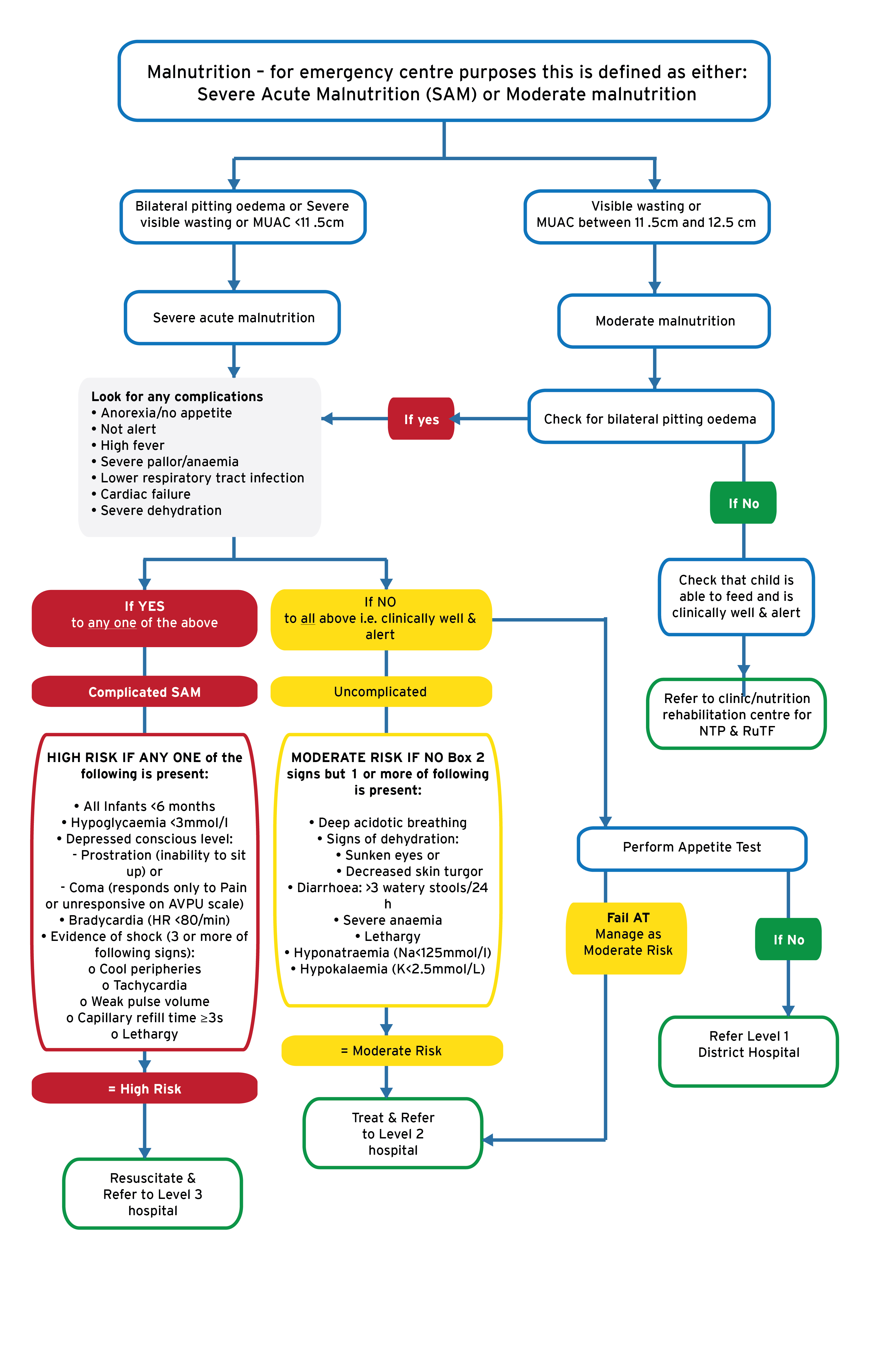
Appendix A: Flowchart for Classification & Referral System for Malnutrition in Children in EC
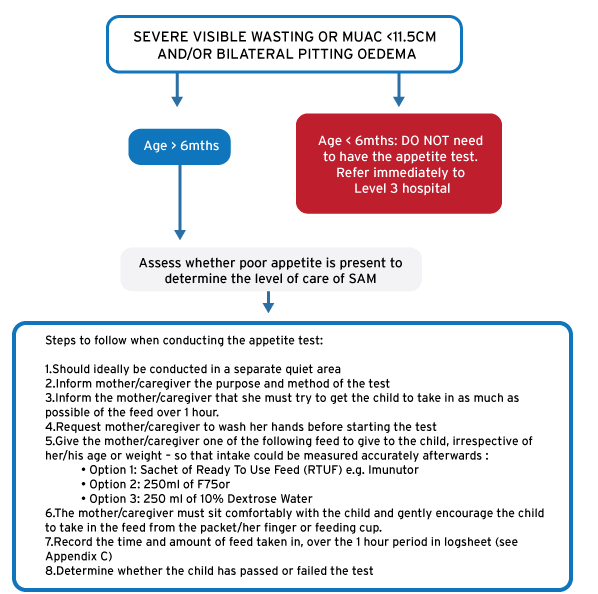
Appendix B: SOP: Appetite Test for SAM in EC
Summary algorithm
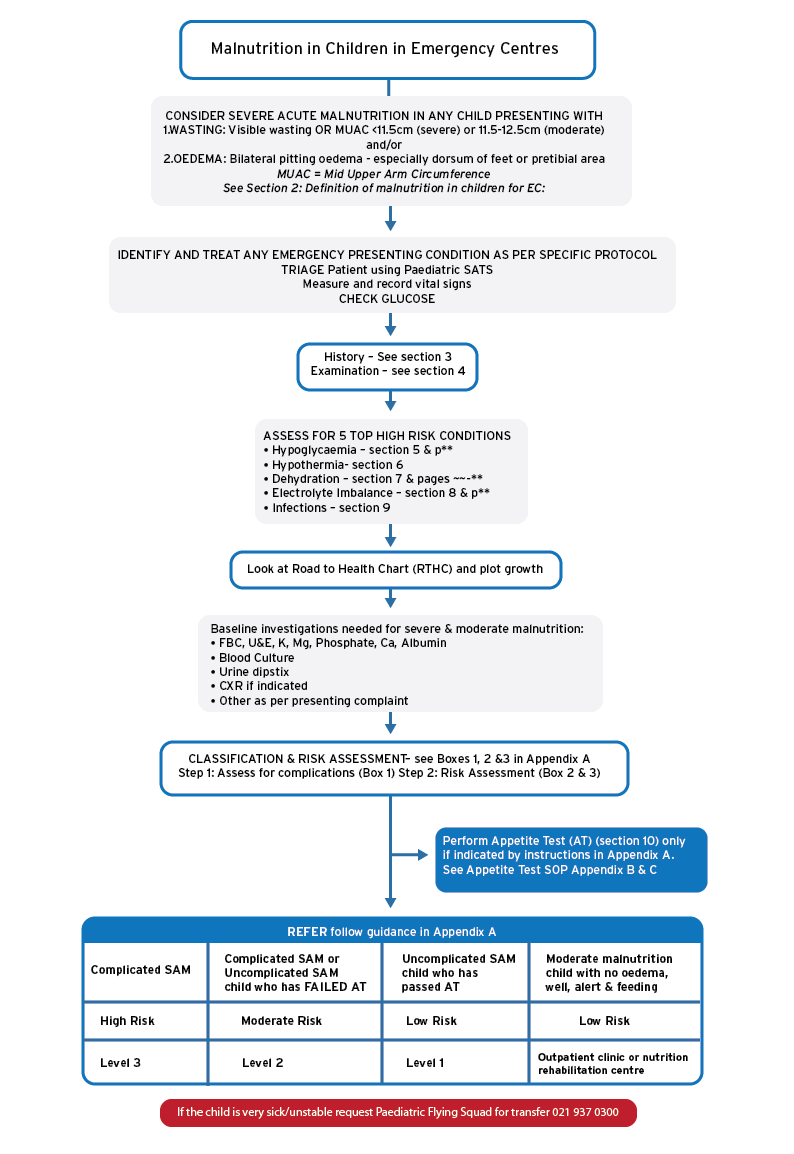
Click on image to enlarge
If the child is very sick/ unstable, request SPRINT for transfer 021 937 0300
Definitions of malnutrition in children for the purposes of EC management
Severe Acute Malnutrition (SAM) is defined by the presence of:
- Severe visible wasting (often best seen over the chest wall, axillary fold or buttock area)
OR - Mid-Upper Arm Circumference (MUAC) <11.5cm
AND/OR - Bilateral pitting oedema
Moderate malnutrition is defined by the presence of:
- visible wasting
OR - MUAC 11.5-12.5cm with no oedema
History and clinical presentation
Ask about
- Events leading up to presentation
- Ask about: fever, cough, vomiting, diarrhoea & ability to feed
- Medications - Recent medications given. Any allergies.
- Past Medical History: RVD Status. Birth History, Growth, Immunisations, Hospitals admissions, Social circumstances.
- Check RTHC for clinic & discharge notes
Additional Signs of SAM:
- Hair changes e.g. sparse, brittle or reddish hair
- Skin changes e.g. patchy discolouration; sores/peeling/sloughing of skin (especially in nappy area)
- General signs: apathy, irritability, loss of appetite, distended abdomen, puffy face or eyes
Examination
- Assess ABCDE's & Head to Toe Examination
- Check GLUCOSE and assess nutrition status
- Check temperature. Weigh Child.
- Assess hydration status.
- Signs of Sepsis - Systemic search for any source of infection.
PROTOCOLS FOR 5 TOP HIGH RISK CONDITIONS *Recommended feeds: Breast Milk or F75 milk |
HYPOGLYCAEMIA: check glucose immediately
- HYPOGLYCEMIA defined as blood glucose < 3 mmol/l (see Hypoglycaemia)
WARNING SIGNS
- Hypothermia noted on routine check
- Child feels cold
- Child drowsy or lethargic
Alert and able to drink:
- Give Oral or NGT feed.
- If no feed available give sugary drink.
- Then feed* 2 hrly - start straight away
- Recheck Glucose after 20 min then 3 hrly
Depressed LOC; Unable to drink or Convulsing:
- Insert an IV LINE: IV Glucose 5 ml/kg 10 % dextrose bolus
- THEN start maintenance with 1/2 DD IV
- RECHECK glucose in 20mins then 3hrly
If Depressed LOC; Unable to drink or Convulsing and unable to get an IV Line:
- Insert an Intraosseous Line. Call for senior help.
- Whilst the attempts for IV/IO access continue do either of the following:
- Put 1 ml 50 % dextrose into the buccal space (between gum and cheek)
- Insert a NGT and give 5 ml/kg 10 % Dextrose via NGT
- Recheck Glucose after 20 min then 3 hrly
PREVENTION
- Feed* immediately then every 2 hrs for 48 hrs.
- Encourage mothers to stay with ill children to watch for deterioration, help feed & keep warm.
HYPOTHERMIA: check temperature hypothermia = Rectal < 35.5 C or Axillary < 35.0 C
WARNING SIGNS
- Cold extremities. inactive; poor appetite; poor feeding.
- Hypothermia in malnourished children often indicates coexisting hypoglycaemia & serious infection.
Temperature < 36 C:
- Feed* straight away then 2 hrly
- Re-warm: On mother's bare chest (skin to skin)
- Cover, OR clothe including head, cover with warmed blanket, place heater/ lamp nearby.
- Take temperature every two hrs: stop when > 36.5 C
- Monitor every 30 minutes if heater used as the child may become overheated
PREVENTION
- Keep room warm. Place skin to skin on mother and clothe and cover with a blanket. Keep bedding/clothes dry. Avoid exposure during examinations and cleaning. Monitor temp 4 hourly
DEHYDRATION: assess for dehydration
WARNING SIGNS
- Profuse watery diarrhoea
- Sunken eyes; Slow skin pinch; Sunken fontanelle
- Absent tears; Dry mouth; Very thirsty; Reduced urine
- Rapid Pulse and Respiration
- NO IV FLUIDS EXCEPT IN SHOCK
If Dehydrated - Give ORS 10 ml/kg/hour first 2 hrs PO/NGT
- Continue 10ml/kg/ hr (Alternate ORS and feeds*)
- Offer breastmilk/feeds* within 4 hrs
- Monitor hrly during rehydration for signs of over-hydration:
STOP rehydration if signs of over-hydration: Increasing pulse or RR; Increasing oedema and puffy eyelids
STOP rehydration if pulse increases by 25 and RR by 5
PREVENTION
- When a child has watery diarrhoea : Feed* straightaway
- Give ORS after each watery stool 50-100ml < 2 years 100-200ml older children.
- Continue feeding, including breastfeeding.
INFECTIONS: If shocked, follow shock guidance
WARNING SIGNS
- Profuse watery diarrhoea
- Sunken eyes; Slow skin pinch; Sunken fontanelle
- Absent tears; Dry mouth; Very thirsty; Reduced urine
- Rapid Pulse and Respiration
GIVE first dose of Antibiotics Immediately
Unwell or COMPLICATIONS:
- Ampicillin 50 mg/kg/dose IV + gentamicin 7.5mg/kg IV (no IV fluids) + Metronidazole 7.5 mg/kg PO
- (Specific infections identified treat accordingly)
Well or NO complications:
- Augmentin 15 mg/kg (no diarrhoea) or cefuroxime 10-15 mg/kg
- (If above Ab not available - Give Amoxil 15 mg/kg)
- Treat TB when suspected.
- Stat Bactrim if HIV-infected and suspected PJP: (<5kg: 25; 5-13.9 kg: 5ml; 14-29.9kg: 10ml or 1 tab; >30kg: 2 tab). Avoid STEROIDS
PREVENTION
- Good nursing care
- Reduce overcrowding
- Wash hands before and after dealing with child or
- Preparing feeds*
- Measles vaccine: unimmunized > 6 months
- Protect from those admitted with severe infection
Electrolyte Imbalance
WARNING SIGNS
- Irritability. Weak/Floppy. Seizures. Oedema develops/worsens
HYPOKALAEMIA: Give KCl
- < 5 kg 250 mg 8 hourly PO
- 5-10 kg 500 mg 8 hourly PO
- > 10kg 1 g 8 hourly PO
- See Hypokalaemia Guidance for more details.
PREVENTION
- Do not give normal saline IV (unless following shock protocol).
- Do not add salt to food
Appetite Test
See: Standard Operating Procedure for Appetite Test and Log sheet Below
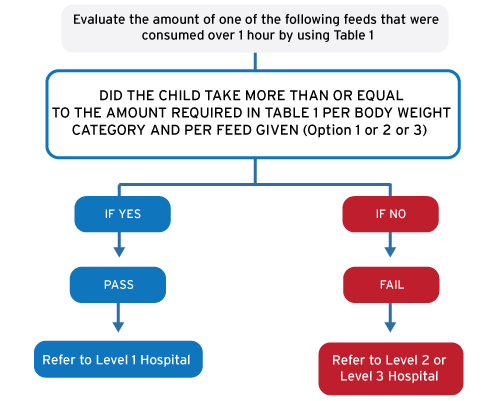
The Appetite Test is by far the most important criterion to decide which level of care a child should be admitted to. A poor appetite means that the child has a significant infection or a major metabolic abnormality such as liver dysfunction, electrolyte imbalance, cell membrane damage or damaged biochemical pathways. These are the patients at immediate risk of death and must be admitted to higher level of hospital care (i.e. NOT to Level 1 but to Level 2 or Level 3 as appropriate for degree of illness of the child – see Classification and Referral Criteria for SAM below).
Flowchart for classification and referral system for malnutrition in children in EC
 Click on image to enlarge
Standard Operating Procedure for Appetite Test
Click on image to enlarge
Table: Minimum amount of feed to be consumed to pass appetite test
Body weight (kg) category | Option 1: RuTF e.g. Imunut Sachet (92g) | Option 2: F75 (250ml | Option 3: 10% Dextrose (250ml) | |
| <4 | 1/8 to ¼ | 12 g | 45 ml | 50 ml |
| 4 - 6.9 | ¼ to 1/3 | 23 g | 70 ml | 80 ml |
| 7 – 9.9 | 1/3 to ½ | 30 g | 100 ml | 150 ml |
| 10-14 | ½ to ¾ | 45 g | 150 ml | 175 ml |
| 15 – 29 | ¾ to 1 | 70 g | 200 ml | 200 ml |
| >30 | >1 | 92 g | 250 ml | 250 ml |
Click on image to enlarge
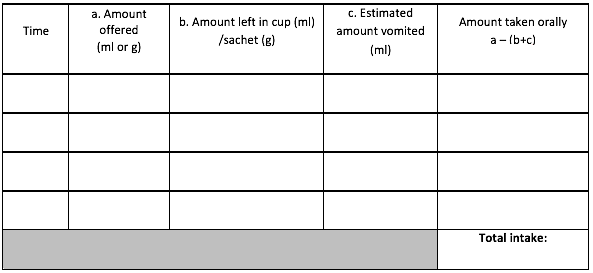
Appetite Test Log Sheet
Complete one chart per child after 1 hour
Name:____________________ Folder number: __________________ Admission weight (kg)_________
Click on image to enlarge
Reference:
- SA National & WC Provincial Dept. of Health SAM Guidelines. WHO IMCI.
Methodology:
Where possible, appropriate evidence has been sought and appraised using standard appraisal methods. High quality evidence is not always available to inform recommendations. Best Practice guidance relied on the consensus of senior physicians and invited experts.
These guidelines were created in May 2015