Management of Adult Cases of Alleged Sexual Assault: Rapid Approach
Management of adult cases of alleged sexual assault (PART A)
Medical management and treatment (if presenting within 72 hours of the alleged incident):
Remember that there are two aspects in the management, namely:
- Health care needs of the patient
- Medico-legal aspects (collecting evidence and completing documentation).
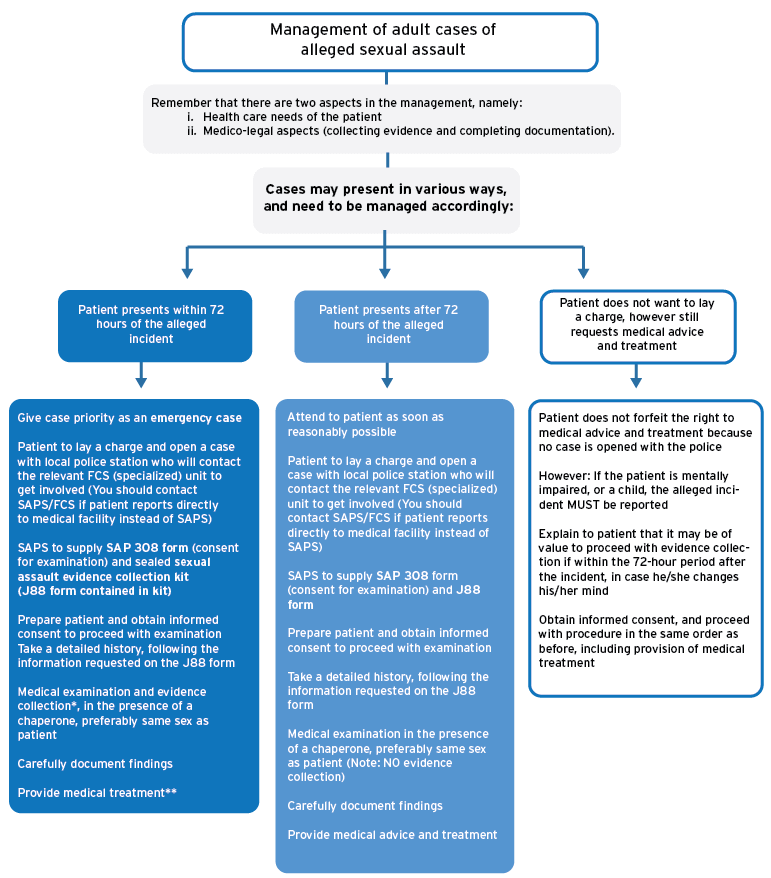
*Evidence collection:
Please refer to Part B for more information, as well as the user guides found in the sexual assault evidence collection kits (SAECK) for step by step instructions to collect evidence.[Kits currently in circulation: D1 (biological evidence from sexual assault survivor), D2 (semen, saliva, blood, debris), D3 (reference hair samples), D5 (clothing), D7 (biological evidence from paediatric survivor), DB (reference DNA buccal sample)]
Seal kit after the evidence has been collected and hand the sealed kit to FCS detective, or keep under lock and seal until it can be handed to the detective.
Maintain the chain of custody.
**Medical management and treatment (if presenting within 72 hours of the alleged incident):
- Pre- and post HIV test counselling
- Rapid HIV test
- Rapid RPR test
- Urine pregnancy test
- Further STI testing if indicated
- Screening for Hepatitis B if the immunisation status of the individual is unknown
- STI prophylaxis
- Non-pregnant: Ceftriaxone 250mg IMI stat, Metronidazole 2g stat, Azithromycin 1g stat
- Pregnant: Ceftriaxone 250mg IMI stat, Metronidazole 2g stat, Azithromycin 1g stat
- Anti-retroviral prophylaxis (Provide if presenting <72 hours)
- HIV negative Standard: 1st choice: Tenofovir 300mg + Emtricitabine 200mg, 1 tablet once daily x 28 days
- Tenofovir is contra-indicated in renal disease or with concomitant use of nephrotoxic medicines e.g. aminoglycosides (check baseline creatinine clearance first if this is to be prescribed). Where tenofovir is contraindicated, switch to the 2nd choice. If zidovudine is not tolerated, consult or refer to a specialist HIV clinic for further management.
OR
2nd choice: Zidovudine 300mg + Lamivudine 150mg, 1 tablet 12 hourly for 28 days
AND
Add protease inhibitor: Lopinavir/ritonavir (Aluvia), 2 tablets 12 hourly for 28 days
Note: Lopinavir/ritonavir often causes diarrhoea.
If lopinavir/ritonavir is not tolerated, switch to atazanavir/ritonavir.
HIV positive (confirmed)
- Refer for further counselling and HIV care at an appropriate health care facility.
- Emergency contraception
- Emergency contraceptive pills (<5days/120 hours)1st choice: Escapelle (1.5mg levonorgestrel) 1 tablet stat po(If not available - Ovral 2 tablets stat and 2 tablets 12 hours later OR Norlevo 2 tablets stat) Add anti-emetics; repeat dose if vomiting occurs within 2 hours
- Copper-bearing intrauterine contraceptive devices (<5 days)
- Anti-nausea medication, e.g. metoclopramide 10mg tds as needed
- Offer simple analgesics if necessary and no contra-indications, such as Paracetamol 500mg qid po or Ibuprofen 200mg tds po (with or after a meal).
- Treat physical injuries.
- Anti-tetanus toxoid 0.5mL IM if open wounds and last vaccination >10 years ago or vaccination status unknown
- Refer for counselling. Arrange follow-up visits (one week, 6 weeks and 3 months)
- Document whether the survivor experience any post-traumatic stress syndrome symptoms at each visit, and give advice regarding medication and blood results.
- Ensure that arrangements for counselling are in place.
- A repeat examination is only required if there was significant injury and documentation regarding healing is required.
- Follow-up blood results on Hepatitis B serology (if this was indicated) and manage accordingly.
- Repeat HIV and RPR test at 6 weeks and 3 months.
- Enquire about menstruation and repeat pregnancy test if indicated at 6 weeks and 3 months.
- Treat sexually transmitted infections if indicated.If the survivor became pregnant as a result of the rape, and wishes to terminate the pregnancy, she should be referred to an appropriate facility for a safe termination of pregnancy, as soon as possible