Management of Adverse Reactions to N-acetylcysteine (NAC)
Division of Clinical Pharmacology, Department of Medicine, Faculty of Medicine and Health Sciences
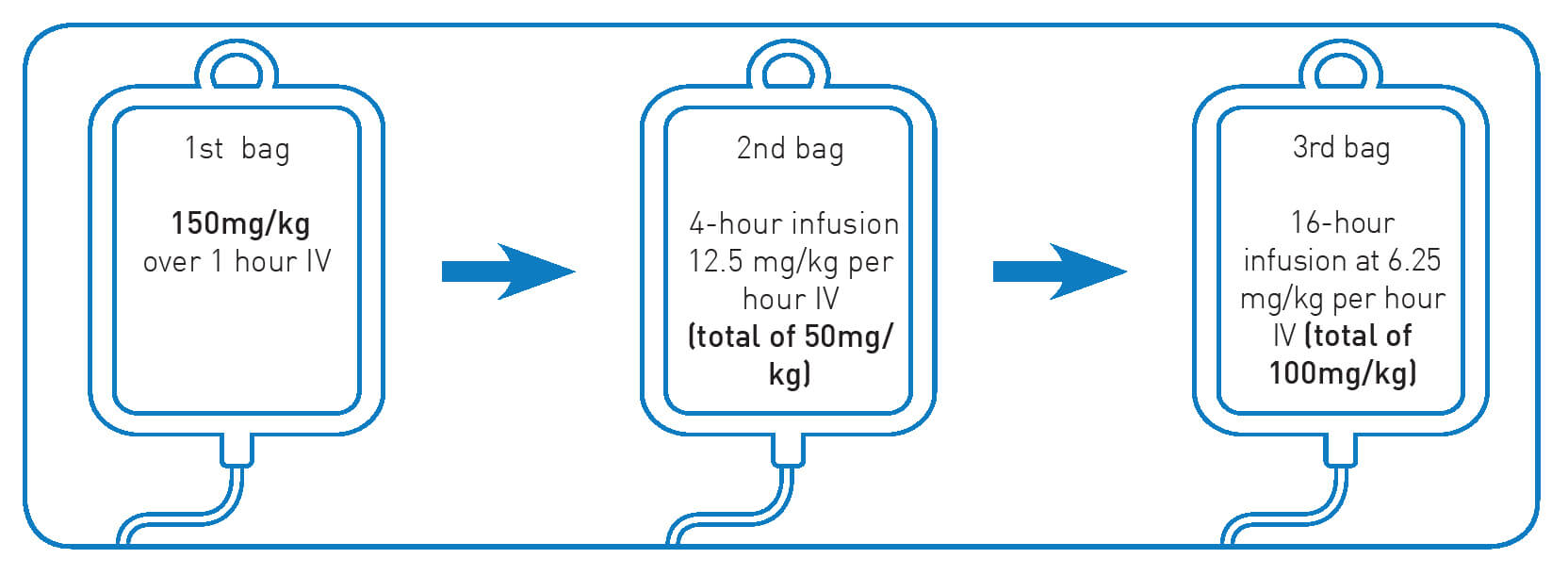
Paracetamol overdose is common and can lead to severe hepatotoxicity if inadequately treated. N-acetylcysteine (NAC) is the antidote of choice in paracetamol toxicity due to demonstrated efficacy and good tolerability.[1] The 3-bag NAC regimen is most commonly used (Figure 1).
Click on image to enlarge
Figure 1: 3-bag NAC regimen
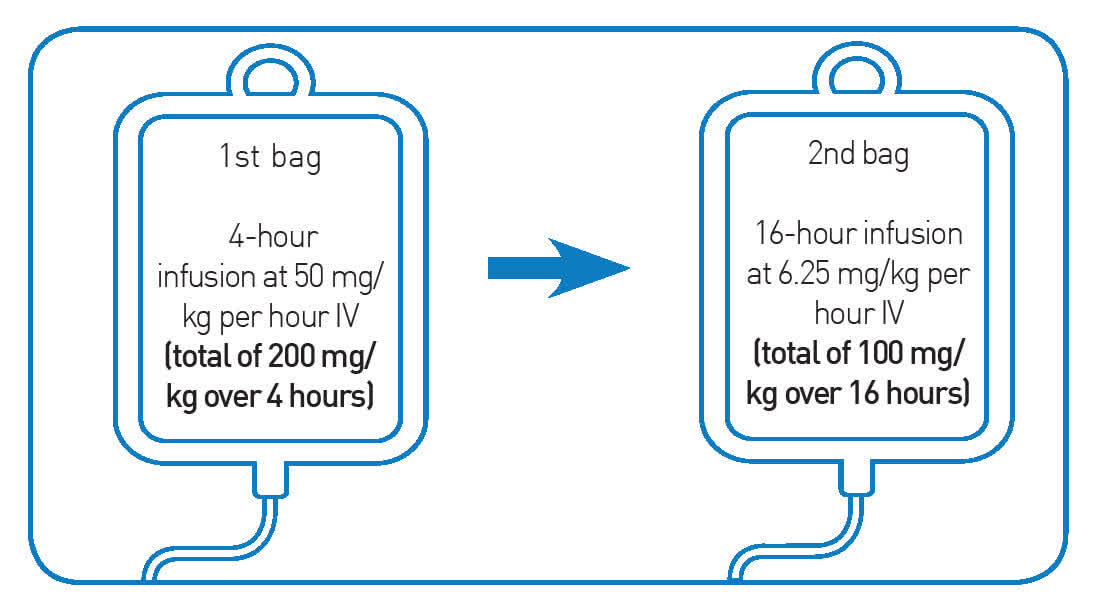
Intravenous NAC results in 14% to 18% non-allergic anaphylactic reactions (NAARs) or non-immunologic anaphylaxis, formerly known as anaphylactoid reactions.[2,3] Unlike immunologic anaphylaxis, it is not IgE mediated and does not require prior sensitization.[4] NAARs are dose related and are mostly seen during the initial phase of NAC administration since half the dose is given in the 1st hour. To overcome this a 2-bag regimen is proposed (Figure 2).
Click on image to enlarge
Figure 2: 2-bag NAC regimen
Example of how to administer the 2-bag NAC regimen in a 70-kg patient:
- 1st bag at 200mg/kg over 4 hours = 14 g of NAC over 4 hours
1 ampoule of NAC = 2g/ 10mL (200mg /mL) therefore 7 ampoules will be needed, which adds up to 70mL NAC
- If using 5% dextrose solution 500mL bag, remove 70mL solution and inject 70mL NAC into the 5% dextrose
Run the infusion at 125mL/hr (3.5g NAC/hr)
- If using 0.9% normal saline solution 1L bag, remove 70mL solution and inject 70mL NAC into the 0.9% solution
Run infusion at 250 mL/hr (3.5g NAC/hr) - 2nd bag at 100mg/kg over 16 hours = 7g of NAC over 16 hours
From a 1L 5% dextrose solution OR 1L 0.9% normal saline, remove 35mL solution and add 35mL NAC (3.5 ampoules) into the 1L 5% dextrose OR 0.9% normal saline bag. Run infusion at 62.5mL/hr (0.4 g NAC/hr)
A comparison of the simplified 2-bag to the conventional 3-bag regimen has been studied and demonstrates lower incidence of NAARs in the 2-bag regimen versus the 3-bag regimen.[5–7]
Since NAARs are dose related, the reaction can be treated by reducing the rate of the infusion. In selected patient groups the administration of antihistamines may be warranted (table 1).
Table 1: Management of non-allergic anaphylactic reactions (anaphylactoid reactions)
|
Presentation
|
Management recommendation
|
| Flushing |
|
| Urticaria |
|
| Angioedema |
|
| Respiratory symptoms or hypotension |
|
Adapted from Bailey et al.,1998[8]
Key points:
- 2-bag NAC regimen is associated with reduced NAARs
- NAARs can be overcome by reducing the rate of the NAC infusion
- 2-bag regimen allows for easier administration in a setting with limited staff
- If NAARs are persistent, consult Clinical Pharmacologist on call
References:
- Peterson RG, Rumack BH. Toxicity of acetaminophen overdose. J Am Coll Emerg Physicians 1978;7(5):202–5.
- NDA. Acetadote ® (acetylcysteine) Injection Package Insert. 2004.
- Anaphylaxis vs. Anaphylactoid Reactions | World Allergy Organization [Internet]. [cited 2019 Jul 22]; Available from: https://www.worldallergy.org/ask-the-expert/questions/anaphylaxis-vs-anaphylactoid-reactions
- Anaphylactic and anaphylactoid reactions | Clinical Gate [Internet]. [cited 2019 Jul 22]; Available from: https://clinicalgate.com/anaphylactic-and-anaphylactoid-reactions/
- Wong A, Graudins A. Simplification of the standard three-bag intravenous acetylcysteine regimen for paracetamol poisoning results in a lower incidence of adverse drug reactions. Clin Toxicol 2016;54(2):115–9.
- Schmidt LE, Rasmussen DN, Petersen TS, Macias-Perez IM, Pavliv L, Kaelin B, et al. Fewer adverse effects associated with a modified two-bag intravenous acetylcysteine protocol compared to traditional three-bag regimen in paracetamol overdose. Clin Toxicol 2018;56(11):1128–34.
- McNulty R, Lim JME, Chandru P, Gunja N. Fewer adverse effects with a modifi ed two-bag acetylcysteine protocol in paracetamol overdose. Clin Toxicol 2018;56(7):618–21.
- Bailey B, Mcguigan MA. Management of Anaphylactoid Reactions to Intravenous N-Acetylcysteine. 1998.