Management of Calcium Channel and Beta-Blocker Overdose
Division of Clinical Pharmacology, Department of Medicine, Faculty of Medicine and Health Sciences
Overdoses with beta-adrenergic blockers (ß-blockers) and calcium-channel blockers (CCBs) are associated with significant morbidity and mortality. Adult intentional self-harming ingestions and accidental ingestions by exploring toddlers constitute the majority of cases. Severely poisoned patients may have profound bradycardia and hypotension refractory to standard vasopressors and this Therapeutic Bulletin will review the additional treatment options that could be considered.
Mechanism of toxicity
Calcium (Ca) is crucial for cardiovascular function as its flow across cell membranes is necessary for cardiac automaticity, conduction, contraction and maintenance of vascular tone. ß-blockers and CCBs interfere with Ca flux across cell membranes via different mechanisms. CCBs directly block L-type calcium channels found in the heart, vasculature and pancreas, whereas ß-blockers decrease Ca flow by modifying the L-type calcium channels via second messenger systems.
The resultant decreased intracellular Ca produces cardiovascular dysfunction which results in cardiovascular collapse in severe overdose situations. The physiological and toxic effects of ß-blockers and CCBs are similar despite their different mechanisms of action, and are therefore reviewed together.
- CCBs exhibit different selectivity for cardiac Ca versus vascular Ca channels. Dihydropyridines (e.g. amlodipine and nifedipine) are predominantly peripheral vasodilators and are less cardiotoxic compared with non-dihydropyridines (diltiazem and verapamil) which may cause pronounced negative chronotropic, inotropic and dromotropic effects. In addition, Ca mediated insulin secretion by pancreatic tissue and decreased free fatty acid utilization by the myocardium may be impaired in all types of CCB toxicity and cause hyperglycaemia, acidosis and further depress cardiac contractility
- Classification of ß-blockers to predict toxicity is less clear, as the toxicity of ß-blockers vary according to various molecular properties (lipophilicity, membrane stabilising activity, α-blockade etc)
Management
ß-blockers and/or CCBs toxicity may produce hypotension and bradycardia that is difficult to treat, and often requires simultaneous therapies of intravenous fluids, vasopressors, calcium, glucagon, high-dose insulin with dextrose, and intravenous lipid emulsion therapy. The algorithm below should be followed in a stepwise fashion, optimising each step before moving over to the next. In severe cases, several treatment options may be started at once, depending on the clinical picture and availability of drugs.
Management of acute beta-blocker or calcium-channel blocker overdose in adults
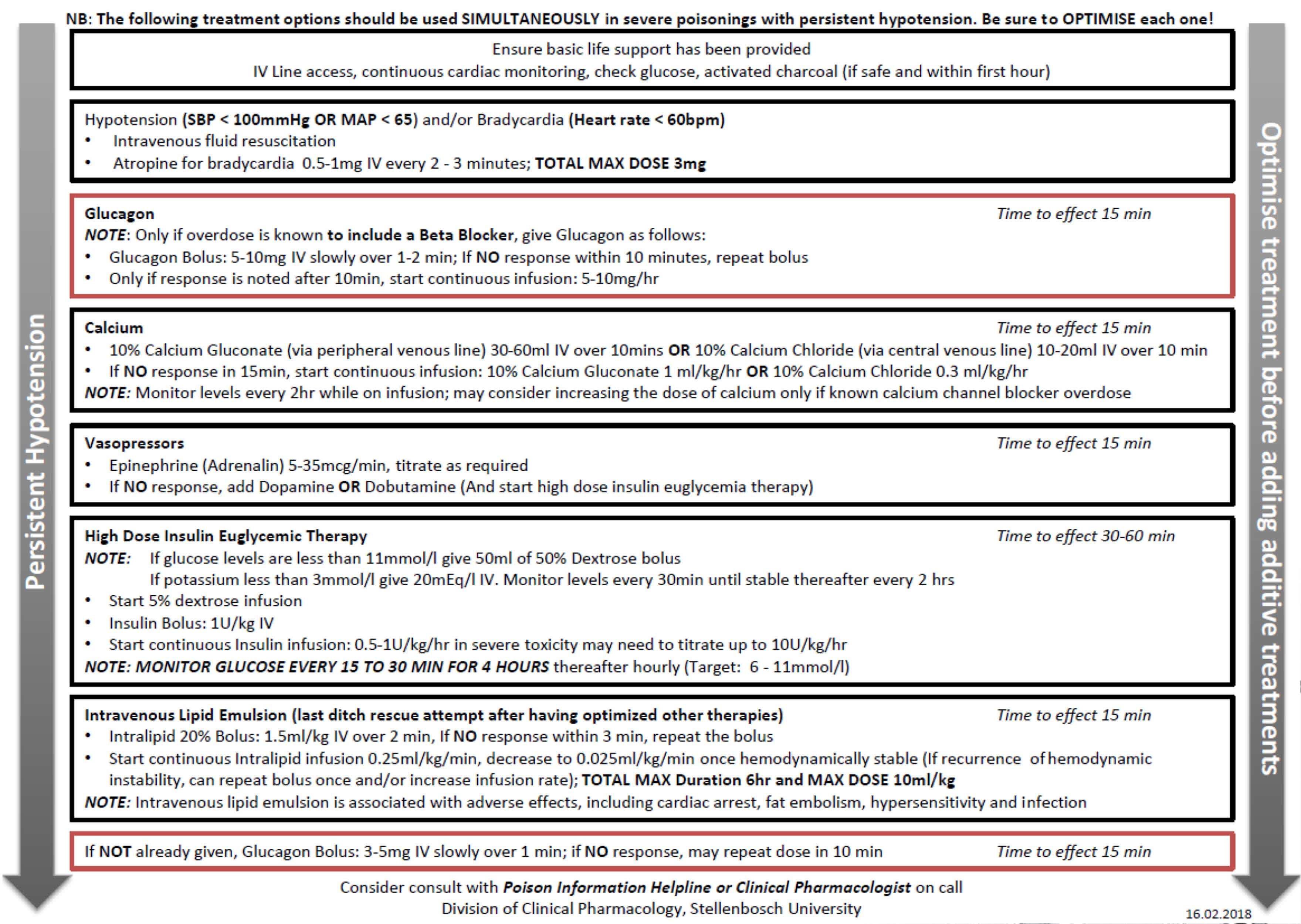
Click on image to enlarge
Key points
- Optimise each step before moving on to the next
- In severe cases simultaneous treatments may be needed
- Glucagon is associated with severe nausea and vomiting
References
- De Witt et al. Pharmacology, pathophysiology and management of calcium channel blocker and beta-blocker toxicity. Toxicol Review. 2004; 23(4):223-38.
- Kerns W. Management of β-Adrenergic Blocker and Calcium Channel Antagonist Toxicity. Emerg Med Clin N Am. 2007; 25: 309-331.
- Olson et al. Calcium channel blocker ingestion: an evidence-based consensus guideline for out-of-hospital management. Clin Toxicol. 2005; 43:797-822.
- St-onge et al. Treatment for calcium channel blocker poisoning: A systematic review. Clinical Toxicology. 2014; 52: 926-944.
- Salhanick et al. Management of calcium channel antagonist overdose. Drug Saf. 2003; 26:65-79.
- Shepherd G. Treatment of poisoning caused by β-adrenergic and calcium-channel blockers. Am J Health-Syst Pharm. 2006; 63: 1828-1835.
- Shepherd et al. High dose insulin therapy for calcium channel blocker overdose. Ann Pharmacother. 2005; 39:923-30.
- Watson et al. Annual report of the American Association of Poison Control Centers Toxic Exposure Surveillance System. Am J Emerg Med. 2005; 23:589-666.
- Wax et al. Beta-blocker ingestion: an evidence based consensus guideline for out-of hospital management. Clin Toxicol. 2005; 43:131-46.
Click here to view the PDF version of this bulletin