Management of Cases of Alleged Assault and Completion of J88 Form
Management of cases of alleged assault and completion of J88 Form
Guidelines on specific sections in the J88 form
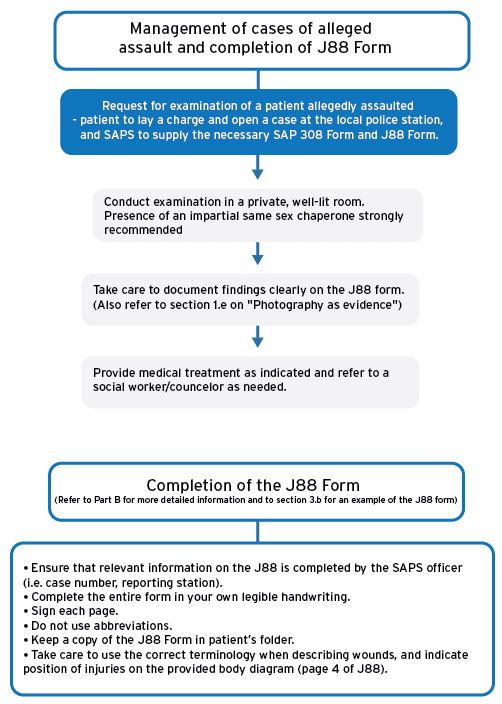
Completion of the J88 Form
- Ensure that relevant information on the J88 is completed by the SAPS officer (i.e. case number, reporting station).
- Complete the entire form in your own legible handwriting.
- Sign each page.
- Do not use abbreviations.
- Keep a copy of the J88 Form in patient’s folder.
- Take care to use the correct terminology when describing wounds, and indicate position of injuries on the provided body diagram (page 4 of J88).
Introduction
The J88 Form was designed to document relevant medical findings for court purposes.
A fully completed, legible form with a well-formulated conclusion will often obviate the need for doctor to testify in court.
Description
Before a patient is examined, a SAP 308 form should be completed and signed by the patient, and a copy of the SAP 308 form should be retained on the patient’s file. This form is proof of consent from the patient to be examined, and permission from the patient to the doctor to hand the completed J88 Form, which contains confidential medical information, to the police for investigative and court purposes.
The J88 should be completed in the examiner’s own legible handwriting and each page should be signed. Do not use abbreviations and do not enter information from an examination or notes by a colleague.
Guidelines on specific sections in the J88 Form
Demographic information:
Remember to include your contact number, as it may negatively influence the criminal proceedings if important medical witnesses cannot be traced.
General history:
State clearly who provided the information: was it the patient or a 3rd party? Provide the name of a 3rd party. State if an interpreter was used, and write down the name of the interpreter.
When taking the medical history, ask specifically about previous injuries.
Ask about medication and drugs/alcohol, specifically any medication that could aggravate bruising or bleeding, any medication that could influence mental awareness and the recent use of recreational drugs or alcohol (voluntary information by patient).
General examination:
When examining the clothing, focus on tears, missing buttons, torn pockets, or stains (blood, dirt, grass, mud, body fluids). Document if patient has changed clothing after the alleged incident.
Clinical findings:
Document your findings systematically, and avoid using technical or medical anatomical terminology – remember the report has to be read and understood by non-medical persons. Describe wounds and injuries individually, and indicate the extent and position of injuries on sketches (number lesions). Describe the position, type, size, shape and age (fresh, healing, healed, colour change of bruises) of the wound. Use a ruler to measure the dimensions of the wound. If photographs are taken, note this in your report. (Also refer to section 1.e on “Photography in clinical medicine”).
Describe existing old scars and anatomical anomalies. Document relevant negative findings in relation to the history, for example if the alleged assault was with a sharp object, mention the absence of such injuries. Remember to also examine occult or hidden areas, such as the palms, soles, axillae, inner thighs, insides of the mouth, lips and throat, eyelids, scalp and back.
It is of the utmost importance to use the correct wound terminology, as this may have serious implications on the case.
Wound terminology:
Blunt force injuries | Sharp force injuries | Combination sharp/blunt force injury |
Contusion (bruise): The skin is intact, however there is extravasation of blood into soft tissue spaces due to rupture of capillary blood vessels. | Incised wound: Superficial wound in which the length of the wound on the skin surface is larger than the depth of the wound. | Chop wound: Wound caused by heavy instruments, with sharp edges, e.g. axes. The wound may have an incised appearance, with sharp edges, however some associated skin tearing and contusion may be evident, with an underlying fracture or deep groove in underlying bone. |
Abrasion: Injury to the superficial layers of the skin. | Stab wound: Depth of the wound track is greater than the length of the skin wound. | |
Laceration: Full-thickness injury of the skin, as a result of skin stretching or splitting, wound with irregular edges. |
General examination:
Take note of the emotional and mental state, and note if the person is mentally impaired, or apparently under the influence of drugs or medication. Take blood and/or urine samples if indicated.
Conclusions:
When you write your conclusions, be sure to separate findings of fact from opinions, and take care when you write your conclusions: Be careful with wording, and remain objective and accountable. Do not provide detailed non-medical information, such as names of alleged perpetrators, dates and times, as this may differ from the statement given by the patient to the police. Don’t name objects used to inflict injuries, but do consider the mode of injury (blunt force versus sharp force injury). Consider the history in terms of time, place and circumstance in relation to the clinical findings.
Your final conclusion should be short, clear, objective and unbiased, e.g. “The injuries are compatible with/not compatible with the time and circumstances of the alleged incident” or “The injuries are compatible with that which would be caused by a blunt object”.
Section D – H on the J88 form needs only to be completed in a case of alleged sexual assault.
References
- Brouwer IG, Burger L. Medico-legal importance of the correct interpretation of traumatic skin injuries. CME2006;24(3):112-115
- Introduction to Medico-Legal Practice, edited by Dada MA, McQuoid-Mason DJ. Butterworths 2001
- Muller K, Saayman G. Clinical Forensic Medicine: Completing the Form J88 – what to do and what not to do. SA Fam Pract 2003;45(8):39-43