Management of Heavy Menstrual Bleeding/Abnormal Uterine Bleeding
Management of Heavy Menstrual Bleeding/Abnormal Uterine Bleeding
Classification (FIGO) of causes
Treatment: Actively bleeding, unstable & requiring transfusion
Clinical problem: bleeding from the uterus that is abnormal in volume, regularity, and/or timing, and has been present for the majority of the past 6 months.
General Measures
- All women over 40 years of age should have a transvaginal ultrasound and endometrial sampling for histology (or any age if at risk for endometrial hyperplasia/polyps as identified from history and/or examination)
- Actively exclude organic causes, e.g. fibroids, for abnormal uterine bleeding (PALM-COEIN).
- All women should receive a speculum examination to rule out cervical pathology. A cervical cytology smear should be performed if indicated according to the screening program. If the cervix appears abnormal, do a cervical biopsy as well.
Classification (FIGO) of Causes
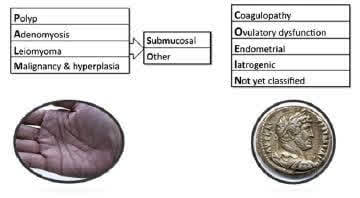
Click on the image to enlarge
Approach
Take a thorough history
Focus on:
- details of the menstrual cycle (menarche, normal cycle, LNMP, change in bleeding pattern)
- symptoms of pregnancy
- dysmenorrhoea
- dyspareunia
- medication including:
- Hormonal contraception
- HRT
- Anticoagulation
- bleeding tendencies (personal/family history)
- endocrine causes (symptoms of thyroid dysfunction)
- last normal cytology smear
Good clinical examination including:
- Signs of anaemia (conjunctival pallor, tachycardia)
- Petechiae
- Purpura
- BMI
- Breast
- Thyroid exam
- Abdominal exam for abdomino-pelvic mass
- Speculum exam (with Pap smear)
- Bimanual exam (only defer in patient who is virgo intacta)
Investigations
- Urine Pregnancy test
- Cervical cytology smear (unless normal result in last year – see report/get telephonic report from laboratory)
- Ward Hb (FBC if Hb < 8g/dl)
- Clotting profile (if suspecting bleeding tendency, e.g. heavy bleeding since first menstruation)
- TSH (not FT4/FT3)- only when signs or symptoms of thyroid disease are present
- Prolactin (expensive test- only do when no other pathology is present, e.g. fibroids)
- Not needed- Estrogen, FSH, LH levels.
- Transvaginal ultrasound and endometrial sampling if 40 years of age or more
Treatment: Actively Bleeding, Unstable & Requiring Transfusion
- Admit
- Stabilise
- Do blood investigations
- Start emergency blood
- Transfer Tygerberg Gynae Registrar on call
Medical treatment when no organic cause is present or identified (if any underlying causes or pathology is identified, refer to Tygerberg Gynaecology clinic for hysteroscopy/evaluation).
Arrest of acute bleeding
Progestin, e.g:
- Norethisterone, oral, 5 mg 4 hourly until bleeding stops up to a maximum 48 hours
OR
- Tranexamic acid, oral, 1g 6 hourly on days 1–4 of the cycle.
After bleeding has stopped, continue with:
- Combined oral contraceptive, oral, 1 tablet 8 hourly for 7 days (if not contra-indicated).
- Follow with 1 tablet once daily for 3 months.
For Restoring Cyclicity
For women in their reproductive years:
- Combined oral contraceptive, oral, 1 tablet daily for 6 months.
As alternative to combined oral contraceptives:
Progestin only:
- Medroxyprogesterone acetate, oral, 30 mg daily from day 5 to day 26 of the cycle. Use
for 3–6 cycles.
OR
- Norethisterone, oral, 15 mg daily from day 5 to day 26 of the cycle. Use for 3–6 cycles.
OR
NSAID, oral: e.g.
- Ibuprofen, oral, 400 mg 8 hourly with meals. Begin trial of NSAID starting on 1st day of menses until menses cease.
OR
- Tranexamic acid, oral, 1 g 6 hourly on days 1–4 of the cycle.
ADD
For dysmenorrhoea and abnormal bleeding:
- Ibuprofen, oral, 400 mg 8 hourly for 2–3 days with meals, depending on severity of pain.
If medical or conservative management fails, refer to Tygerberg for evaluation for LNG-intra-uterine system.
Click here to open the above content in the original PDF view
Tygerberg Hospital, Department of Obstetrics and Gynaecology; Management of Heavy Menstrual Bleeding/Abnormal Uterine Bleeding (compiled from EDL,NICE 2018 and FIGO 2011) ; Version: May 2013; Last checked for updates by EMGuidance: Oct 2023