Management of Paediatric Cases of Alleged Sexual Assault - Rapid Approach
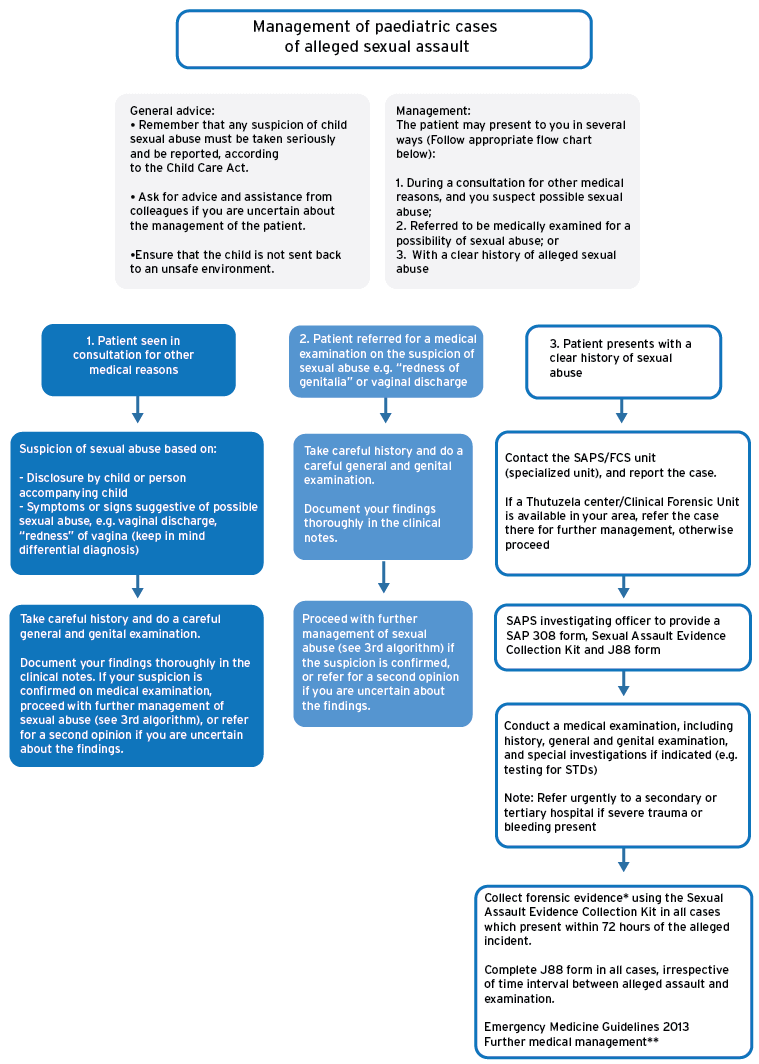
Management of paediatric cases of alleged sexual assault
General advice
Management
Management Algorithm
Medical management and treatment:
HIV Prophylaxis*** (in all cases where HIV test negative)
General advice
- Remember that any suspicion of child sexual abuse must be taken seriously and be reported, according to the Children's Act.
- Ask for advice and assistance from colleagues if you are uncertain about the management of the patient.
- Ensure that the child is not sent back to an unsafe environment.
Management
The patient may present to you in several ways (Follow appropriate flow chart below):
- During a consultation for other medical reasons, and you suspect possible sexual abuse;
- Referred to be medically examined for a possibility of sexual abuse; or
- With a clear history of alleged sexual abuse
1. Patient seen in consultation for other medical reasons
Suspicion of sexual abuse based on:
- Disclosure by child or person accompanying child
- Symptoms or signs suggestive of possible sexual abuse, e.g. genital warts, genital ulcers, vaginal discharge, “redness” of ano-genitalia, pregnancy in children under the age of 16 years, sexualised behaviour or other unexplained behavioural problems, unexplained difficulty in walking or standing (keep in mind differential diagnosis)
Take careful history and do a careful general and genital examination.
Document your findings thoroughly in the clinical notes. Consult with a senior colleague or a colleague at a Thuthuzela/clinical forensic unit regarding genital examination.
If your suspicion is confirmed on medical examination, proceed with further management of sexual abuse (see 3rd algorithm), or refer for a second opinion if you are uncertain about the findings.
2. Patient referred for a medical examination on the suspicion of sexual abuse e.g. “redness of genitalia” or vaginal discharge
Take careful history and do a careful general and genital examination.
Document your findings thoroughly in the clinical notes. Consult with a senior colleague or a colleague at a Thuthuzela/clinical forensic unit regarding genital examination.
Proceed with further management of sexual abuse (see 3rd algorithm) if the suspicion is confirmed, or refer for a second opinion if you are uncertain about the findings.
3. Patient presents with a clear history of sexual abuse
Contact the SAPS/FCS unit (specialised unit – Family Violence, Child Protection and Sexual Offences), and report the case, if this hasn’t been done already.
If the child has severe/life-threatening injuries refer immediately to the appropriate level of care. Clearly communicate if evidence has not been collected yet
FCS detective to provide a SAP 308 form, Sexual Assault Evidence Collection Kit(s) and a J88 form
Conduct a full medical examination, including history, general and genital examination, and special investigations if indicated (e.g. testing for STDs)
Collect forensic evidence* using the Sexual Assault Evidence Collection Kit(s) if indicated by the history, and the case presented within 72 hours of the alleged incident.
Complete a J88 form in all cases, irrespective of time interval between alleged assault and examination.
Further medical management**
Management Algorithm
*Evidence collection:
Please refer to Part B of the Emergency Guidelines and the user guide found in the sexual assault evidence collection kit (SAECK) for step by step instructions to collect evidence.
Seal the evidence collection kit(s) after the evidence has been collected and hand the sealed kit to the FCS detective, or keep under lock and seal until it can be handed to the detective.
**Medical management and treatment:
Investigations:
- Urine pregnancy test, based on pubertal development (all female children who have reached Breast development Tanner Stage 3 and upwards)
- Rapid HIV test, with pre-and post-HIV-test counselling
- Rapid RPR test
- Full blood count and ALT if antiretroviral medication is prescribed.
- Further tests for sexually transmitted infections, if indicated.
- Medical vaginal swabs for sexually transmitted infection assessment should only be taken if a recent discharge is reported, or a discharge is present at the time of the examination.
- A Hepatitis B test should only be requested in those children who are not completely immunized, or if the immunisation status is unknown.
- Refer a child who presents with genital warts to a specialist for further assessment and treatment.
Treatment:
- Treat all acute injuries evident on presentation.
- Treat established complications – infections or pregnancy
Prophylaxis: (if presenting within 72 hours of the alleged incident), except for emergency contraception which can be provided up to 120 hours after the alleged incident)
- Infections
- Anti-tetanus toxoid: ½ cc IMI if skin or mucosal barrier shows a significant tear; and depending on vaccine status (if available).
- Ceftriaxone: <12 years 125mg IMI stat or >12 years 250mg IMI stat
- Metronidazole
- 1–3 years: 50mg 8-hourly for 7 days
- 3–6 years: 100mg 12-hourly for 7 days
- 7–10 years: 100mg 8-hourly for 7 days
- 11 years and older: 200mg 8-hourly for 7 days.
- <8 years:
- Azithromycin 20mg/kg single dose stat (maximum 1g) OR
- Erythromycin 10mg/kg 6-hourly for 7 days (if still in stock at hospital) OR
- Clarithromycin 10mg/kg 12-hourly for 5 days
- 8 years and older:
- Azithromycin 20mg/kg single dose stat (maximum 1g) OR
- Doxycycline 100mg 12-hourly for 7 days
- Emergency contraception (for all girls with Tanner stage 3 or more, even if they have not reached menarche)
- 1st choice: Escapelle (1.5mg Levonogestrel) 1 tablet stat po(If not available: Ovral 2 tablets immediately and 2 tablets after 12 hours, OR stat OR Norlevo 2 tablets stat)
- Add anti-emetics: 5 – 14 years: Metoclopramide 5 mg tds po, take 30 minutes before eating>14 years: Metoclopramide 10 mg tds po, take 30 minutes before eating
- Repeat dose of emergency contraception if vomiting occurs within 2 hours after taking.
- Increase dose with 50% if patient is already on any liver-enzyme inducing medication. e.g. Escapelle 2 tablets stat OR Norlevo 3 tablets stat OR Ovral 3 tablets stat and 3 tablets 12-hours later
- Anti-retroviral prophylaxis
- HIV positive (confirmed)Refer for further counselling and HIV care at local clinic/day hospital.
- HIV negative*** – see below for dosage according to weight
Note: Give the first dose of antiretroviral medication as soon as possible.Take a Full Blood Count and ALT prior to the initiation of antiretroviral medication.
Simple analgesia
Offer simple analgesia if indicated, e.g. Paracetamol.
Refer appropriately if other medical treatment or intervention indicated
Refer for counselling and involve the social worker if it hasn’t been done yet.
Arrange for hospital admission if no place of safety available.
Arrange follow-up visits (2 weeks, 6 weeks and 3 months)
At the follow-up visit(s):
- Document whether the child or caregiver experience any post-traumatic stress syndrome symptoms at each visit, and give advice regarding medication and blood results.
- Ensure that arrangements for counselling are in place.
- A repeat physical examination is only required if there was significant injury and documentation regarding healing is required.
- Follow-up blood results on Hepatitis B serology (if this was indicated) and manage accordingly.
- Repeat Full blood count at 2 weeks, to monitor for anaemia, if antiretroviral medication was provided.
- Repeat HIV and RPR test at 6 weeks and 3 months.
- Enquire about menstruation and repeat pregnancy test if indicated at 6 weeks and 3 months.
- Investigate and treat sexually transmitted infections.
- If the survivor becomes pregnant as a result of the rape, and wishes to terminate the pregnancy, she should be referred for a safe termination of pregnancy as soon as possible.
HIV Prophylaxis*** (in all cases where HIV test negative) | ||
| Zidovudine (AZT) 12 hourly dosing Sol. 10 mg/ml Tablet 300mg Capsule 100mg | Lamivudine 12 hourly dosing Sol. 10 mg/ml Tablet 150mg | Lopinavir/Ritonavir 12hourly dosing Sol. 80/20mg/ml Adult tabs: 200mg/50mg Paed tabs 100/25mg |
| Weight (kg) | Zidovudine | Lamivudine | Lopinavir/Ritonavir |
| <3 | CONSULT WITH A CLINICIAN EXPERIENCED IN PAEDIATRIC ARV PRESCRIBING FOR NEONATES | ||
| 3-3.9 | 6ml bd | 2ml bd | 1ml bd |
| 4-4.9 | 6ml bd | 2ml bd | 1ml bd |
| 5-5.9 | 6ml bd | 3ml bd | 1.5ml bd |
| 6-6.9 | 9ml bd | 3ml bd | 1.5ml bd |
| 7-7.9 | 9ml bd | 4ml bd | 1.5ml bd |
| 8-8.9 | 1 capsule bd OR 12 ml bd | 4ml bd | 1.5ml bd |
| 9-9.9 | 1 capsule bd OR 12 ml bd | 4ml bd | 1.5ml bd |
| 10-10.9 | 1 capsule bd OR 12 ml bd | 6ml bd OR 12ml od | 2ml bd |
| 11-13.9 | 1 capsule bd OR 12 ml bd | 6ml bd OR 12ml od | 2ml bd |
| 14-16.9 | 2 caps am and 1 cap pm OR 15ml bd | 8ml bd OR ½ 150mg tablet bd | 2.5ml bd OR 2 paed tabs bd OR 1 adult tab bd |
| 17-19.9 | 2 caps am and 1 cap pm OR 15ml bd | 8ml bd OR ½ 150mg tablet bd | 2.5ml bd OR 2 paed tabs bd OR 1 adult tab bd |
| 20-22.9 | 2 capsules bd OR 20ml bd | 150mg tablet bd OR 15ml bd | 3ml bd OR 2 paed tabs bd OR 1 adult tab bd |
| 23-24.9 | 2 capsules bd OR 20ml bd | 150mg tablet bd OR 15ml bd | 3ml bd OR 2 paed tabs bd OR 1 adult tab bd |
| 25-29.9 | 1 x 300mg tablet bd OR 1 x AZT/3TC 300/150mg tab bd | 1 x 150mg tablet bd OR 1 x AZT/3TC 300/150mg tablet bd | 3.5ml bd OR 3 paed tabs bd |
| 30-34.9 | 1 x 300mg tablet bd OR 1 x AZT/3TC 300/150mg tab bd | 1 x 150mg tablet bd OR 1 x AZT/3TC 300/150mg tablet bd | 4ml bd OR 3 paed tabs bd |
| 35-35.9 | 1 x 300mg tablet bd OR 1 x AZT/3TC 300/150mg tab bd | 1 x 150mg tablet bd OR 1 x AZT/3TC 300/150mg tablet bd | 5 ml bd OR 2 adult tabs bd |
| >40 | 1 x 300mg tablet bd OR 1 x AZT/3TC 300/150mg tab bd | 1 x 150mg tablet bd OR 1 x AZT/3TC 300/150mg tablet bd | 5 ml bd OR 2 adult tabs bd |