Management of RR-TB Among People Living with HIV
Key Principles Considerations RR-TB/HIV co-infected clients Antiretroviral Therapy in HIV-infected persons with RR-TB Earlier antiretroviral agents that are no longer recommended in standard care Assessment of renal function before starting tenofovir The content of this chapter is aligned with the National 2023 ART Clinical Guideline [16] . Key Principles The short and longer DR-TB regimens may b
Considerations RR-TB/HIV co-infected clients
Antiretroviral Therapy in HIV-infected persons with RR-TB
Earlier antiretroviral agents that are no longer recommended in standard care
Assessment of renal function before starting tenofovir
The content of this chapter is aligned with the National 2023 ART Clinical Guideline [16].
Key Principles
- The short and longer DR-TB regimens may both be offered to people with HIV, and HIV status alone does not mandate any changes in the DR-TB regimen composition.
- To improve the chances of RR-TB treatment success, all people co-infected with RR-TB and HIV should receive antiretroviral therapy (ART) to suppress their viral load (VL).
Considerations RR-TB/HIV co-infected clients
- Treating RR-TB and HIV simultaneously can:
- Negatively affect serum drug levels due to drug-drug interactions
- Negatively affect adherence, due to increased pill burden
- Potentiate side effects due to overlapping toxicities, e.g., hepatic toxicity
- Selected ART regimens should therefore be optimized to avoid drug-drug interactions, minimize toxicities and reduce pill burden.
- DTG in combination with tenofovir (TDF) and lamivudine (3TC), in the fixed-dose combination known as TLD, is the optimized regimen of choice, provided the client has normal renal function.
- Dolutegravir can be used concurrently with all currently recommended RR-TB medications.
- TLD is well tolerated and minimizes the additional pill burden due to ART (TLD is one tablet once a day).
- ABC, 3TC and DTG (ALD) can be used in children < 10 years of age or weighing < 30 kg. Paediatric DTG 10 mg dispersible tablets are available for children weighing < 20 kg.
- For a client with an eGFR of < 50, TDF can be replaced with abacavir (ABC).
- Recommendations for routine VL, creatinine and eGFR, and CD4 count monitoring of clients on ART are still applicable, in addition to the routine monitoring investigations for the management of their RR-TB diagnosis.
- Co-trimoxazole therapy should be provided regardless of CD4 count, as TB is a WHO Stage 3 condition.
- Identification and management of other co-morbid opportunistic infections is required for persons with RR-TB and HIV.
- Additional counselling support will be needed to help people with RR-TB and HIV successfully adhere to their treatment.
- Clinicians should provide integrated TB and ART management at clinical consultation visits. Failure to combine care leads to increased visits and significantly increases the risk of disengagement.
Antiretroviral Therapy in HIV-infected persons with RR-TB
Initiating (or re-initiating) ART after starting RR-TB treatment
- For ART naïve clients and clients re-initiating ART after previously interrupting ART, TLD should be initiated within 2 to 8 weeks after starting RR-TB therapy. In patients with CD4 ˂50 cells/mm3 ART should be started within 2 weeks. In patients with RR-TB meningitis, initiate ART 4 to 6 weeks after starting RR-TB medication due to the risk of intracranial immune reconstitution inflammatory syndrome (IRIS).
Clients who are already on ART when RR-TB is diagnosed
- Clients who are already on ART when RR-TB is diagnosed should have a CD4 count and viral load test at the time of RR-TB treatment initiation. Any VL > 50 c/mL should receive a thorough ‘ABCDE’ assessment, have interventions implemented, and have a repeat VL in 3 months’ time (see The VL monitoring and management algorithm on page 21 of the 2023 ART Clinical Guideline).
- Clients who have not yet been transitioned to TLD should be evaluated and transitioned as a matter of urgency:
- Clients on the following regimens qualify for a same-day switch to TLD (regardless of VL result*):
- TEE
- AZT, 3TC, DTG
- Any protease inhibitor (PI) containing regimen if the client has a VL of < 1000 c/mL
- Any PI-containing regimen if the client has been on the regimen for less than 2 years
- Any PI-containing regimen on which the client is less than 80% adherent
*Note: While the VL does not influence the decision to switch to TLD on the same day, the VL result in the last 12 months should still be checked. If the VL in the last 12 months was not suppressed, continue to switch same day, but do an ABCDE assessment and provide enhanced adherence counselling (EAC) if needed, as per the VL Monitoring and Management algorithm on page 21 of the 2023 ART Clinical Guideline. If the VL was not done in the last 12 months, do it at this visit, but do not wait for the result to switch.
- Clients on a PI-containing regimen who have two or more consecutive VLs ≥ 1000 c/mL taken two or more years after starting the PI regimen, and who are adherent to their regimen, may require a resistance test before switching to TLD.
Please refer to the 2023 ART Clinical Guidelines for further guidance.
Earlier antiretroviral agents that are no longer recommended in standard care
- Although PIs increase bedaquiline exposure via enzyme inhibition, this does not appear to increase toxicity. PI based regimens are compatible with RR-TB treatment. But note that the dose of rifabutin needs to be reduced with PIs. However, in the 2023 ART guideline, all clients on a PI regimen should be transitioned to a DTG-containing regimen. PIs will only be used in an ART regimen if DTG has been shown to be inactive based on a resistance test.
- Efavirenz induces hepatic metabolism of bedaquiline and decreases bedaquiline exposure; therefore, concomitant use of efavirenz and bedaquiline is contra-indicated. Efavirenz is no longer a preferred first-line antiretroviral agent, and all clients on TEE should be switched to TLD.
- Zidovudine and linezolid should not be used concurrently, as both drugs can cause bone marrow suppression. Zidovudine is no longer part of standard first and second-line regimens.
Assessment of renal function before starting tenofovir
Tenofovir is contra-indicated in patients with impaired renal function, which can be assessed by checking eGFR/creatinine, as detailed in the table below.
Tenofovir should not be used for any patients ˂10 years of age or weighing ˂30 kg.
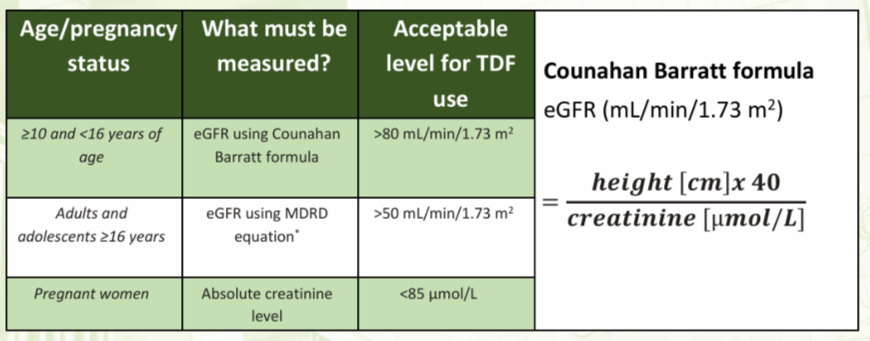
Table adapted from page 8 of the national 2023 ART Clinical Guidance [20]
Click on the image to enlarge.
* The MDRD formula is automatically calculated by the laboratory for those 18 years and older, using a modified version of this formula to estimate eGFR. For assistance in manually calculating the eGFR for adolescents between 16 and 18 years of age, please contact one of the "Helplines" on page 23. Alternatively, use the calculator provided at https://www.mdcalc.com/mdrd-gfrequation, or one of numerous smartphone applications available for this purpose. Ensure that the website/application uses the correct unit of measurement (i.e., μmol/L) for the creatinine level.
National Department of Health Clinical Management of Rifampicin-Resistant Tuberculosis, September 2023
Management of RR-TB Among People Living with HIV