Management of Selected Antiretroviral Adverse Drug Reactions
Please click on the link below to access the most up-to-date version of this guideline. The content on this page is currently being updated to align with the latest publication. Always check the version number at the bottom of the screen to confirm which version you are using. Click here to access the Adult Hospital Level Chapter 10: HIV_and_AIDS_with_supporting_NEMLC_Report_Reviews_2025-9-Versio
Please click on the link below to access the most up-to-date version of this guideline. The content on this page is currently being updated to align with the latest publication. Always check the version number at the bottom of the screen to confirm which version you are using.
Dyslipidaemia
Anaemia and neutropenia
Hypersensitivity
Hyperlactaemia
Hepatotoxicity
Hepatitis in patients on ART and anti-tuberculosis therapy
Dyslipidaemia
E78.0-5 + (Y41.5 + B24)
The protease inhibitors can cause significant dyslipidaemia. Fasting lipids should be done 3 months after starting protease inhibitors. LPV/r is associated with a higher risk of dyslipidaemia (especially hypertriglyceridaemia) than ATV/r.
Patients on LPV/r with the following should switch to ATV/r and repeat the fasting lipids in three months:
- triglycerides >10 mmol/L
- total cholesterol >6 mmol/L with a high risk (i.e. >20% risk of developing a CVD event in 10 years).
Patients with persistent dyslipidaemia despite switching to ATV/r may need lipid lowering therapy. Criteria for initiating lipid lowering therapy are the same as for HIV seronegative patients. (See Ischaemic heart disease and atherosclerosis, prevention).
Many statins (including simvastatin) cannot be used with protease inhibitors, as protease inhibitors inhibit the metabolism of the statin resulting in extremely high blood levels.
Patients, who fail to respond to lifestyle modification and have hypertriglyceridemia >10 mmol/L, treat with a fibric acid derivative, e.g.:
- Bezafibrate, oral, 400 mg at night.
OR
If LDL cholesterol is raised (See Ischaemic heart disease and atherosclerosis, prevention):
- Atorvastatin, oral, 10 mg daily (do not exceed this dose due to a drug interaction with PIs).
Anaemia and neutropenia
D64.9/D70 + (Y41.5 + B24)
AZT causes macrocytosis and can cause anaemia and neutropenia (note that it does not cause thrombocytopenia). AZT does not need to be stopped with mild anaemia and/or neutropenia, but must be stopped and replaced with an alternative medication if:
- anaemia is symptomatic,
- anaemia is severe (Hb <8.0 g/dL), or
- the neutrophil count is below 0.75 × 10⁹/L.
Lamivudine and emtricitabine can cause pure red cell aplasia, but this is rare.
Hypersensitivity
L27.0-1 + (Y41.5 + B24)
Note that pre-existing dermatological conditions (especially papulopruritic eruptions and acne) may worsen after commencing ART due to immune reconstitution inflammatory syndrome (see: Immune reconstitution inflammatory syndrome (IRIS)) – this is not a hypersensitivity reaction and ART should be continued.
Other medicines, notably cotrimoxazole, can also cause hypersensitivity.
Hypersensitivity rashes occur commonly in the 8-week period after starting EFV. NNRTI-associated rashes can be severe and life-threatening.
If any of the following features occur when a patient is on EFV, then EFV must be permanently discontinued:
- Blistering
- Lesions affecting mucous membranes (mouth, eyes, or genitals)
- Fever
Patients with lesions affecting the mucous membranes, or with significant blistering, likely have Stevens Johnson syndrome or toxic epidermal necrolysis, and will require admission.
With mild rashes EFV can be continued with careful observation and the rash will often subside.
If rash worsens or does not improve within a week discontinue EFV.
DTG can cause systemic hypersensitivity syndrome with rash, but this is very uncommon. DTG should be permanently discontinued if this occurs.
ABC can cause a rash as part of a systemic hypersensitivity reaction, which is confined to people who are HLA-B*5701 positive. ABC should be permanently discontinued if this occurs.
LoE:IVbxxix
Hyperlactataemia
E87.2 + (Y41.5 + B24)
Symptomatic hyperlactataemia occurs due to mitochondrial toxicity of NRTIs. The estimated risk of symptomatic hyperlactataemia differs among the NRTIs, with zidovudine having moderate risk and the other NRTIs very low risk.
Risk factors for hyperlactataemia include:
- females,
- obesity,
- prolonged use of NRTIs (> 3 months), or
- development of NRTI-induced peripheral neuropathy or fatty liver.
Clinical symptoms of hyperlactataemia are non-specific and may include:
- nausea
- vomiting
- abdominal pain
- weight loss
- malaise
- tachycardia
- liver dysfunction (due to steatosis)
A high index of suspicion is necessary. Send blood for lactate levels (check with your local laboratory for specimen requirements for lactate). Alternatively, point of care finger prick lactate monitoring can be done. Check the serum bicarbonate level if lactate is elevated to confirm metabolic acidosis.
Patients with mild hyperlactataemia (lactate 2.5–5 mmol/L):
Alter therapy, selecting NRTIs that are less associated with hyperlactataemia.
Note:
The resolution of hyperlactataemia may take a few months.
Patients with lactate levels > 5 mmol/L:
Stop the ART temporarily.
Consult with an HIV specialist regarding the future ART plan.
Admission to a high care unit is recommended in patients with acidosis.
Lactic acidosis carries a poor prognosis. Treatment is largely supportive. It is essential to exclude other causes of lactic acidosis, especially sepsis. High dose vitamin B, especially riboflavin and thiamine, may have a role in therapy.
Hepatotoxicity
K71.9 + (Y41.5 + B24)
All currently available antiretrovirals are potentially hepatotoxic. EFV has the highest risk. NRTIs uncommonly cause acute hepatitis, but may result in steatohepatitis after prolonged use, which manifests with mildly elevated liver enzymes, affecting GGT and alkaline phosphatase more than the transaminases, and ALT more than AST. Patients on atazanavir may develop jaundice due an unconjugated hyperbilirubinaemia, which is not accompanied by liver injury. This is a cosmetic issue and the atazanavir can be substituted if the patient is unable to tolerate the jaundice. However, all protease inhibitors can rarely cause hepatitis, so it is important to exclude this in patients developing jaundice on ATV/r. DTG can cause a hepatitis, but this is rare.
Other potentially hepatotoxic medicines prescribed in PLHIV include anti-tuberculous therapy, fluconazole and cotrimoxazole. Cotrimoxazole, amoxicillin/clavulanate, and macrolides may cause cholestatic hepatitis that may take months to resolve.
The exclusion of viral hepatitis is important in the work-up of drug-induced liver injury (DILI). Testing for hepatitis A, B and C should be undertaken. Hepatitis B is common, and flares of viral hepatitis may occur after ART initiation (i.e. IRIS). Furthermore, life threatening flares may occur when antiretrovirals that are also active against hepatitis B (i.e. TDF, 3TC and FTC) are withdrawn.
Other potential causes include disseminated TB, IRIS, alcohol, alternative remedies, fatty liver, sepsis and HIV cholangiopathy.
Investigations:
- Request an ALT.
- Request viral hepatitis screen, full liver function tests and INR in patients with any of the following criteria:
- Perform a liver ultrasound if GGT or ALP are significantly elevated or if conjugated bilirubin is elevated, to exclude:
- ALT >5 x upper limit of normal (ULN)
- Jaundice
- Other symptoms of hepatitis (e.g. right upper quadrant pain, nausea or vomiting).
- Perform a liver ultrasound if GGT or ALP are significantly elevated or if conjugated bilirubin is elevated, to exclude:
- Extrahepatic biliary obstruction.
- Fatty liver due to NRTIs.
- Disseminated TB.
Management:
| Upper Limit of Normal (ULN) | <2.5 x ULN | 2.5 – 5 x ULN | > 5 x ULN |
| ALT | Repeat in 2 weeks | Repeat in 1 week | Stop ART |
*Stop the relevant medicines at lower levels if symptoms of hepatitis (right upper quadrant pain, nausea/vomiting) or jaundice are present.
Table 1: Management of hepatotoxicity associated with ART
If ART is considered to be the cause substitute ART as follows:
- If the hepatitis occurred on efavirenz, substitute with DTG or a boosted PI.
- If hepatitis occurred on PI, substitute with DTG.
- NRTI fatty liver – discontinue AZT (if relevant) and replace with safer NRTI (TDF or ABC) – if not on AZT and hepatitis is severe switch to NRTI-sparing regimen (see footnote in Table 1: ART regimens, located in Antiretroviral therapy. Importantly, consult a specialist).
Hepatitis in patients on ART and anti-tuberculosis therapy
Drug-induced liver injury (DILI) is a known adverse effect of anti-tuberculosis therapy and ART and is a common problem in HIV/TB co-infected patients. First-line TB medicines associated with DILI include isoniazid (INH), rifampicin (RIF) and pyrazinamide (PZA). Anti-tuberculosis therapy commonly causes transient, mild, asymptomatic elevations in serum aminotransferase levels that may not necessarily require discontinuation of therapy.
If hepatitis develops, as defined above, stop all antiretrovirals, cotrimoxazole and all potentially hepatotoxic TB medicines (i.e. INH, RIF and PZA).
TB immune reconstitution inflammatory syndrome (TB-IRIS) should be considered in the differential diagnosis (see: Immune reconstitution inflammatory syndrome (IRIS)). This condition presents shortly after ART initiation in patients with TB. The GGT and ALP are elevated to a greater degree than the transaminases. Mild jaundice with a conjugated hyperbilirubinaemia and tender hepatosplenomegaly may be present.
Investigations:
- Request an ALT.
- Request viral hepatitis screen, full liver function tests and INR in patients if ALT >5 x ULN and/or jaundice and/or symptoms of hepatitis are present.
- Perform a liver ultrasound if GGT or ALP are significantly elevated or if conjugated bilirubin is elevated, to exclude extrahepatic biliary obstruction.
- Reassess the grounds for TB diagnosis.
- Check if patient is on intensive or continuation phase of TB treatment.
Management:
- Stop TB therapy and initiate background TB therapy and continue throughout rechallenge:
- Linezolid, oral 600 mg daily (amikacin, IV/IM, 15 mg/kg daily is an alternative if Hb <8g/dL, but only for short term use).
- Levofloxacin, oral, 750–1000 mg daily or Moxifloxacin, oral, 400 mg daily.
- Ethambutol, oral, 800 - 1200 mg daily.
- Stop cotrimoxazole prophylaxis.
- Stop ART as described above.
- Repeat ALT and bilirubin in 2 days (inpatient) or 7 days (outpatient).
- When ALT is <100 IU/L and total bilirubin is less than twice the upper limit of normal, start TB medicine rechallenge as follows:
Management of drug-induced liver injury (DILI):
| Day 1: | - Rifampicin, oral 600 mg daily. - If <60 kg: rifampicin, oral 450 mg daily. |
| Day 3: | - Check ALT. |
| Day 4–6: | ADD - Isoniazid, oral 300 mg daily. |
| Day 7: | - Check ALT. |
| Day 8: | - Stop moxifloxacin/levofloxacin and linezolid. Consider pyrazinamide rechallenge only in cases of TB meningitis or intolerance/resistance to other medicines. - Pyrazinamide, oral 25 mg/kg daily. |
| Day 10: | - Check ALT. - Thereafter, monitor ALT twice weekly for the first 3 weeks, then every two weeks for a month, then monthly until 3 months. - Restart ART 2 weeks after completing rechallenge of TB therapy. - Monitor ALT every 2 weeks for 2 months after ART rechallenge. |
LoE:IVbxxx
Table 2: Management of drug-induced liver injury (DILI)
If drug rechallenge is unsuccessful, then manage as per the following algorithm:
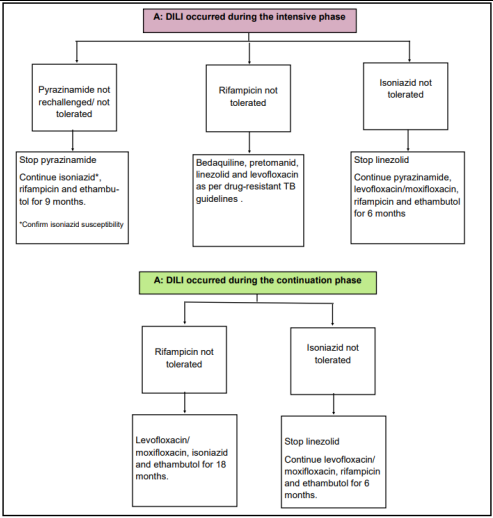
Click on image to enlarge.
Figure 1: Management of TB if drug re-challenge unsuccessful
Standard Treatment Guidelines and Essential Medicines List for South Africa, Adult Hospital Level, 2020-2024_Version 2.1_09 December 2024
Chapter 10 HIV and AIDS_10.1 Antiretroviral Therapy_10.1.1 Management of Selected Antiretroviral Adverse Drug Reactions
Drugs mentioned
ICD-10 codes
- B24Unspecified human immunodeficiency virus [HIV] disease
- D64.9Anaemia, unspecified
- D70Agranulocytosis
- E78.0Pure hypercholesterolaemia
- E78.1Pure hyperglyceridaemia
- E78.2Mixed hyperlipidaemia
- E78.3Hyperchylomicronaemia
- E78.4Other hyperlipidaemia
- E78.5Hyperlipidaemia, unspecified
- E87.2Acidosis
- K71.9Toxic liver disease, unspecified
- L27.0Generalized skin eruption due to drugs and medicaments
- L27.1Localized skin eruption due to drugs and medicaments
- Y41.5Adverse effects in therapeutic use, antiviral drugs