Management of Suspected Choking/ Foreign Body Aspiration in Children
ICD-10 code: T17.2-5/T17.8-9/ T18.0-1 Table 21.3: Managing suspected choking/foreign body aspiration in children If the child is able to talk and breathe Encourage the child to cough repeatedly while arranging transfer urgently with supervision. If the child is conscious but with no effective cough or breathing Give up to 5 abdominal thrusts and if ineffective up to 5 back slaps, followed by re-a
ICD-10 code: T17.2-5/T17.8-9/ T18.0-1
Table 21.3: Managing suspected choking/foreign body aspiration in children
If the child is able to talk and breathe |
Encourage the child to cough repeatedly while arranging transfer urgently with supervision. |
If the child is conscious but with no effective cough or breathing |
Give up to 5 abdominal thrusts and if ineffective up to 5 back slaps, followed by re-assessment of breathing. Repeat as a cycle until recovery or child becomes unconscious. See technique below and figure 21.4 for differences between infants and children. |
If the child is unconscious with no effective breathing |
Call for assistance. Open airway and check for any visible foreign body and remove. Start CPR: compressions and breaths (30:2) (check airway for foreign body each time before giving breaths). |
(Infant: < 1 year of age; Child: > 1 year of age until puberty)
Techniques for back blows and chest/abdominal thrusts
Infants
- Place the baby along one of the rescuer’s arms in a head down position with baby face down.
- Rescuer to rest his/her arm along own thigh and deliver 5 back slaps to the child.
- If this is ineffective turn the baby over (face up) and lay on the rescuer’s thigh in the head down position.
- Apply 5 chest thrusts – use the lower ½ of the sternum – compress at least 1/3 of the anteroposterior diameter of the chest. If baby too large to carry out on the thigh this can be done across the lap.
Children
- In older children, rather lie child across rescuer’s lap to deliver back blows. Use abdominal thrusts (Heimlich manoeuvre) in place of chest thrust.
- For abdominal thrust in the standing, sitting, or kneeling position, rescuer to move behind the child and pass his/her arms around the child’s body. Then, form a fist with one hand, and place against the child’s abdomen above the umbilicus and below the xiphisternum. Then place the other hand over the fist and thrust both hands sharply upwards into the abdomen towards the chest.
- In the lying (supine) position, the rescuer to kneel astride the victim and do the same manoeuvre except use the heel of one hand rather than a fist.
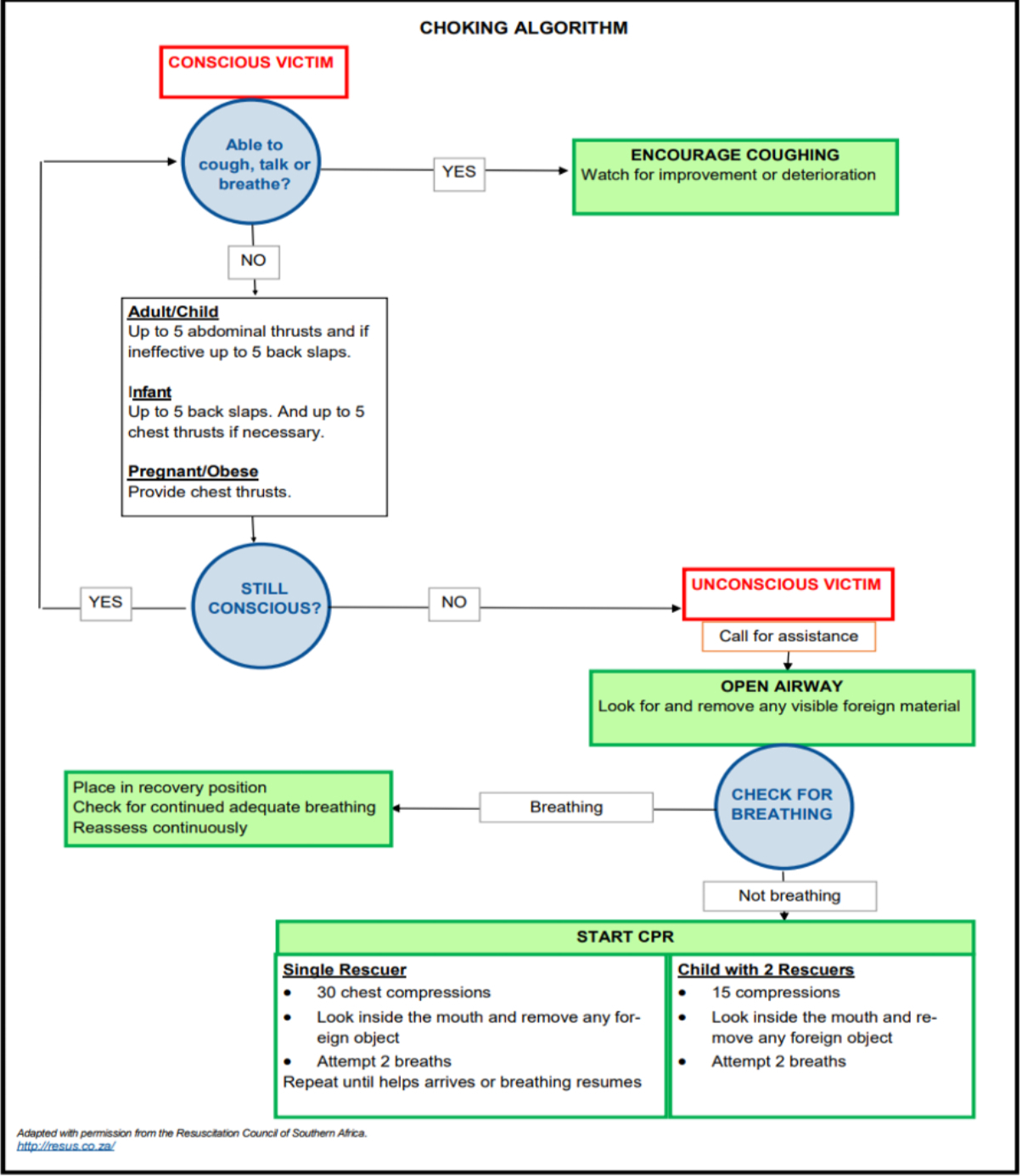
Figure 21.4 Choking algorithm
Click on the image to enlarge.
Adapted with permission from the Resuscitation Council of Southern Africa. https://resus.co.za/
Click here for the NEMLC Recommendations for medicine amendments (2020-4 review cycle).
Standard Treatment Guidelines and Essential Medicines List for South Africa, Primary Healthcare, 2020-4_Version 1.1_October 2024
Chapter 21: Emergencies and Injuries