Management of the Asphyxiated Newborn
National Neonatal Resuscitation Guidelines
Factors associated with birth asphyxia
Equipment needed for basic neonatal resuscitation
Anticipation
There should be good communication between obstetric and paediatric caregivers. Many babies who need resuscitation can be identified from the available history regarding maternal disease; the pregnancy and labour (see Factors associated with birth asphyxia). The event causing the asphyxia may occur before, during or after delivery
Not all babies with a poor history will be asphyxiated and, on the other hand, an asphyxiated neonate may be delivered to a mother with no apparent risk factors. It is therefore most important to be prepared for unexpected resuscitation at all normal deliveries. At each and every delivery there must be a person whose sole responsibility is to take care of the newborn and start resuscitation if needed.
Factors associated with birth asphyxia
Maternal risk factors:
- Age >35 years or <17 years Maternal diabetes
- Pregnancy induced hypertension Anaemia
- Renal disease Infection
Drug therapy
- Maternal substance abuse
- No prenatal care
Pregnancy related risk factors
- Antepartum haemorrhage
- Polyhydramnios / oligohydramnios
- Intrauterine growth restriction
- Placenta praevia
- Abruptio placentae
- Multiple gestation
- Fetal anomaly
- Large fetus
- Diminished fetal movement
- Post-dates pregnancy
Labour related risk factors
- Preterm labour (especially <34 weeks)
- Prolonged rupture of membranes (>24 hours)
- Prolonged labour
- Malposition / malpresentation including breech presentation
- Precipitous labour
- Prolonged second stage of labour (>1 hour)
- Meconium stained liquor
- Fetal bradycardia
- Abnormal CTG tracing
- Uterine tetany
- Narcotic analgesics within 4 hours of delivery
- Emergency Caesarean Section
- General anaesthesia
Personnel
Everyone attending a normal delivery should be able to start resuscitating a baby. A person able to do a complete resuscitation should be readily available for all normal deliveries and should attend high-risk deliveries. These staff should be responsible for the baby only.
It is much easier to do a full resuscitation with two people – one to ventilate the infant and the other to monitor the baby, do chest compressions and give medications. A third person, if available, could establish venous access, administer medications and monitor the baby as well as keep track of time, allowing the second assistant to do chest compressions. However, in practice there is often only one person available to resuscitate an asphyxiated infant.
Equipment
Wherever deliveries are done, a clean warm environment with a complete set of resuscitation equipment and drugs should be maintained, fully equipped and in proper working order.
Equipment needed for basic neonatal resuscitation
General
- Clock
- Overhead radiant warmer Temperature probe
- 3 Clean towels or receiving blankets – (one folded beneath the baby’s shoulders, one for drying the baby and one for wrapping the baby in)
- Stethoscope
- Gloves
- Scissors
- Syringes – 1ml, 2.5ml, 5ml, 10ml and
- 20ml Needles – 18, 21, 25 gauge
- Feeding tubes - 5F, 6F and
- 8F Alcohol swabs
- Adhesive tape
- Intravenous solutions – 200ml – normal saline/ neonatal solution / Ringer’s lactate
- Intravenous giving sets and buretrol (100ml)
- Infusion pump or device such as a “Dial a flow” to control IV infusion rate
- Pulse oximeter with sensor if available
Suction
- Suction pump (either wall suction or portable unit) with pressure manometer and tubing (if unavailable can use bulb syringe)
- Suction catheters – 5F to 10F
Bag and Mask
- Self- inflating resuscitation bag (e.g. Laerdal) – neonatal size with oxygen reservoir
- 2 Face masks – one for term newborns (size 1) and one for premature or small babies (size 0)
- Oxygen supply with flow meter and tubing
- T Piece with tubing (e.g. NEOPUFF) if available Cardiac monitor (if available)
Drugs
- Adult naloxone (Narcan) (0.4mg/ml)
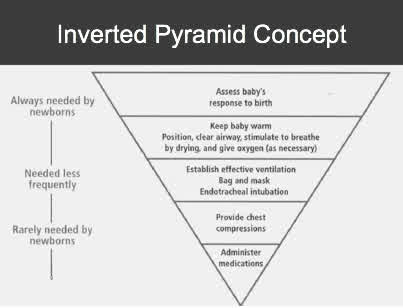
The Inverted Pyramid Concept
The inverted pyramid concept of approaching newborn resuscitation enables one to put into perspective the relative frequency of each set of actions required.
As can be seen from the inverted pyramid below, ALL babies require assessment at birth and need the routine of being kept warm, being positioned correctly as well as being dried and stimulated. Babies need their airway to be clear which in some cases involves gentle suctioning. Some babies may require a short period of oxygen supplementation.
Some babies however require more assistance soon after birth as they have either not established effective respiration or this is inadequate and so require bag and mask ventilation. In some of these babies, bag and mask ventilation is insufficient and endotracheal intubation is required.
Very few babies will require further support with chest compressions in addition to ventilation either by bag and mask or via an endotracheal tube. And a minority of babies will go on to require medication. The babies requiring medication form the absolute end of the spectrum of all requiring resuscitation efforts and hence one needs to appreciate that medication use indicates the most extreme cases with the worst prognosis.