Massive Transfusion Protocol
Description Major haemorrhage may be defined as blood loss >150 ml/min, loss of >50% of blood volume in 3 hours, or loss of entire blood volume in 24 hours. A massive transfusion may also be defined by the transfusion of >4 units of red blood cells in 1 hour, replacement of >50% of blood volume in 3 hours (>5 units in 3 hours), or the replacement of entire blood volume in 24 hours
Description
Major haemorrhage may be defined as blood loss >150 ml/min, loss of >50% of blood volume in 3 hours, or loss of entire blood volume in 24 hours.
A massive transfusion may also be defined by the transfusion of >4 units of red blood cells in 1 hour, replacement of >50% of blood volume in 3 hours (>5 units in 3 hours), or the replacement of entire blood volume in 24 hours (>10 units in 24 hours).
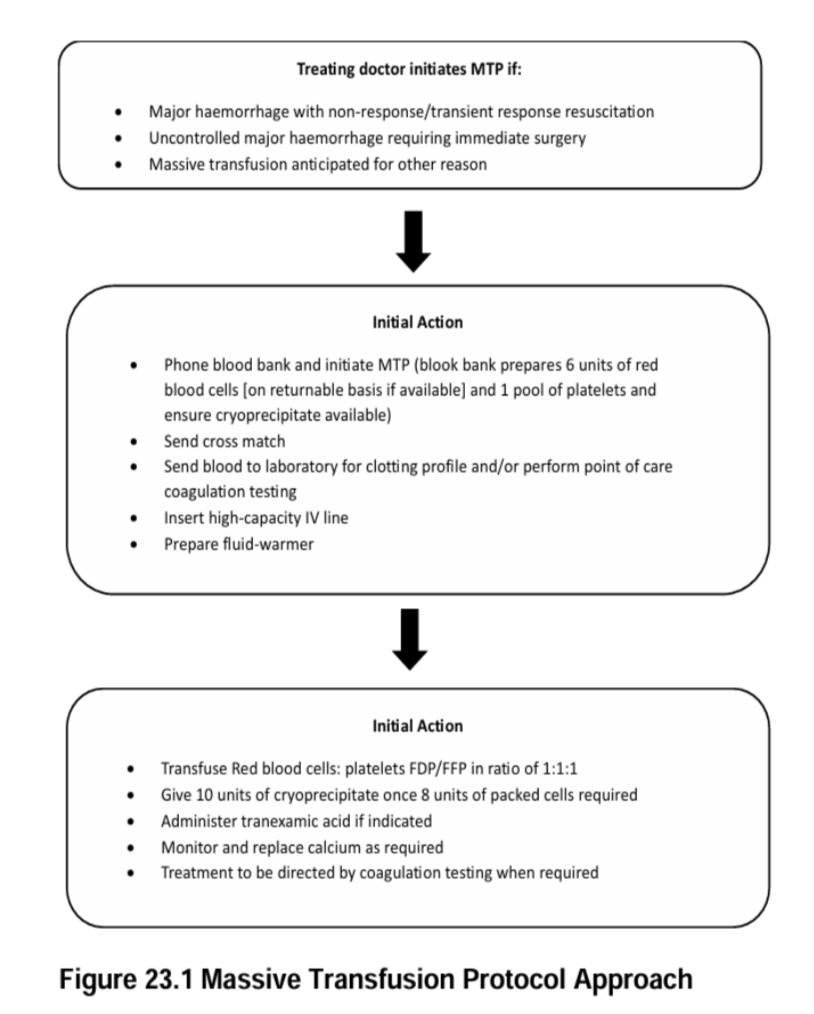
In the setting of major haemorrhage, blood and blood products are most efficiently and effectively administered using a massive transfusion protocol (MTP).
Essentials of the protocol:
- The massive transfusion protocol is designed to facilitate the transfusion of large volumes of blood (at least 6 units of red blood cells) and blood products.
- MTP aims to avoid acute coagulopathy in major haemorrhage that is associated with trauma and other causes during the resuscitation phase.
- Blood components are given in fixed ratios initially. Further blood product administration is ideally guided by point of care coagulation testing.
- An MTP should be a collaboration between the treating unit/institution and the providing blood service. The exact details of the protocol will differ depending on the specifics of the treating unit/institution (See Figure 23.1 below for an example of a massive transfusion protocol).
Massive Transfusion Protocol Approach
Standard Treatment Guidelines and Essential Medicines List for South Africa Adult Hospital _Chapter 23: Adult Critical Care_NEMLC Medicine Recommendations Review Cycle_ 2020_2023