Measuring Improvement
Supporting the Antimicrobial Resistance Strategy Framework and the Guidelines on Implementation of the Antimicrobial Strategy in South Africa: One Health Approach and Governance, 2018
Measuring improvement in interventions
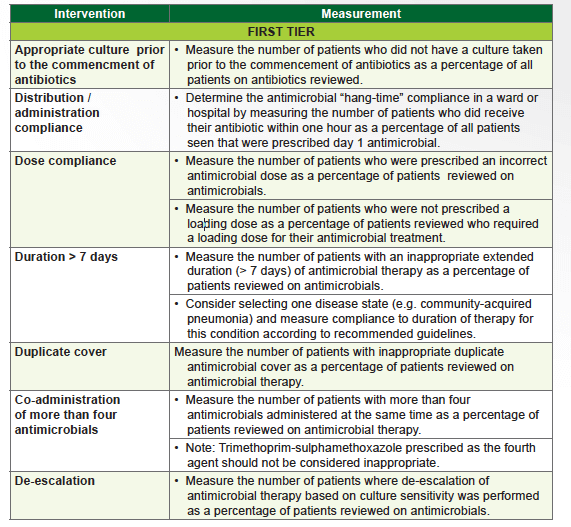
During the test and monitor phase of the QI cycle, rapid continuous PDSA cycles are undertaken. Measurement of intervention compliance is critical at this point to monitor if the changes implemented by the team have resulted in an improvement. The Table below suggests monitoring indicators for each of the interventions in the tiered approach above:50
Measurement of tiered AMS interventions
|
Intervention
|
Measurement
|
| FIRST TIER | |
| Appropriate culture prior to the commencment of antibiotics | Measure the number of patients who did not have a culture taken prior to the commencement of antibiotics as a percentage of all patients on antibiotics reviewed. |
| Distribution / administration compliance | Determine the antimicrobial “hang-time” compliance in a ward or hospital by measuring the number of patients who did receive their antibiotic within one hour as a percentage of all patients seen that were prescribed day 1 antimicrobial. |
| Dose compliance | Measure the number of patients who were prescribed an incorrect antimicrobial dose as a percentage of patients reviewed on antimicrobials. |
| Measure the number of patients who were not prescribed a loading dose as a percentage of patients reviewed who required a loading dose for their antimicrobial treatment. | |
| Duration > 7 days | Measure the number of patients with an inappropriate extended duration (> 7 days) of antimicrobial therapy as a percentage of patients reviewed on antimicrobials. |
| Consider selecting one disease state (e.g. community-acquired pneumonia) and measure compliance to duration of therapy for this condition according to recommended guidelines. | |
|
Duplicate cover
|
Measure the number of patients with inappropriate duplicate antimicrobial cover as a percentage of patients reviewed on antimicrobial therapy. |
|
Co-administration of more than four antimicrobials
|
Measure the number of patients with more than four antimicrobials administered at the same time as a percentage of patients reviewed on antimicrobial therapy. |
| Note: Trimethoprim-sulphamethoxazole prescribed as the fourth agent should not be considered inappropriate. | |
|
De-escalation
|
Measure the number of patients where de-escalation of antimicrobial therapy based on culture sensitivity was performed as a percentage of patients reviewed on antimicrobials.
|
|
Intravenous-to-oral- switch (IVOS)
|
Measure the numer of patients where the appropriate antimicrobial IVOS was done as a percentage of patients seen. |
|
De-escalation/ escalation of antibiotic therapy (drug-bug match)
|
Measure the number of patients where de-escalation of antimicrobial therapy based on culture sensitivity was performeed as a percentage of patients reviewed on antimicrobials. |
|
Therapeutic drug monitoring (TDM)
|
Ensure the appropriate dose according to PK/PD principles and disease state. |
| Patient or population specific. | |
| Monitoring the implementation of the prescription chart |
Measure the number of patients where the prescription chart was correctly completed for all elements in the bundle as a percentage of all prescription charts reviewed.
|
|
Operational indicators for AMS
|
Annual report of AMS completed for the hospital and reported to the PAMSC. |
| Number of AMS committee meetings per year as per schedule. | |
Measuring AMS intervention outcomes
It is necessary to determine whether the AMS interventions are having an impact. This will help focus efforts and support buy-in from staff when progress is being made or to help motivate for improvements to continue. These results should be reported regularly to the hospital management and leadership team.
Outcome indicators are already provided in the Guidelines on Implementation of the Antimicrobial Strategy in South Africa: One Health Approach and Governance; and replicated below for ease of reference (see Table below: Indicators and measurement for outcomes ). In addition, Clostridium difficile has been added as it is associated with a breakdown in infection control practices and the overuse of antibiotics in general. There is evidence for the restriction of quinolones, clindamycin and 2nd and 3rd generation cephalosporins in order to control C. difficile outbreaks. It has thus been proposed as an additional measure for hospitals.
Indicators and measurement for outcomes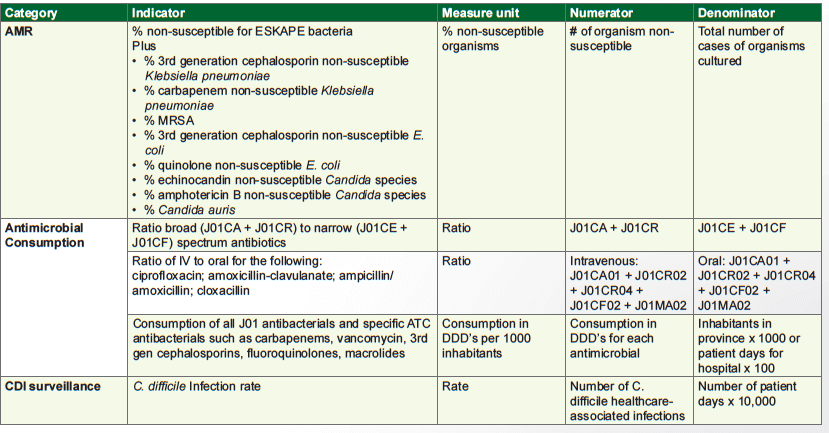
Click on image to enlarge
50 Brink AJ, Messina AP, Feldman C, et al on behalf of the Netcare Antimicrobial Stewardship Study Alliance. Antimicrobial stewardship across 47 South African hospitals: an implementation study. Lancet Infectious Diseases 2016. DOI:10.1016/S1473-3099 ((16)30012- 3).