Methotrexate Toxicity
Division of Clinical Pharmacology, Department of Medicine, Faculty of Medicine and Health Sciences
Methotrexate (MTX), a dihydrofolate reductase inhibitor, is associated with a variety of adverse effects over a wide range of severity. These adverse effects are dose and treatment regimen related.
MTX is used in high dose regimens (≥1g given in cyclic fashion) for its cytotoxic effects on malignant cells. MTX is also widely used for its immunosuppressant effect on systemic inflammatory diseases. It is licensed for use in rheumatoid arthritis and psoriasis at low doses (5 to 25 mg weekly). Off-label MTX uses include Crohn’s disease, SLE, myositis, and vasculitis treatment.
Common low-dose MTX adverse effects are rarely life-threatening, but often result in premature discontinuation of the best therapeutic alternative for a given individual.
This bulletin provides guidance to routine safety monitoring of patients on low-dose MTX.
Methotrexate toxicity
Bone marrow failure
Although rare, low-dose MTX toxicity may be life threatening, mainly due to myelosuppression. A significant fall in blood cell count should actuate withdrawal of MTX therapy and specialist consultation.
Factors associated with MTX related pancytopenia are patient age >75, renal failure, MTX-drug interactions (particularly co-administration of other anti-folate drugs), dose errors, hypoalbuminaemia and pre-existing folate deficiency.
Immune suppression
In contrast to many immunosuppressant therapies, methotrexate is relatively safe and has a low risk of infection with its use. If infections do occur MTX should be stopped immediately to prevent systemic dissemination.
A randomised controlled trial showed that perioperative continuation of MTX treatment does not increase the risk of infection or surgical complications in patients with rheumatoid arthritis.
Hepatotoxicity
Clinically serious liver disease is rarely seen in patients receiving low-dose MTX. High cumulative dose, heavy alcohol intake and pre-existing liver disease, increases the risk of hepatotoxicity. Routine liver function tests are not a reliable indicator of early MTX-induced liver fibrosis. Therefore, patients with a cumulative dose >5g MTX should be referred to liver clinic to consider liver biopsy and/or fibroscan.
Pulmonary toxicity
Methotrexate pneumonitis is a rare potentially fatal hypersensitivity reaction. It is most frequently observed within the first year of treatment and the incidence is higher in patients with pre-existing interstitial lung disease.
Folic acid reduces MTX haematological toxic effects and improves continuation of therapy and compliance. Folinic acid rescue therapy following high or toxic doses of MTX helps prevent myelospupression, renal failure, pneumonitis and mucositis.
Routine safety monitoring
Table 1 summarizes the safe use of MTX. It is a guide only, which may be overridden at the discretion of the consultant dermatologist, gastroenterologist or rheumatologist.
Table 1: Methotrexate (MTX) dosing and monitoring
Section A: Dosing and treatment instructions
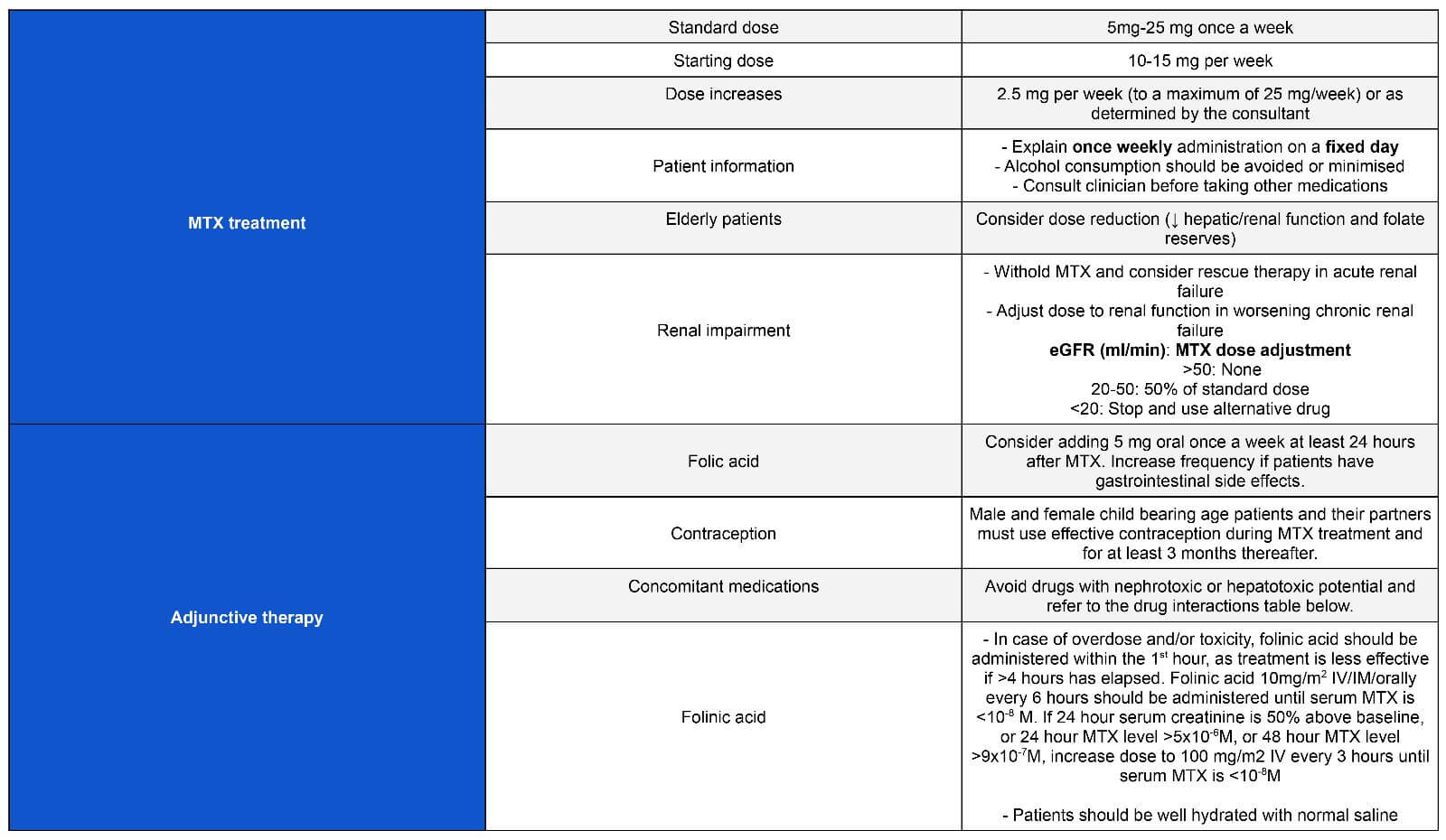
Click on image to enlarge
Section B: Clinical and laboratory monitoring
Clinical monitoring
1. Rule out contra-indications to MTX prior to initiation (via history, examination and baseline special investigations outlined below)
- Pregnancy and lactation
- Severe renal impairment
- Severe liver insufficiency
- Pre-existing blood dyscrasias
- Serious local or systemic infections or immunodeficiency
- Interstitial lung disease
- Known MTX hypersensitivity
- Ulcers of the oral cavity and known active gastrointestinal ulcer disease
- Alcohol abuse
Note:
- All patients should be screened for TB symptoms and investigated for active TB if indicated
- Pleural effusions and ascites should be drained prior to initiation of methotrexate therapy since systemic toxicity of MTX may be enhanced due to prolongation of the elimination half-life
2. Monitor patient’s response to MTX treatment
Time to clinical response
- 3 weeks to 6 months
- Lack of MTX efficacy at 25mg per week for three months is considered treatment failure
Specific adverse effects
- Rash or oral ulceration
- Withhold MTX and discuss with consultant
- New or increasing dyspnoea
- Withhold MTX and discuss urgently with consultant
- Severe sore throat or abnormal bruising
- Immediate FBC and withhold MTX until result available
3. Monitor concomitant medication and alcohol use
Notable drug interactions
- Probenecid, penicillin, NSAIDs
- MTX renal clearance is reduced (clinically significant interaction with NSAIDs and MTX is rare)
- Co-trimoxazole
- MTX anti-folate effect is increased and greatly increases the risk of marrow aplasia
- Phenytoin
- MTX anti-folate effect is increased
- Alcohol
- MTX hepatotoxicity risk increased
4. Monitor cumulative MTX dose
Patients without pre-existing liver disease with a cumulative dose >5g MTX should be referred to liver clinic to consider liver biopsy and/or fibroscan.
Laboratory safety monitoring schedule
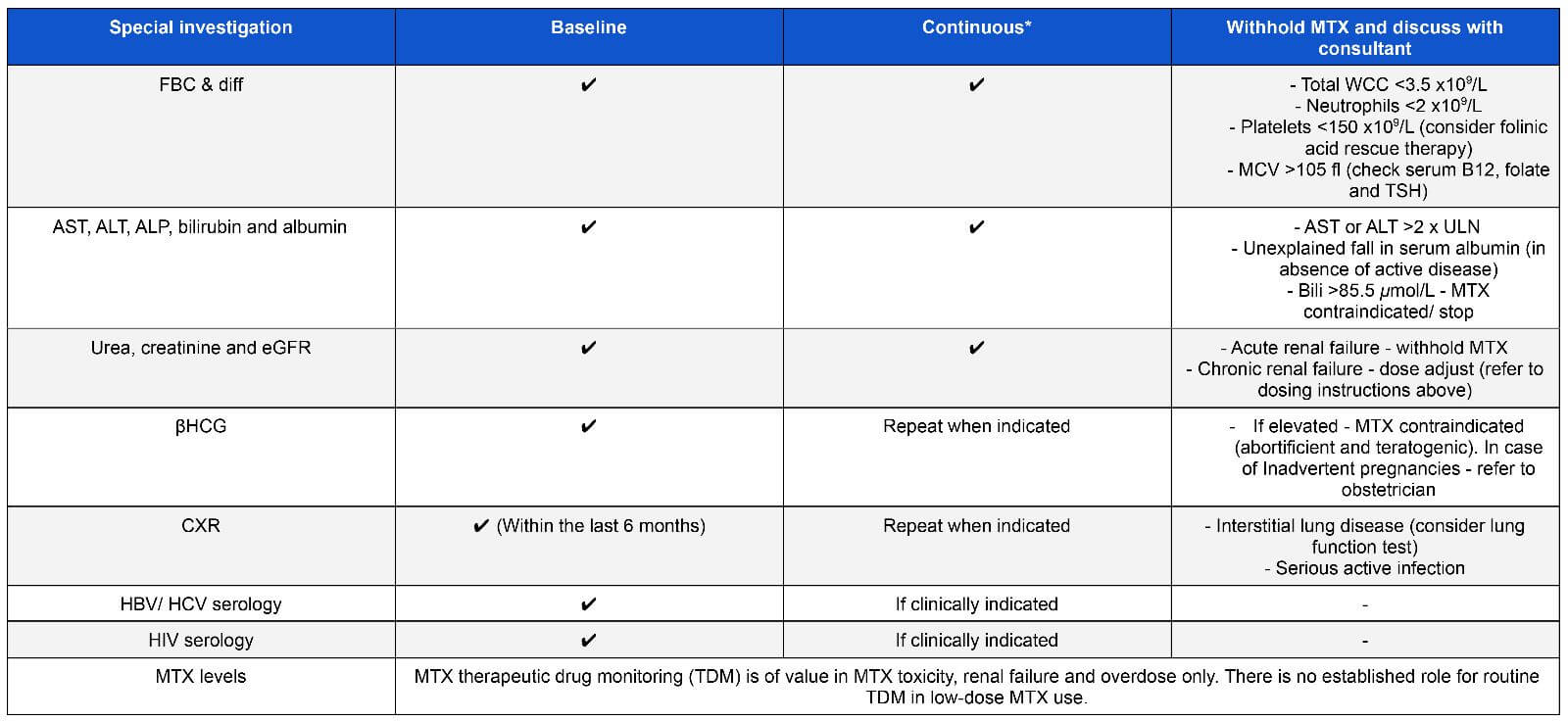
Click on image to enlarge
* Recommended continuous monitoring frequency
Rheumatology
- FBC and ALT after 1 month, then 3-6 monthly
Dermatology
- FBC and diff after one week. Then all tests indicated above once 2 weekly for 2 months. Thereafter, once 2-3 monthly
Gastroenterology
- All tests indicated above within 4 months of starting therapy then monthly
Note:
- When a dose increase has occurred close monitoring should be reinstated for at least 6 weeks
- More frequent monitoring should be considered in patients with pre-existing organ dysfunction and those taking concomitant drugs that may lead to increased MTX plasma exposure and toxicity (eg NSAIDs)
References and bibliography
- Dogra S, et al. Systemic methotrexate therapy for psoriasis: past, present and future. Clin Exp Dermatol. 2013 Aug;38(6):573-88.
- Methotrexate product information (Pfizer).
- www.hampshirehospitals.nhs.uk/media/16409/methotrexate_scg_1111.pdf (NHS Shared Care Guideline for Methotrexate)
- Chakravarty K, McDonald H, Pullar T et al. BSR/BHPR guideline for disease-modifying anti-rheumatic drug (DMARD) therapy in consultation with the British Association of Dermatologists. Rheumatology 2008. doi: 10.1093/rheumatology/kel216b
- Kivity S, Zafrir Y, Loebstein R. Clinical characteristics and risk factors for low dose methotrexate toxicity: A cohort of 28 patients. Autoimmunity Reviews 13 (2014) 1109–1113
- www.uptodate.com (Major side effects of low-dose methotrexate)(Hepatotoxicity associated with chronic low-dose methotrexate for nonmalignant disease)(Methotrexate drug information)
- Kalb RE, et al. Methotrexate and psoriasis: 2009 National Psoriasis, Foundation Consensus Conference. J Am Acad Dermatol 2009; 60: 824–37.
- Pathirana D, et al. European S3: Guidelines on the systemic treatment of psoriasis vulgaris. J Eur Acad Dermatol Venereol 2009; 23: S1–70.
- © 2015 Truven Health Analytics Inc. MICROMEDEX(R) Healthcare Series Vol. 163 10.
- Hodkinson B, Van Duuren E, Pettipher C, Kalla A; South African Rheumatism and Arthritis Association. South African recommendations for the management of rheumatoid arthritis: an algorithm for the standard of care in 2013. S Afr Med J. 2013 Jun 14;103(8 Pt 2):576-85. doi: 10.7196/samj.7047 PubMed PMID: 23885741