Multiple Pregnancy
The guidelines recommend management of common obstetric conditions at primary and referral level, based on local experience and evidence-based practice. They are not intended as strict protocols nor as standard operating procedures, but rather as a guide to safe effective management of common obstetric problems. The guidelines should be most useful to interns, medical officers and registrars.
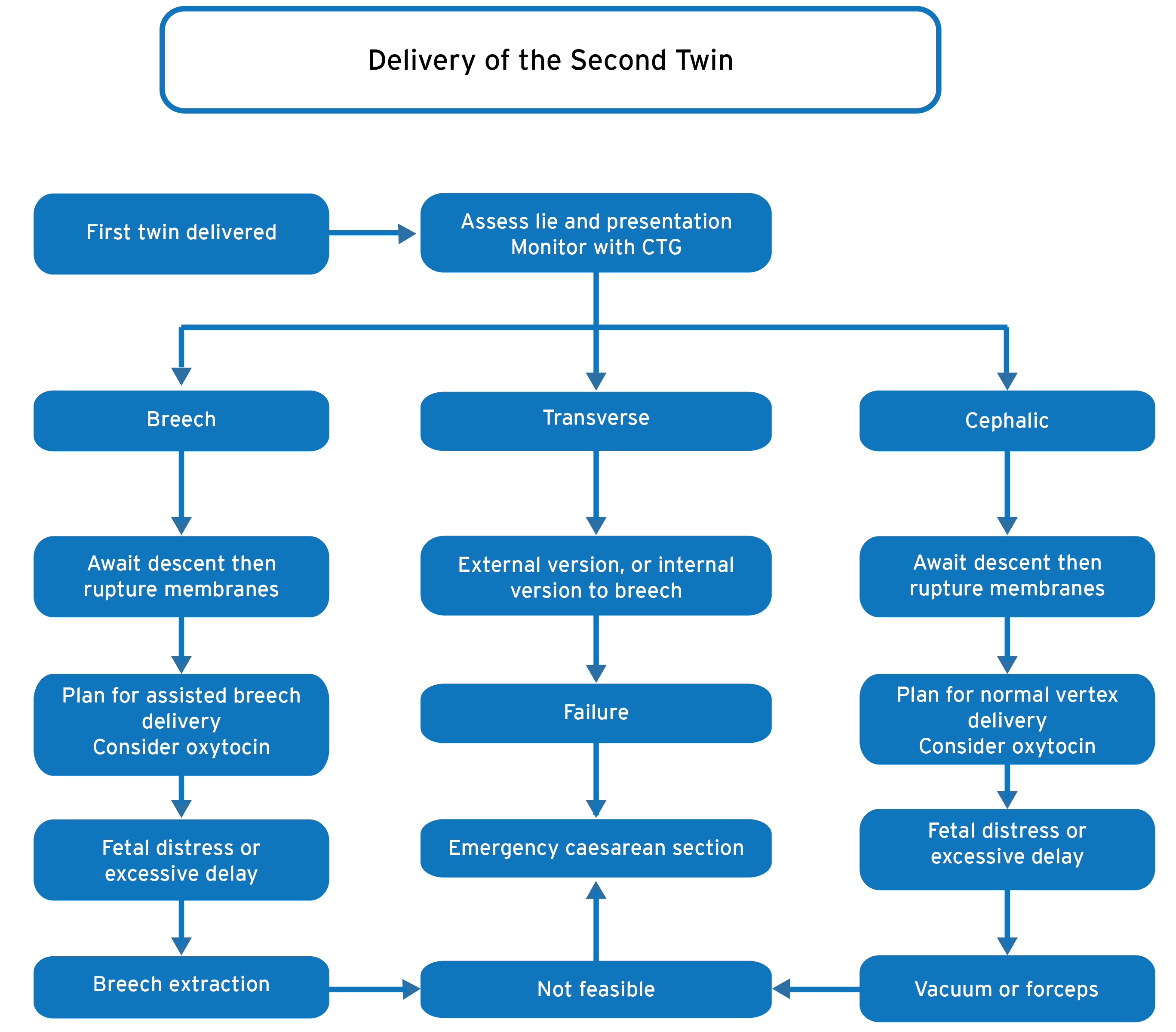
Delivery of the second twin algorithm
Multiple pregnancy is frequently suspected on clinical examination, but is diagnosed by ultrasound scan. Request ultrasound assessment for pregnancies with the following signs:
- Symphysis-fundal height >90th centile for gestational age
- An unusually wide and round uterus
- Impression of increased liquor volume
- More than 2 fetal poles palpable
- Head feels smaller than expected for the uterine size
Ideally, multiple pregnancies should be detected at a routine 11-14 week scan, where gestational age, chorionicity & Down’s syndrome risk can be assessed.
Chorionicity on ultrasound
- Dichorionic twins may be of different sexes with separate placentas & a ‘lambda’ sign at <24 weeks if there is a single placenta
- Monochorionic twins are always same-sex with a single placenta, & usually a ‘T’ sign at <24 weeks. Subsequent ultrasound scans include assessment for twin-to-twin transfusion syndrome
- Chorionicity is undetermined if the twins are same-sex and there is a single placenta at ≥24 weeks. This is managed as for monochorionic twins
ANTENATAL MANAGEMENT
- All antenatal visits must take place at a referral centre or specialized clinic
- Warn the woman of possible complications: preterm labour, anaemia, hypertension & general discomfort
- Advise the woman to monitor fetal movements
- Monitor SFH, expected at >90th percentile
- Repeat Hb at 28, 32 and 36 weeks
- Give ferrous fumarate 200 mg orally 8 hourly to treat anaemia
- If there are no complications, follow up every 4 weeks to 28 weeks, then every 2 weeks
- Perform ultrasound scan every 4 weeks from 28 weeks
- Refer for fetal medicine unit assessment if there is discordant growth (smaller twin >25% lighter than larger twin), single fetal death, or suspected twin-to-twin transfusion syndrome
DELIVERY
- For dichorionic twins, plan vaginal delivery at 37 weeks, by inducing labour (preferably with a Foley catheter bulb). Monitor both twins continuously with CTG during labour. Do an elective caesarean section at 37 weeks if the first twin is breech or transverse, or if there are obstetric indications, e.g. previous caesarean section
- For monochorionic twins, plan an elective caesarean section (to prevent intrapartum acute twin-to-twin transfusion) at 36 weeks. With onset of labour at <36 weeks, consider allowing vaginal delivery, but monitor both twins with continous CTG
- For triplets, plan an elective caesarean section at 33 weeks, after giving betamethasone to accelerate fetal lung maturity
Notes on labour in twin pregnancy
- Treat preterm labour as for singleton pregnancies. Monitor maternal condition in a high care area. Beware of pulmonary oedema if salbutamol & betamethasone are used together
- Plot labour progress on a partogram
- Monitor both fetuses continuously using twin CTG if available
- Epidural analgesia is preferred
- Oxytocin may be used for induction & augmentation of labour
Delivery of the second twin, and management of the third stage
- Immediately after delivery of the first twin, assess lie & presentation
- Monitor fetal heart rate with continuous CTG
- If cephalic or breech, allow descent, then rupture membranes and deliver
- If transverse, attempt external version to breech or cephalic presentation, using salbutamol 250 mcg IV over 2 minutes, if necessary to relax the uterus
- Consider internal version to breech of persistent transverse lie by an experienced registrar or consultant (easiest under epidural anaesthesia)
- If contractions are inadequate, start oxytocin augmentation
- For fetal distress, perform breech extraction or assisted vaginal delivery
- Do an emergency caesarean section for the second twin if there is excessive delay & assisted delivery or version are not feasible or unsuccessful
- After routine management of the third stage of labour, add 40 units of oxytocin to 1L Ringer-Lactate & infuse at 125 mL/hour to prevent PPH
DELIVERY OF THE SECOND TWIN ALGORITHM