GuidelinesOther guideline
Nasal Continuous Positive Pressure Ventilation (nCPAP)
Management guidelines for students, interns and registrars on a variety of routine and emergency situations in our neonatal service at Tygerberg Children’s Hospital. Published in 2014.
Indications
- Mild to moderate respiratory distress as a result of i.e.:
- Respiratory distress syndrome (HMD)
- Wet lung syndrome
- Meconium aspiration syndrome
- Pneumonia
- Apnoea of prematurity
- Post extubation
- Atelectasis (and also small lung volumes)
Contraindications
- Upper airway abnormalities e.g. cleft palate, Pierre Robin
- Recurrent apnoea with bradycardia
- Severe cardio-respiratory instability
- Essential intubation and mechanical ventilation
Failure of nCPAP
- Recurrent apnoea with bradycardia
- Severe rib retraction
- Severe grunting
- PaCO2 > 7.5 kPa
- FiO2 ≥ 0.6 (60% O2)
- pH < 7.25 (or Base excess >-10)
- O2 saturation < 90% with FiO2 ≥ 0.6
- a/A ratio < 0.22

Dangers (complications)
- Nasal obstruction (and apnoea) as a result of secretions or displaced nasal prongs
- Nasal prongs displacement
- Nasal irritation, septum and mucosal erosion/necrosis
- Nasal decannulation
- Water accumulation in circuit and nose
- Pneumothorax
Components of nCPAP apparatus (See photographs below)
- Oxygen-air blender
- Humidifier
- Circuit (pipes)
- Nose-piece (“generator”) with correctly sized nasal prongs
- Tapes for stabilisation of nose-piece
- Cap for head
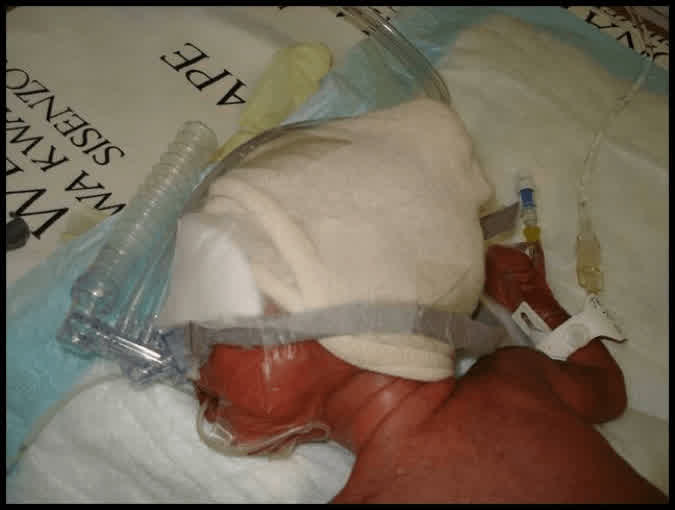
Nose-piece and tapes attached to woollen cap
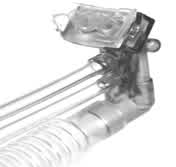
Nose-piece (generator) with prongs
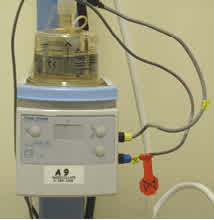
Oxygen humidifier
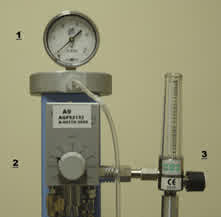
1. Pressure meter 2. Oxygen-air blender and 3. Flow meter
Setting up the Apparatus
Commence nCPAP as quickly as possible
- Place baby supine in overhead radiant heater bed (open incubator) with small rolled up nappy under the shoulders
- Keep baby nil per os initially with orogastric tube on open drainage
- Begin intravenous infusion
- Put snug-fitting woollen cap on baby’s head (low down over forehead)
- Stick Granuflex strips over nose, nasal septum (outside) and cheeks. This decreases pressure necrosis. 1 strip between upper lip and nostrils; 1 strip over nasal bridge (above nostrils) and cheeks, and 1 strip over nasal septum.
- Choose correct size of nasal prongs so as to fit comfortably into nostrils.
- Insert without pressing on nasal septum.
- 3 sizes to choose from viz. small, medium, large.
- Connect correct size of nasal prongs to the nose-piece (“generator”) and place in baby’s nostrils. The prongs should fit snugly without pressing on the nasal septum.
- Tie the tapes of the nose-piece to the woollen cap with sticking plaster
- Stick the small gauge oxygen tube to the top of the baby’s head so that the nose-piece fits comfortably into the nostrils
- Do not tape the thick corrugated expiratory tube to the woollen cap
- Check that there is sterile water in the humidifier and set the temperature to 37°C
- Oxygen is heated to 36°C
- Commence initial oxygen flow of 6-8 litres/minute or 4-5 cm H2O pressure.
- Adapt oxygen concentration (FiO2) according to saturation:
Aim to maintain O2 saturation 92 - 95% in term baby
Aim to maintain O2 saturation 85 - 90% in preterm baby <1.5kg or <32 weeks corrected age
Aim to maintain O2 saturation 88 - 92% in preterm baby 33 – 36 weeks corrected age - Observe baby and document saturations
- Prescribe the nCPAP, pressure and O2 saturation range/criteria on the patient’s prescription chart
Observation of Baby
- As the nasal prongs can easily become dislodged and the baby then may become hypoxic, a baby on nCPAP must be observed continually by the nurse
- Observations must be documented half hourly:
- Respiratory rate
- Heart rate
- Retraction
- Grunting
- Colour
- Apnoea
- Are nasal prongs correctly positioned in the nostrils? (must not slip out or press against the nasal septum)
- Check water level (fill/empty)
- Check humidification temperature
- Remove excess water from the nCPAP circuit every hour (clear rain-out)
- Check sterile water level in the humidifier every hour
- Oxygen in apparatus must automatically be heated (37°C) and humidified
- Suction the nose and mouth as necessary. (Routine suctioning is not indicated)
- Suction apparatus must not exceed the following pressures:
-80 to -100mm Hg, or -130 mbar, -13 kPa, -0.13 bar, -4 inches Hg - [Conversion: 1 mm Hg = 0.133 kPa or 0.0013 bar or 1.33 mbar or 1.36 cm H2O or 0.039 mm Hg]
- Suction apparatus must not exceed the following pressures:
- Baby to be on continuous transcutaneous oxygen monitoring
- Measure and document oxygen saturations hourly
- Maintain oxygen saturations at appropriate levels for preterm and term babies.
- If oxygen requirements exceed 60 % O2 (FiO2 >0.6), or baby develops severe retraction, or apnoea or grunting, then the doctor must be notified immediately
- If oxygenation is low, increase pressure by 1cm H2O as necessary
- Maximum pressure 8cm H2O.
- Do blood gases and acid-base as necessary. If PaCO2 rises (because of over distension of lungs), decrease pressure. Maintain pH > 7.25 and PaCO2 < 7.5 kPa.
- Keep stomach tube open if baby is nil per mouth
- As soon as baby is stable, consider feeding through stomach tube
- Baby may be turned onto back, stomach or side. (Do not place baby on stomach if umbilical catheter is in situ)
- Change the circuit and nasal prongs every week
- Do CXR if no clinical improvement (look for air leaks, small lung volumes)
Weaning
- Wean FiO2 and pressure according to clinical improvement, blood gases, O2 saturation and acid-base.
- Decrease FiO2 by 0.05 (5% O2) at a time. If FiO2 <0.25, decrease CPAP pressures by 0.5 - 1cm H2O every 4 hours.
- Discontinue nCPAP and remove device once FiO2 = 0.21 (21 % O2) for 24 hours with pressures
≤ 2cm H2O and no grunting or severe retraction present - If the baby still requires supplementary oxygen, administer oxygen with oxygen-air blender through nasal cannulae with a maximum flow of 1 – 2 litres O2 per minute.
Aim to maintain O2 saturation 92 - 95% in term baby
Aim to maintain O2 saturation 85 - 90% in preterm baby <1.5kg/<32 weeks
Aim to maintain O2 saturation 88 - 92% in preterm baby 33 – 36 weeks - Kangaroo mother care can be administered if baby is stable
- Observe baby