Neck Injuries - Penetrating
Penetrating Neck Injuries
Definition
Classification
Injuries by zone
Management
Investigations
Definition
An injury to the neck that has penetrated the platysma muscle.
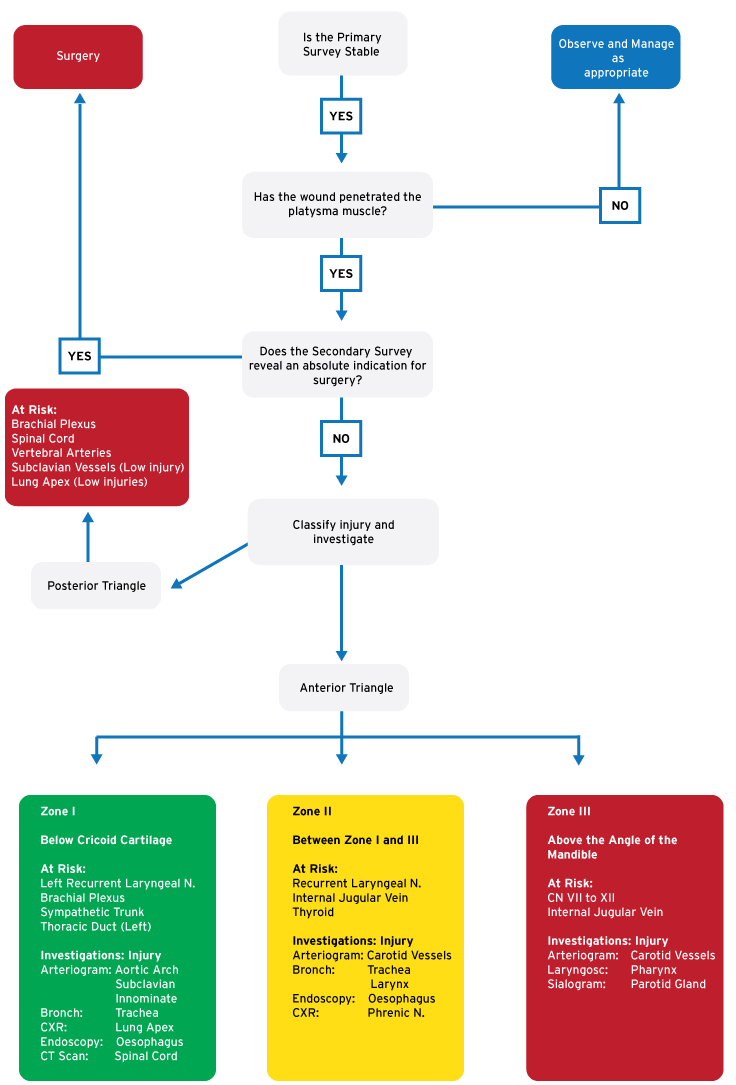
Classification
1. Posterior Triangle Injuries
These injuries occur behind the posterior border of the sternocleidomastoid muscle.
2. Anterior Triangle Injuries
These injuries occur in front of the posterior border of the sternocleidomastoid muscle.
They can further be divided into 3 zones:
- Zone I
- Below the cricoid cartilage
- Zone II
- Between Zone I and Zone III
- Zone III
- Above the angle of the mandible
Injuries by Zone
It is important to note that injuries in any zone can damage any structure within the neck.
The anatomical subdivision is useful for guiding diagnosis and areas of concern.
It is easiest to categorise injuries to 6 types of anatomical structure:
- Blood Vessels (BV)
- Nervous System (NS)
- Respiratory System (RS)
- Digestive Tract (DS)
- Lymphatic System (LS)
- Glands (G)
Posterior Triangle
- Less likely to injure major structures
- Most likely injuries are
- Brachial Plexus
- Spinal Cord
- Vertebral Arteries
- Subclavian Vessels (low injury)
- Lung Apex (Low injuries)
Anterior Triangle
Zone I:
- BV: Aortic Arch; subclavian; innominate vessels
- NS: Brachial Plexus; Left recurrent laryngeal nerve; spinal cord; sympathetic trunks
- RS: Trachea; Apex of lung
- DS: Oesophagus
- LS: Thoracic Duct (left)
Zone II:
- BV: Carotid vessels; Internal Jugular Vein
- NS: Recurrent Laryngeal; Vagus; Phrenic
- RS: Trachea; Larynx
- DS: Oesophagus
- G: Thyroid
Zone III:
- BV: Carotid vessels; Internal Jugular Vein
- NS: Cranial Nerves VII to XII
- RS: Pharynx
- DS: Pharynx
- G: Parotid
Management
Level 1 Facility Management:
Primary Survey
- Bear in mind that other injuries may be present
- Penetrating neck injuries, especially to the vascular or airway structures may be progressive and require proactive management to prevent disaster
- Anticipate deterioration – if unsure, protect airway and refer to District Level facility for further management
- Refer any patient to District Level facility if Primary Survey requires intervention
- Airway:
- Hoarseness or change in voice?
- Difficulty in swallowing?
- Drooling?
- Swollen Pharynx?
- Blood in Oro-Pharynx?
- Haemoptysis?
- Breathing:
- Shortness of Breath
- Decreased Air Entry on injured side?
- Air bubbles coming from wound?
- Circulation
- Hypotension unexplained by other injuries?
- Systolic blood pressure differences in Left or Right arms?
- Bruit over injury site?
- Disability
- GCS <15/15 (if <8/15, consider intubation to protect airway)?
- Evidence of neurological fallout?
Secondary Survey
- Only proceed to secondary survey when Primary Survey is complete and any problems have been managed
- Bear in mind that it is unusual for a patient to only have a single injury when presenting for medical assistance
- Document all injuries pre-emptively on a J88 injury form, or draw diagrams in the notes for future reference
The patient should be referred for admission and observation.
If the patient requires emergency surgery, this must be done as a priority. If the patient is stable, the injury can be classified according to Zone and investigated further.
Level 2 Facility Management:
Primary Survey
- Bear in mind that other injuries may be present
- Penetrating neck injuries, especially to the vascular or airway structures may be progressive and require proactive management to prevent disaster
- Anticipate deterioration – if unsure, protect airway and refer to surgeons for further management
- Airway:
- Hoarseness or change in voice?
- Difficulty in swallowing?
- Drooling?
- Swollen Pharynx?
- Blood in Oro-Pharynx?
- Haemoptysis?
- Breathing:
- Shortness of Breath
- Decreased Air Entry on injured side?
- Air bubbles coming from wound?
- Circulation
- Hypotension unexplained by other injuries?
- Systolic blood pressure differences in Left or Right arms?
- Bruit over injury site?
- Disability
- GCS <15/15 (if <8/15, consider intubation to protect airway)?
- Evidence of neurological fallout?
Secondary Survey
- Only proceed to secondary survey when Primary Survey is complete and any problems have been managed
- Bear in mind that it is unusual for a patient to only have a single injury when presenting for medical assistance
- Document all injuries preemptively on a J88 injury form, or draw diagrams in the notes for future reference
All patients should be admitted overnight for observation.
If the patient requires emergency surgery, this must be done as a priority. If the patient is stable, the injury can be classified according to Zone and investigated further. Where patients require further investigation, refer to a level 3 facility if no advanced imaging is available at your facility.
Level 3 Facility Management:
Primary Survey
- Bear in mind that other injuries may be present
- Penetrating neck injuries, especially to the vascular or airway structures may be progressive and require proactive management to prevent disaster
- Anticipate deterioration – if unsure, protect airway and refer to surgeons for further management
- Airway:
- Hoarseness or change in voice?
- Difficulty in swallowing?
- Drooling?
- Swollen Pharynx?
- Blood in Oro-Pharynx?
- Haemoptysis?
- Breathing:
- Shortness of Breath
- Decreased Air Entry on injured side?
- Air bubbles coming from wound?
- Circulation
- Hypotension unexplained by other injuries?
- Systolic blood pressure differences in Left or Right arms?
- Bruit over injury site?
- Disability
- GCS <15/15 (if <8/15, consider intubation to protect airway)?
- Evidence of neurological fallout?
Secondary Survey
- Only proceed to secondary survey when Primary Survey is complete and any problems have been managed
- Bear in mind that it is unusual for a patient to only have a single injury when presenting for medical assistance
- Document all injuries preemptively on a J88 injury form, or draw diagrams in the notes for future reference
All patients should be admitted overnight for observation.
If the patient requires emergency surgery, this must be done as a priority. If the patient is stable, the injury can be classified according to Zone and investigated further.
Investigations
Zone II injuries are often easy to expose surgically or through special investigations. Zone I and III injuries are more difficult to expose and require more planning and preparation.
Chest X-Ray:
This should be done supine to prevent air embolism
Cervical Spine X-Ray:
Look for fractures, foreign bodies or air in the soft tissues.
Arteriography:
Zone I:
- If any indication of a vascular injury
- Blood Pressure difference of >10mmHg in either arm
- Widened mediastinum
- Bruit
- Haematoma
Zone III:
- Bruit
- Neurological Deficit
- Haematoma
CT Scan
- Spiral CT of the neck and/or upper chest if aortic injury is suspected
Endoscopy
- If oesophageal injury is suspected
Gastrograffin ® Swallow
- Useful in lower injuries only
- Avoid Barium as there is a risk of leak in oesophageal injuries
Laryngoscopy
- Diagnostic
- Therapeutic (removal of foreign body, blood clot etc.)
Investigations normal: Observe overnight and discharge if well.
Investigations abnormal: Refer Surgery.