Neonatal Jaundice
Neonatal Jaundice
Up to 60% of neonates develop clinically detectable jaundice. We therefore need to distinguish between harmless (physiological jaundice) and harmful (pathological jaundice). Peak bilirubin levels usually occur from day 3-5 (d7 in prems) of life.
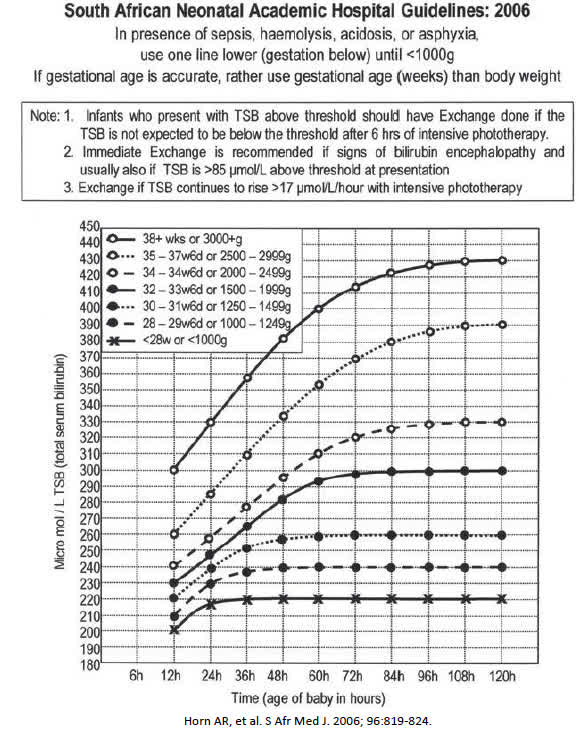
At the clinic the following is important: History eg maternal blood group (O and Rh neg), examination eg is the infant sick/pale or well and special investigations: transcutaneous bilirubin (TcB) level. If there are red flags in the history/exam or the TcB is above the phototherapy line for age and weight (or >250μmmol/l at any time), the baby needs a formal history and examination done plus a laboratory TSB (conjugated and unconjugated fraction). On arrival at hospital, baby should be placed under phototherapy even before the doctor has seen the baby until result of lab TSB is available.
Red flags for pathological jaundice (needs investigation)
- Onset jaundice ≤24hrs of life, duration >14 days in term and >21 days preterm
- Mom: Rh neg or blood group O, anaemia in baby: do haemolysis work-up.
- Sick baby eg sepsis, temperature instability, hypoglycaemia, acidosis, HSM
- Clinical features of bilrubin encephalopathy (kernicterus)
- Serum TSB rising > 50μmol/l in 6 hrs
- Jaundice not responding well to phototherapy ie not coming down by 17-34μmol/l in 4-6hrs under intensive phototherapy
- History of pathological jaundice in siblings or family eg G6PD deficiency etc
- Conjugated fraction > 34μmol/l >20% of total bilirubin (if > 85 μmol/l), pale stools, dark urine
About the TcB (Bilicheck)
It is very accurate at values under 250μmol/l. Above 250μmol/l it can be out with up to 80μmol/l ie formal lab TSB should be requested. After phototherapy, the TcB is inaccurate unless the area of skin tested was covered without interruption or 48hrs have lapsed since phototherapy was stopped. (Also refer to TBH guideline book p21 for trouble shooting).
Management
Early onset jaundice: Haemolysis work-up. Mom bloodgroup and Rh, baby blood group, Rh and Coombs. FBC, diff and smear + reticulocyte count. TSB (also conjugated and unconjugated fraction). If requested urgently and arranged with lab, TSB could be done in 30 minutes. Start intensive phototherapy and repeat lab TSB in 4 hrs.
Jaundice after 24 hrs: exclude haemolysis (see above), rule out infection, extravasated blood/bruising and polycytaemia. Check feeding volumes and infant weight. Do not stop breastfeeding unless exchange transfusion is planned. Supplement with DEBM/formula where indicated to stimulate gut motility and prevention of bilrubin reabsorbtion in the gut.
Prolonged neonatal jaundice: (duration >10 days in term and >21 days preterm): History: breastfeeding, familial jaundice, TPN given. Examination: HSM, pale stools, dark urine. Do FBC, retics, diff and smear, full LFT’s (look specifically at conjugated fraction- >20% of TSB is abnormal), TFT’s, α1-antitrypsin level, urine for reducing substances (to exclude galactocaemia) and urine MCS. If biliary atresia is suspected, request abdo U/S and discuss with consultant for possible liver biopsy/HIDA scan. In severe liver failure, consider doing clotting profile, observation for HGT’s and discussion with TBH.
Phototherapy
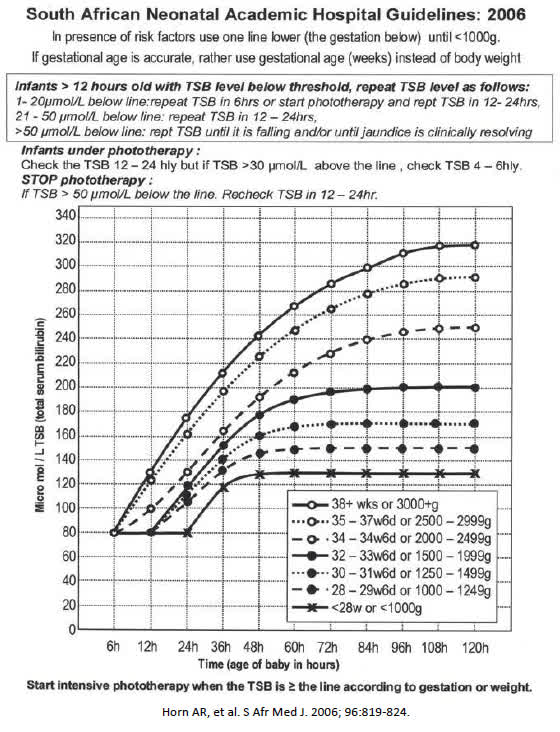
- See guideline charts for when to start
- Indicated for unconjugated hyperbilirubinaemia
- Cover eyes, remove nappy and place under lights (15cm-no further than 40cm away)
- Turn every 2-3hrs
- Monitor temp and increase fluid intake by 10% if lights generate heat
- In severe jaundice or Rh incompatibility, check lab TSB 4hrly
- Stop once TSB 50 μmol/l below phototherapy line
- Light source 460-490nm and irradiance 10-30μW/cm²/nm
- Complications: rash, loose stools, hypo/hyperthermia, dehydration, separation from mother, bronze baby syndrome if conjugated hyperbili gets phototherapy
- Intensive phototherapy should lower TSB by 85μmol/l/hr
- Greater exposure can be achieved by lining the sides of the bassinet with aluminium foil or white linen
Intravenous gamma globulin (Polygam): 0.5g/kg IVI over 2hrs (once off only)
- Discuss with consultant
- Rapidly rising TSB (>8.5μmol/hr) + Coombs: positive haemolytic anaemia
- Babies with rapidly rising TSB and siblings who needed exchange transfusions
- Babies with signs of bilirubin encephalopathy (kernicterus)
- If there is a delay in obtaining blood for exchange transfusion and TSB is rising>8.5μmol/hr despite optimal phototherapy and hydration
Exchange transfusion (discuss with consultant)
- See guideline charts for when to consider
- Babies with signs of bilirubin encephalopathy (kernicterus)
- Order 180ml/kg whole blood < 5days old from blood bank
- Get consent from mother for exchange transfusion
- When blood arrives, check TSB is still above exchange via urgent lab TSB
- Consider taking blood for G6PD deficiency if baby is male before transfusion (Make sure the following bloods were done: BG, Rh, Coombs, FBC with diff, smear and retics, CRP and syphilis serology).
- For procedure: see exchange transfusions under procedures
Exchange transfusion
An exchange transfusion is a medical emergency and any infant that may require an exchange transfusion must be fast tracked with regard to admission, blood samples and intensive phototherapy. Bilirubin levels should be hand delivered to the lab and an urgent result requested – this can be done in 30 min. All infants that need or may require an exchange transfusion must be discussed with the consultant.
Prepare for an exchange:
- Obtain informed consent from the parent(s).
- Ensure that the baby is not fed for at least 2 hours before the procedure.
- Order fresh whole blood (<72hrs old but not older than 5 days). Volume needed: 180ml/kg
- Always examine the infant, check Hgt and temperature before starting the procedure
- Get an assistant who will help with the monitoring of the infant and recording of blood volume removed and given from the infant during the exchange.
- Restrain infant’s limbs and monitor heart rate, respiration, colour and O2 saturation.
- Each unit of blood must be heparinized with 400IU heparin and mixed well (dilute 1 ml 5000iu heparin in 10 ml syringe with saline. 0.8ml from this = 400IU)
- Thereafter add 4ml 10% Ca gluconate in each unit as well and mix.
- A double volume exchange (160-180ml/kg) is done in roughly 4ml/kg aliquots.
- Do not rush the procedure as it may compromise the infant. The procedure can be done over 45-60 minutes.
- Connect 2 two-way taps in series to the feeding tube or umbilical catheter at one end and to the syringe at the other end.
Procedure
- Catheterize the umbilical vein with a feeding tube or umbilical catheter under sterile conditions and advance catheter until there is back flow of blood (usually a few cm).
- Attach the tubing from the blood pack to the side hole of one of the two-way taps and connect a second tubing set from the disposal bag to the other side hole of the second two-way tap for disposal of the blood from the infant.
- Blood must be warmed throughout the exchange either using a warmer or a coil put in a bucket of water with temperature maintained at 37°C (not higher as this will cause haemolysis).
- Start the exchange by drawing blood from the patient first which should be sent for U+E, ionized Ca (ie blood gas) and bilirubin.
- Send blood for the same tests at the end of the exchange.
- Once the exchange is complete, remove the catheter and cover with gauze and a pressure dressing to ensure homeostasis. Alternatively, the catheter can be left in situ in case a second exchange transfusion is needed. There should always be flow through the catheter, so connect either maintenance fluids or normal saline to run at at least 2ml/hr.
- Recheck the Hgt and temperature at the end of an exchange, leave written instructions to monitor the baby ¼ hourly for 1st hour, ½ hourly for 2nd hour, then hourly for the next 4 hrs, then 3 hrly. Heart rate, respiration and saturations should be checked. 3hrly Hgt checks.
- Put the infant back on intensive phototherapy immediately after the exchange and restart feeds (to stimulate gut and prevent reabsorbtion of bilirubin).
- Inform the mother of how the procedure went.
- Document summary of the procedure (including indications and complications).
- Prophylactic antibiotics not indicated.
Phototherapy
Exchange Transfusion