Nephrotic Syndrome (NS) in Children
Approach to nephrotic syndrome in children
Lead Author: Dr Christel Du Buisson
Acknowledgements: Dr Peter Nourse, Dr Priya Gajjar, Prof Mignon McCullouch
These guidelines were created in May 2015.
Algorithms
Introduction
Clinical presentation, examination and assessment
Differential diagnosis of oedema
Investigations
Management
Algorithms
Haemodynamically STABLE
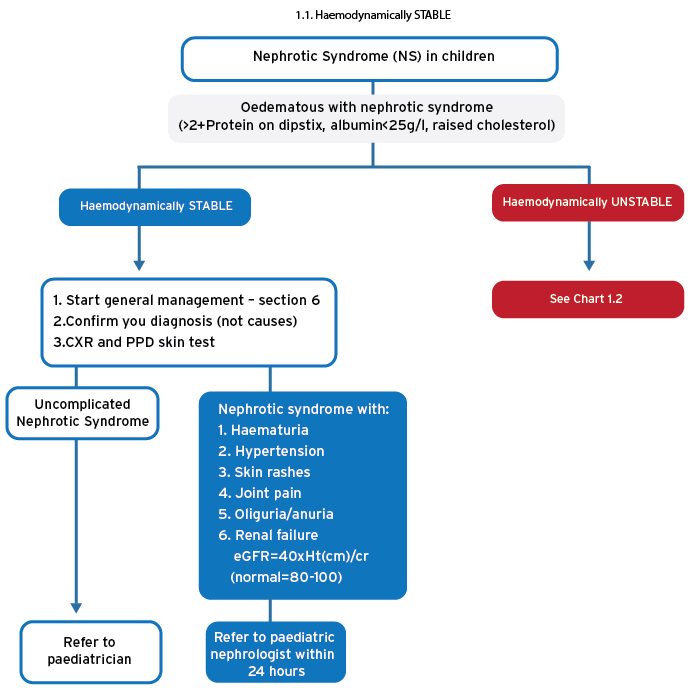
Click on image to enlarge
Hemodynamically UNSTABLE
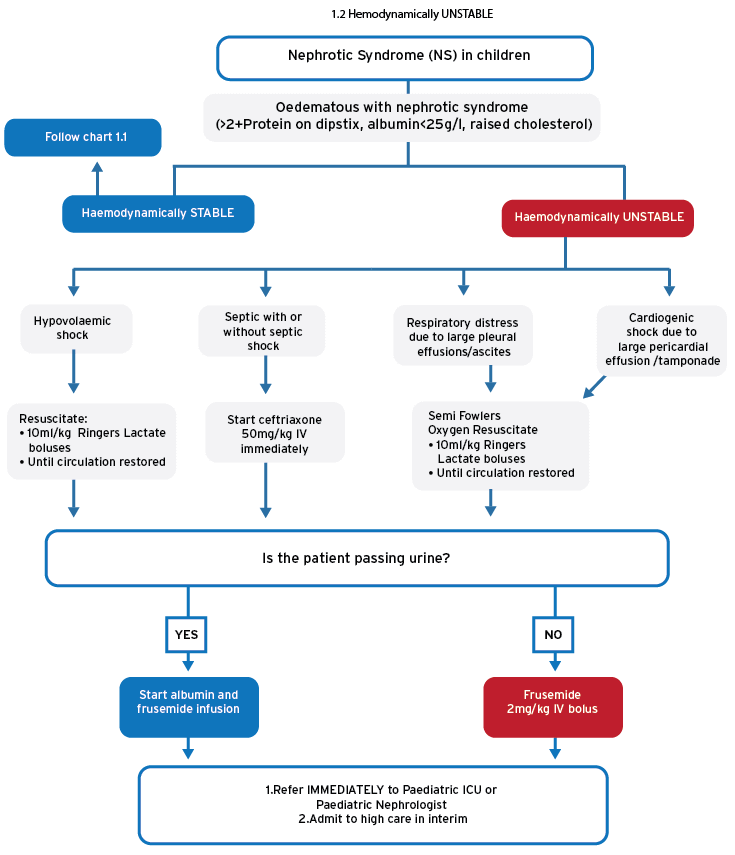
Click on image to enlarge
Introduction
Nephrotic syndrome is a renal disease that presents with the following
- Oedema
- Proteinuria: Protein/Creatinine ratio of above 0.2g/mmol
- Hypoalbuminaemia: Serum Albumin <25mg/l
- Hypercholesterolemia
- All the above criteria have to be present to make a diagnosis of nephrotic syndrome.
- Seen most commonly in ages 3-8 years, but can occur in younger and older children.
- Mostly idiopathic, but there may be history of a preceding upper respiratory tract infection or skin infection.
- Other secondary causes include: Syphilis, Hepatitis B, HIV and Autoimmune diseases, and these have to be excluded before any steroid treatment is commenced.
- When present in a child younger than 2 year of age, congenital nephrotic syndrome has to be considered as a cause.
Clinical presentation, examination & assessment
- Oedema
- This is the most common presenting symptom.
- Facial and periorbital swelling is common – if severe the eyes may be swollen shut
- Varying degrees from mild pedal oedema to more severe cases with massive ascites, pleural and pericardial effusion causing haemodynamic instability and respiratory distress.
- Severe scrotal oedema causes immobility, which is dangerous in patients with nephrotic syndrome, due to a hypercoagulable state.
- Infection
- Pneumonia to peritonitis or meningitis – may present with/without septicaemia.
- This is due to nephrotic patients being immunocompromised.
- Thrombotic episodes
- Nephrotic patients are hypercoagulable.
- Have to exclude DVT if asymmetrical swelling present.
- Also can present with pulmonary emboli, stroke etc.
- Hypovolaemic shock in the face of oedema.
Red flags:
Persistent haematuria: This is seen frequently, but resolves early on. If persistent, the patient has most likely mixed nephritic-nephrotic syndrome.
Persistent hypertension can be seen early in the course, but resolves early on. If persistent the patient most likely has mixed nephritic-nephrotic syndrome.
When patients present before 2 years or after 10 years of age, secondary causes must be excluded as the most likely histological subtype & causes differ in these age groups
Differential Diagnosis of oedema
- Malnutrition: Growth parameters will support this diagnosis. Have hypoalbuminaemia, but normal to low cholesterol levels.
- Cardiac Failure
- Liver failure
- Protein losing enteropathy: Associated history of chronic diarrhoea
Investigations
- Urine:
- Specimen collection for dipstix: Urine bag can be used to collect in children still in nappies. Midstream sample in potty trained children
- Specimen collection for culture:
- If not potty trained: clean catch or in/out sterile catheterisation NOT bag urine
- If potty trained: midstream sample
- Dipstix:
- >2+protein
- Haematuria might be present (if 4+ or macroscopic consider nephritic/nephrotic syndrome)
- When leucocytes and/or nitrites present, a sterile sample needs to be sent for microscopy & culture.
- Urine Protein: Creatinine ratio
- Normal <0.02g/mmol
- Proteinuria 0.02-0.2g/mmol
- Nephrotic range proteinuria >0.2g/mmol
- Blood tests:
- Renal function: Na, K, Urea, Creatinine
- ESR
- Albumin level
- Cholesterol
- Syphilis serology*
- Hepatitis B antigen*
- HIV PCR*
- C3,C4 levels*
- ANA*
*Tests marked with a * are not necessary for diagnosing nephrotic syndrome, but to establish a secondary cause & to start treatment. If you are unable to do these test in you service inform the receiving doctor, as treatment of treatment will need to be delayed until these results are available.
- Mantoux/PPD skin test:This must be done immediately to prevent delay in treatment
- Chest X-ray:
- Must be done to either assess for pleural/pericardial effusion, but to help in excluding or diagnosing Tuberculosis. As the primary treatment in nephrotic syndrome is Corticosteroids, thus TB must be excluded.
Management
Start general management in EC – & specific management on instruction from receiving specialist
General management
- Restrict salt intake, and start high protein diet.
- Strict urine output monitoring
- Blood Pressure monitoring 6 hourly.
- Daily weight.
- Daily urine dipstix.
- Aspirin:
- <1year 1/8 tablet of 250mg
- 1-3years ¼ tablet
- >3years 1/2tablet
References:
- Up To Date: Nephrotic syndrome in children. Available from: UpToDate.com
- A. Pasini and Nephrokid group. Best Practise duilines for idiopathic neprhotic syndrome: Recommendations versus Reality. Paediatric Nephrology (2015)30:91-101