Neuro-Psychological Support
Description Pain Management Mood Disorders Seizures Intracranial Pressure Management Description ICU patients are treated with many interventions that may be distressing and uncomfortable. Pain, restlessness, agitation, and delirium may have untoward effects. LoE:IVb xxviii Pain Management ICD-10 code: R52 Description Prioritization of effective pain control is imperative for optimising the care
Intracranial Pressure Management
Description
ICU patients are treated with many interventions that may be distressing and uncomfortable. Pain, restlessness, agitation, and delirium may have untoward effects.
Pain Management
ICD-10 code: R52
Description
Prioritization of effective pain control is imperative for optimising the care of critically ill patients. Recognizing the impact of uncontrolled pain on anxiety and psychological distress also underscores the importance of a holistic approach to care. A comprehensive treatment approach for critically ill patients places a strong emphasis on timely and appropriate pain management, positively influences physiological stability and patient, reduces the incidence of complications, and improves overall quality of care. Current guidelines recommend that pain management should be guided by routine pain assessment. An example of a pain assessment tool is given in Table 23.1.
Table 23.1 Behavioural Pain Scale
| Item | Description | Score |
| Facial expression | Relaxed | 1 |
| Partially tightened e.g., brow lowering | 2 | |
| Fully tightened e.g. eyelid closing | 3 | |
| Grimacing | 4 | |
| Upper limb movements | No movement | 1 |
| Partially Bent | 2 | |
| Fully bent with finger flexion | 3 | |
| Permanently retracted | 4 | |
| Compliance with mechanical ventilation | Tolerating movement | 1 |
| Coughing but tolerating ventilation for most of the time | 2 | |
| Fighting ventilator | 3 | |
| Unable to control ventilation | 4 | |
| BPS score ranges from 3 (no pain) to 12 (maximum pain) | ||
Taken From: Sessler CN, Gosnell MS, Grap MJ, Brophy GM, O’Neal PV, Keane KA, et al. The Richmond Agitation-Sedation Scale: validity and reliability in adult intensive care unit patients. Am J Respir Crit Care Med. 2002 Nov 15;166(10):1338–44.
General Measures
- Pharmacological treatment includes opioid and non-opioid medicines.
- Pain should be treated before sedation is considered.
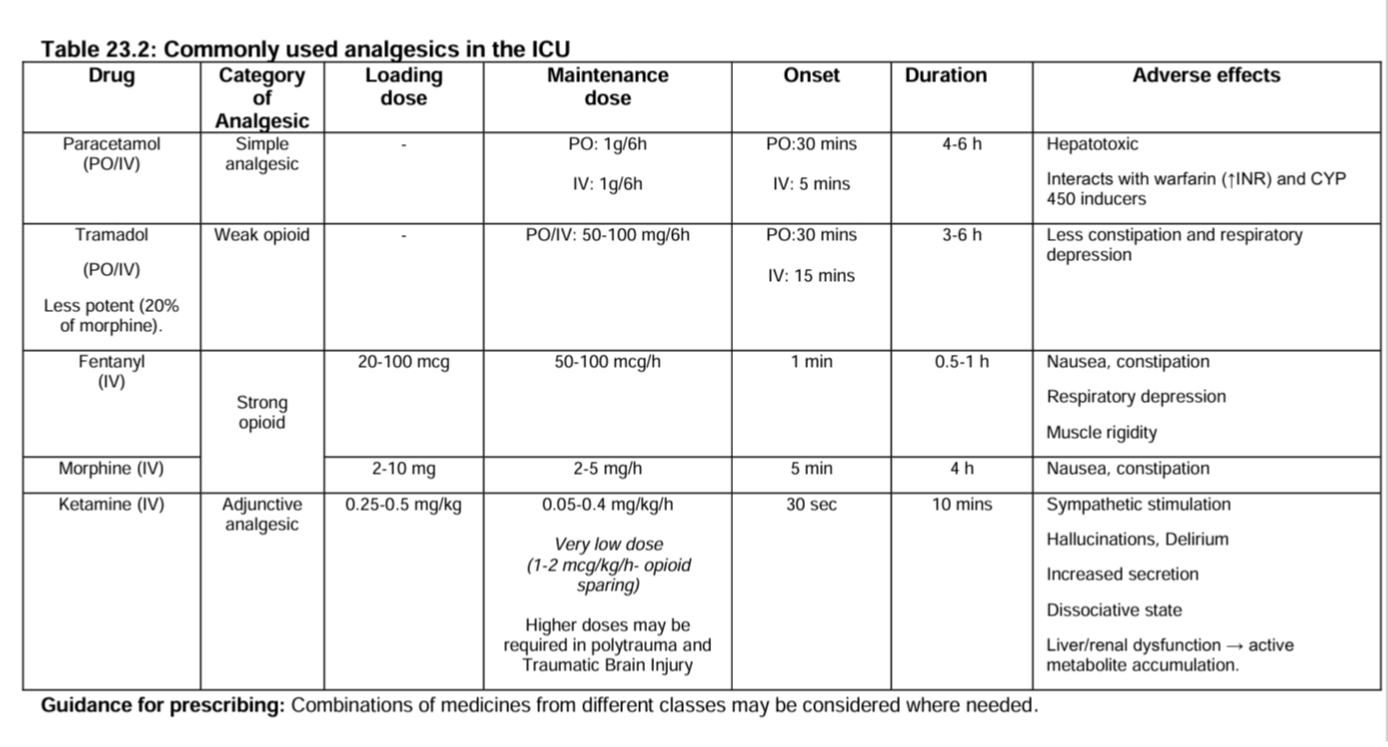
- Table 23.2 provides some important characteristics to be considered when prescribing commonly used analgesics in the ICU.
- Paracetamol and ketamine are recommended adjuncts to reduce opioid consumption.
- Non-pharmacological strategies such as positioning, music, massage and relaxation therapies may also be beneficial.
- See: Perioperative analgesia for more details on pain management.
Medicine Treatment
Parenteral therapy
If paracetamol is required and patient is nil per mouth:
- Paracetamol, IV, 1 g 6 hourly for 24 hours (Specialist initiated).
- If required beyond 24 hours prescription would need to be authorised by a specialist.
Regional anaesthesia
- Local anaesthetic agents can be considered for regional analgesia e.g. epidural (see: Epidural anaesthesia), para-vertebral, and peripheral nerve blocks where expertise is available and appropriate (see: Peripheral nerve block or wound infiltration).
Click on the image to enlarge
LoE:Ivbxxxxii
Click here for the Pain Management pdf
Mood Disorders
See: Mood disorders (Bipolar and Related Disorders and Depressive Disorders).
Seizures
See: Epilepsy.
Intracranial pressure management
See: Brain oedema due to traumatic injury.
Click here for the Mood Disorders, Seizures and Intracranial Pressure Management pdf
Standard Treatment Guidelines and Essential Medicines List for South Africa Adult Hospital _Chapter 23: Adult Critical Care_NEMLC Medicine Recommendations Review Cycle_ 2020_2023