Neuropathic Pain
An approach to symptom management to guide decision-making in the management of patients with life-threatening illness
Explanation to patient and family
Disease specific palliative therapy
Non-pharmacological interventions
The International Association of the Study of Pain defines Neuropathic pain (NeuP) as pain that arises as a “direct consequence of a lesion or disease affecting the somatosensory system”. It is caused by damage or disease affecting the central or peripheral nervous system, for example:
- Peripheral nerve damage (injury) (HIV, surgery, radiotherapy, chemotherapy and other neurotoxic drugs);
- Nerve compression or infiltration (peripheral nerve, spinal nerve root, brachial- and lumbo-sacral plexus)
- Central pain (post stroke, myelopathy, spinal cord compression)
Neuropathic pain has different causes and mechanisms of pain and different treatment to nociceptive pain. Patients suffering from neuropathic pain require careful assessment, regular review of response to treatment and may require changes in treatment to achieve optimal pain control. Most of the evidence for treatment of neuropathic pain comes from studies of Diabetic peripheral Neuropathy (DPN) or Post-Herpetic Neuropathy (PHN).
Assessment of pain
Patients with neuropathic pain experience symptoms in an area of altered sensations. Typical symptoms of NeuP include burning pain, pins and needles, numbness, allodynia (pain produced by a non-noxious stimulus) and hyperalgesia when a normally painful stimulus (e.g. pinprick) evokes a heightened pain sensation. The painful symptoms include spontaneous pain (i.e. occurs with no apparent stimulation), which can be continuous or paroxysmal.
Patients may have a mixed pain picture and frequently a neuropathic pain component is diagnosed, rather than pure neuropathic pain.
In assessing the patient’s pain experience it is important to document the somatosensory abnormalities in the affected area. There are a number of screening tolls to help identify NeuP. These include Douleur Neuropathique en 4 questions DN4 and Leeds Assessment of Neuropathic Symptoms and Signs LANSS.
A simple examination-based way to identify NeuP and differentiate from nociceptive pain is the “3L” approach: Listen, Locate and Look (in the table below).
Listen to the verbal description of pain and any non-painful symptoms in the same area as the pain.
Locate the region of pain and document with a pain drawing, created either by the patient or by the physician. Any abnormal sensations may also be highlighted on the same illustration.
Look for sensory abnormalities and recognise the distribution pattern. A careful inspection of the painful body area should be carried and any differences in colour, texture, temperature etc. should be noted. A simple bedside examination of somatosensory functions is recommended, including touch, cold, warmth and pain sensibility (Table 1 below). The aim is to identify altered sensation in the painful area, and hence responses should be compared with a non-painful adjacent area.
Table 1: Approach to differential diagnosis of Neuropathic pain
| Listen | Locate | Look | |
| Neuropathic pain | Common descriptors: Shooting, electric shock, burning, tingling, itching, numbness | the painful region may not necessarily be the same as the site of injury. Pain occurs in the neurological territory of the affected structure (nerve, root, spinal cord, brain) | Apply bedside sensory tests. Conduct aetiology-specific tests if appropriate |
| Nociceptive pain | Common descriptors: Aching, throbbing, stiffness | Painful region is typically localised at the site of injury | Physical manipulation causes pain in site of injury |
Modified from Haanpaa et al.59
Explanation to patient and family
Patients need to understand that neuropathic pain is challenging to treat, may need several different analgesic strategies and that response to treatment may take several days or weeks. Realistic expectations should be discussed. An explanation of the different drugs and why they are used is important. Patients need to know why they are taking “epilepsy” and “depression” medication for pain. Neuropathic pain is associated with additional problems such as insomnia, depression as well as psychosocial problems affecting a person’s ability to work and interact socially. It is important to involve the interdisciplinary team early to help a person with neuropathic pain.
Correct reversible factors
In patients who are HIV positive experiencing distal sensory neuropathy respond to appropriate antiretroviral medication avoiding stavudine and didanosine. It is important to treat the patient’s pain while waiting for the ARVs to take effect in controlling peripheral neuropathy. Patients with peripheral neuropathy assessed as being caused by ARVs should be changed to a regimen without this side effect.
Disease specific palliative therapy
HAART in patients with HIV/AIDS – prolonged use of any regimen has been shown to decrease the pain severity of HIV associated peripheral neuropathy.
Palliative radiotherapy or chemotherapy to reduce the size of the tumour mass causing the nerve pain may be appropriate.
Non-pharmacological interventions
Good sleep hygiene and graded physical activity. Physiotherapy can reduce myofascial components that commonly exacerbate neuropathic pain.
Pharmacological management
There is substantial individual variation in the response to the medications used to treat neuropathic pain. Therefore a trial of different medications or combinations of these may be required.
Mechanism of action of analgesics used in the management of Neuropathic Pain:
First-line treatment:
- Tricyclic antidepressants – act on descending inhibitory serotogenic and nor-adrenergic pathways. The analgesic effect of tricyclic antidepressants is independent of the antidepressant effect. Starting doses are low 10-25mg amitriptyline at night with titration to 100mg nocte. Combination of low dose amitriptyline with low dose tramadol or morphine has been used successfully in managing peripheral neuropathy in HIV patients treated in SA hospices. The analgesic effect is independent of the antidepressant effect, and occurs at a lower dose. Therefore, low-dose TCA are not the neuropathic pain treatment of choice in patients with co-morbid depression. TCAs are associated with cardiac toxicity and hence amitriptyline is contraindicated in patients who have ischemic heart disease or an increased risk of sudden cardiac death
- Pregabalin and gabapentin act on calcium channels in the dorsal horn of the spinal cord. Gabapentin –start 100mg tds, ttrate to maximum 600mg tds (decrease if impaired renal function) Pregabalin start at 50 mg tds titrate up to 100mg tds. Caution in patients with renal insufficiency.
- Selective serotonin/noradrenalin reuptake inhibitors (SNRIs) also act on descending inhibitory serotogenic and nor-adrenergic pathways. Duloxetine – initiate treatment at 30 mg/day and titrate after one week to 60 mg/day. Venlafaxine - start with 37,5mg/d, titrate to maximum dose of 225mg/d; Venalfaxine should be tapered when treatment is being discontinued as a withdrawal syndrome has been described Both duloxetine and venlafaxine are approved for the treatment of major depression disorder (MDD) and generalised anxiety disorder (GAD) and hence are the treatment of choice in NeuP patients with these co-morbid conditions. Duloxetine is contraindicated in patients with hepatic impairment. Venlafaxine should be prescribed with caution in patients with cardiac disease.
- Carbamazepine and lidocaine target sodium channel in the peripheral nerve
- Tramadol and opioid medications are recommended as first line for patients with acute neuropathic pain, neuropathic pain due to cancer, and episodic exacerbations of severe neuropathic pain, usually in combination with one of the above medications
Combination analgesia is often required in patients with neuropathic pain, often as first line therapy
To date, no single pharmacological agent has been conclusively shown to improve the outcome of pain due to HIV peripheral neuropathy. Symptomatic treatment is therefore based on medication shown to be effective for other similar neuropathic pain states.
Second-line treatment
- Corticosteroids are used as adjuvant treatment if neuropathic pain is suspected to be due to nerve compression e.g. by tumour or inflammation
- Betamethasone – 8mg daily
- Prednisone – 40-60mg daily
- NMDA receptor antagonists: Ketamine (if poor response to first-line options) – 0,25-0,5 mg /kg tds PO/SC/IV
- A trial of ketamine is appropriate in patients with severe refractory neuropathic pain and should be reserved for pain and palliative care specialist use.
- Local application of Capsaicin cream (0,75%) (if poor response to first-line options) applied 5x daily.
- Burning skin pain following application can cause significant distress
(SSRIs and NSAIDs are not recommended for the treatment of neuropathic pain).
Review management
Pharmacological therapy for neuropathic pain requires adequate time to demonstrate maximum efficacy – usually several weeks although there will be an indication of decreasing pain levels as the medication takes effect. The patient and family will need encouragement and to set realistic goals to improving pain levels.
Always consider involvement of the interdisciplinary team or referral to a pain specialist or multidisciplinary pain centre.
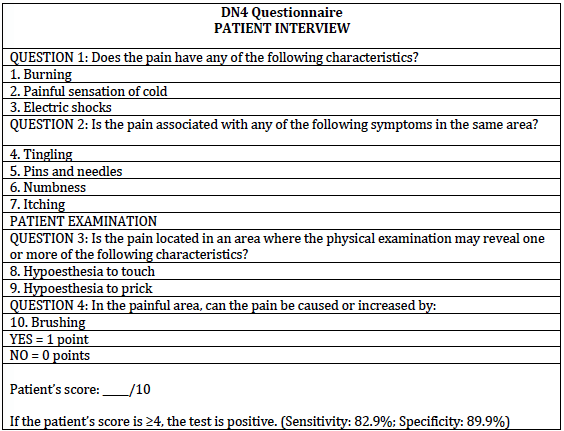
Reprinted from Bouhassira D, et al.