Neuropathy Assessment
Neuropathy Assessment
Rapid Screening for Diabetic Neuropathy Using the 10g Semmes-Weinstein Monofilament
Rapid Screening for Diabetic Neuropathy Using the 128Hz Tuning Fork (The“On-Off” Method)
Rapid Screening for Diabetic Neuropathy Using the Ipswitch Touch the Toes Test
These methods are designed to screen for the presence or absence of diabetic neuropathy, as opposed to screening for specific sites on the feet that are at risk of ulceration (multi site testing). If neuropathy is identified by either of these methods, other sites may be tested to identify high-risk areas for ulceration.
RAPID SCREENING FOR DIABETIC NEUROPATHY USING THE 10G SEMMES-WEINSTEIN MONOFILAMENT
- Show the 10-g Semmes-Weinstein monofilament to the patient
- Touch it first to the patient’s forehead or sternum so that the sensation is understood
- Instruct the patient to say“yes” every time the monofilament stimulus is perceived
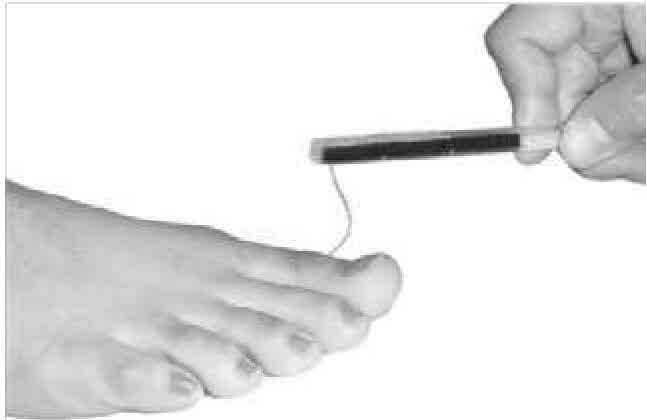
- With the patient’s eyes closed, apply the monofilament to the dorsum of the great toe proximal to the nail bed as shown in the illustration below. Use a smooth motion – touch the skin, bend the filament for a full second, then lift from the skin
- Perform this stimulus 4 times per foot in an arrhythmic manner so the patient does not anticipate when the stimulus is to be applied
- Add up all correct stimuli for a score out of 8. A score of 7 or 8 correct responses likely rules out the presence of neuropathy
RAPID SCREENING FOR DIABETIC NEUROPATHY USING THE 128Hz TUNING FORK (THE "ON-OFF" METHOD)
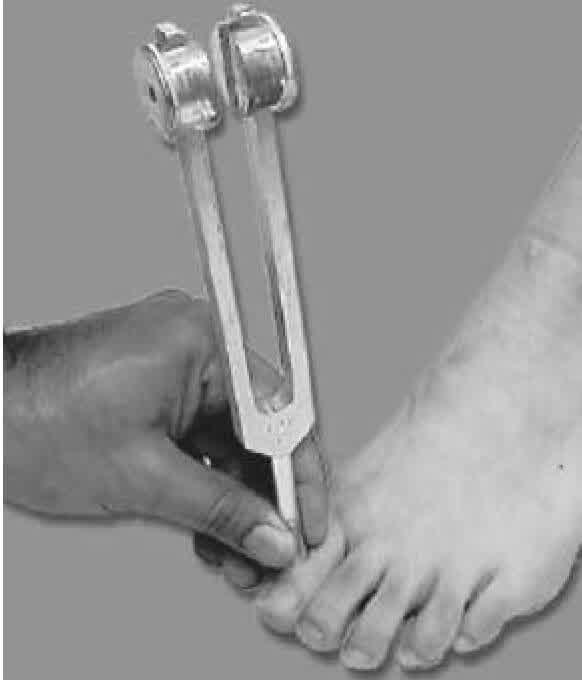
- Strike the tuning fork against the palm of your hand hard enough that it will vibrate for approximately 40 seconds
- Apply the base of the tuning fork to the patient’s forehead or sternum and ensure that the vibration sensation (not just the touch sensation) is understood
- With the patient’s eyes closed, apply the tuning fork to the bony prominence situated at the dorsum of the first toe just proximal to the nail bed. Ask if the vibration sensation is perceived
- Ask the patient to tell you when the vibration stimulus is stopped, and then dampen the tuning fork with your other hand
- One point is assigned for each vibration sensation perceived (vibration “on”). Another point is assigned if the correct timing of dampening of the vibration is perceived (vibration “off ”)
- Repeat this procedure again on the same foot, then twice on the other foot in an arrhythmic manner so the patient does not anticipate when the stimulus is to be applied
- Add up all correct stimuli for a score out of 8. A score of 7 or 8 correct responses likely rules out the presence of neuropathy
RAPID SCREENING FOR DIABETIC NEUROPATHY USING THE IPSWITCH TOUCH THE TOES TEST
- Remove socks and shoes and rest the subject with their feet lying on a sofa or bed
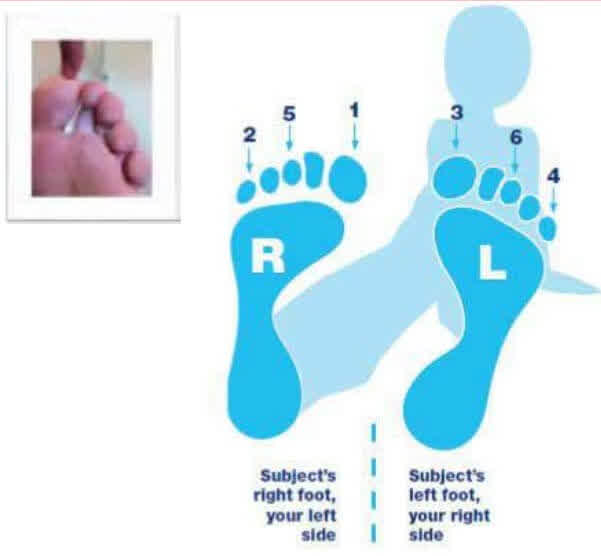
- Remind them which is their RIGHT and LEFT leg, pointing this out by firmly touching each leg, saying “this is your right” when the right leg is touched and “this is your left side” when the left is touched. If you face the soles of their feet their right is on your left
- Ask them to close their eyes and keep them closed until the end of the test
- Inform them that you are going to touch their toes and ask them to say right or left as soon as they feel the touch and depending on which foot was touched
- Perform the touch, using your index (pointing finger) as shown in the photo and diagrams
- The picture also shows which six toes should be touched and the sequence
- Start by lightly touching the tip of the toe marked 1 (right big toe) with the tip of your index finger. The patient will respond by saying “right” if they feel the touch
VERY IMPORTANT
- The touch must be light as a feather, and brief (1–2 seconds): do not press, prod or poke, tap or stroke the skin
- If the person did not respond do not attempt to get a reaction by pressing harder. If they did not feel; this should be recorded as not felt
- You must not touch each toe more than once
- If not felt do not repeat the touch, there is no second chance
- 2 or more spots absent qualifies as neuropathy
Adapted from Touch The Toes Test by Diabetes UK, based on The Ipswich Touch Test: a simple and novel method to screen patients with diabetes at home for increased risk of foot ulceration. Sharma S, Kerry C, Atkins H, Rayman G. Diabet Med. 2014 Sep;31(9):1100-3.