Nonopioid Analgesics and Co-Analgesics
General principles and management of cancer pain in adults
Nonsteroidal anti-inflammatory drugs (NSAIDs) and paracetamol
Management of neuropathic pain
Bone pain and role of bisphosphonates
Antispasmodics: baclofen and hyoscine
Topical lignocaine and capsaicin
Nonsteroidal anti-inflammatory drugs (NSAIDs) and paracetamol
NSAIDs and paracetamol are indicated for mild to moderate pain.
NSAIDs are more effective than placebo for reducing cancer pain, although there is no evidence to support the superiority of one NSAID over another.34 They offer the potential advantage of causing minimal nausea, constipation, sedation or adverse effects on mental functioning and therefore may be useful for control of mild to moderate pain and in conjunction with opioids. Adding a NSAID to opioid analgesia may allow reduction of opioid dose when sedation, confusion, dizziness or other central nervous system effects of opioid analgesia alone have become problematic.2 However, there is conflicting evidence as to whether combining a NSAID with an opioid regimen provides better pain relief than using either of these drugs alone.9
Adverse effects of NSAIDs include dyspepsia and gastrointestinal (GI) ulceration, renal dysfunction and impairment of platelet aggregation. Renal dysfunction and liver failure are relative contraindications to their use. NSAIDs are contraindicated with platelet dysfunction or other potential bleeding disorders, which commonly occur in cancer patients due to either the disease itself or its treatment. Cyclo-oxygenase-2 (COX-2) selective inhibitors (COXIBs) may be associated with a lower risk of GI complications, but this advantage appears to diminish after 6 months of use.2 Co-prescription of misoprostol, standard dose proton pump inhibitors or double dose histamine-2 receptor antagonists, equivalent to ranitidine 300 mg twice daily, may be effective for prevention of gastric and duodenal ulcers associated with chronic use of NSAIDs.9
At prescription doses, ibuprofen has a low risk for gastrointestinal adverse events and with long-term use, in comparison with COXIBs, was no more likely to be associated with withdrawal from clinical studies due to adverse events.35
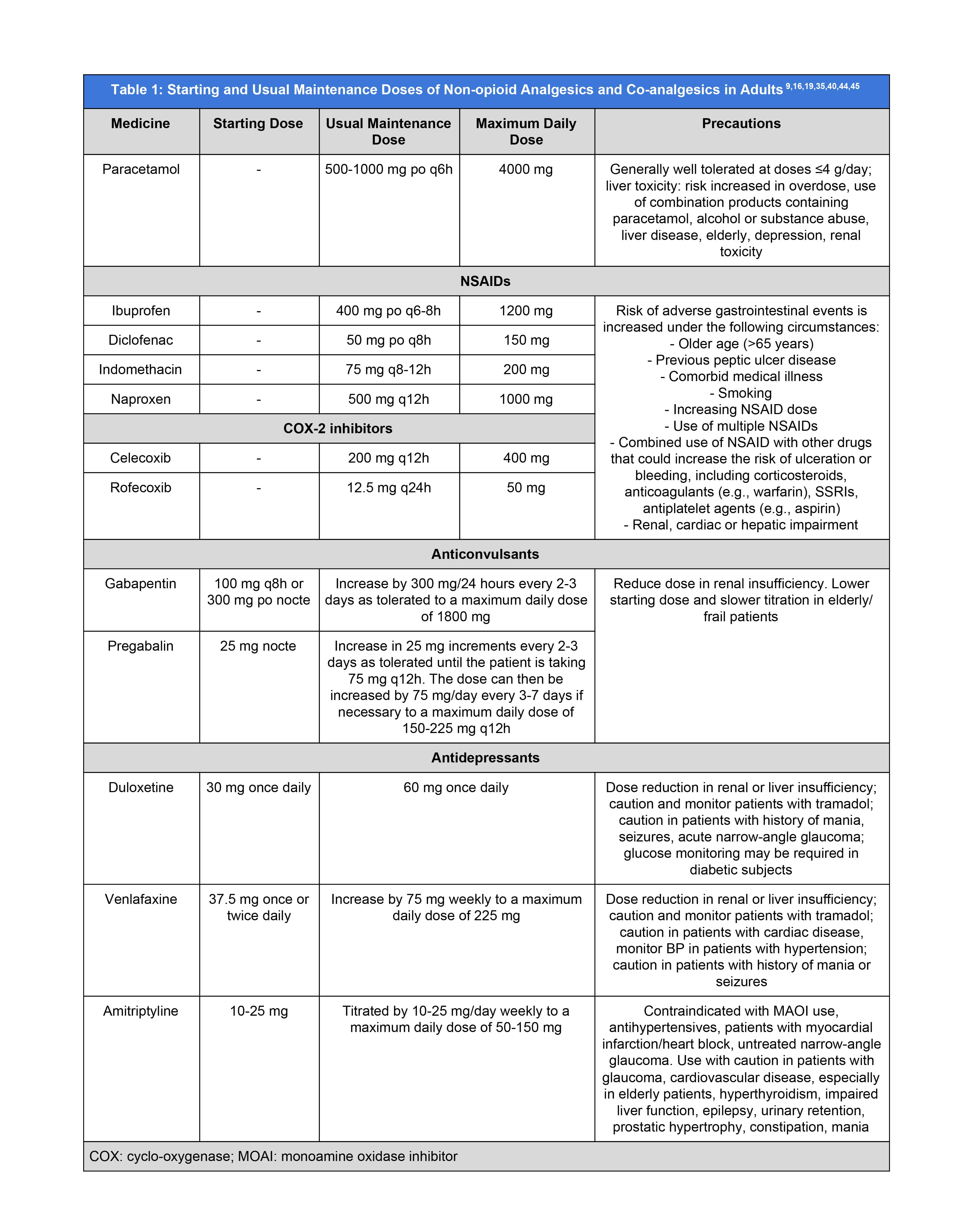
Current recommendations are to use the lowest effective dose of NSAID or COXIB for the shortest period required to control symptoms and to periodically reassess the need for ongoing long-term treatment (Table 1).9
In contrast, there is little or no evidence of benefit of paracetamol at recommended clinical doses (≤4 g/day) in cancer patients, although a trial of therapy may allow individual patients to decide for themself.36-39 If the patient experiences no analgesic benefit after 2 days, paracetamol should be discontinued. When an opioid is added to paracetamol in patients with increasing pain despite a definite past benefit of paracetamol, the need for continuing paracetamol should be reviewed after 3-4 days of adequate pain control. If pain returns after discontinuing paracetamol, it should be restarted.40
Therefore, treatment recommendations are that, unless contraindicated, NSAIDs and/or paracetamol may be prescribed at all stages of the analgesic ladder, with ongoing evaluation and regular re-assessment in patients who have a favourable response that may justify prolonged use.9,11,17,23,36,40
NSAIDs and paracetamol have a limited role in the treatment of neuropathic pain. However, nociceptive and neuropathic pain are often mixed and some patients report relief, so a trial of these agents may be indicated.41
Management of neuropathic pain
Both cancer and/or its treatment may give rise to neuropathic pain. In a large survey of 8615 oncology patients in Europe, 30% were suffering from pain and, of those, 33% were diagnosed with neuropathic pain (half of whom were confirmed using DN4).42 Sixty-nine percent of neuropathic pain cases were tumour related and up to 43% were treatment related, primarily due to chemotherapy or biologic therapy.
When prescribing for neuropathic pain, it is important to note that an analgesic response does not occur immediately and patients should receive an adequate trial of medication before treatment failure is considered.
Anticonvulsants (α2δ-ligands)
The α2δ-ligands, pregabalin and gabapentin, are recommended as first-line therapy for neuropathic pain. Both drugs may also be useful for patients with comorbid sleep disorders, and pregabalin in patients with anxiety disorder associated with pain. The analgesic efficacy of the two drugs is similar. For gabapentin the initial dose is 100 mg three times daily, gradually increased based on clinical response and tolerability, to a maximum daily dose of 1800 mg. Pregabalin should be started at 25 mg at night, increased slowly to 150-225 mg twice daily (Table 1).19
The dose of both drugs needs to be reduced in patients with impaired renal function.
Clonazepam is a reasonable alternative to gabapentin and pregabalin starting at a dose of 0.5 mg twice daily and escalating to 4 mg twice daily. Clonazepam is particularly useful for patients with concomitant insomnia and anxiety, but may result in excessive sedation and/or dissociation when administered in combination with tricyclic antidepressants (TCAs).
Antidepressants
SNRIs (duloxetine and venlafaxine) are recommended as a first-line option for the treatment of neuropathic pain and are also the treatment of choice for patients with comorbid anxiety or depressive disorders.19 To improve tolerability, doses should start low and be titrated according to therapeutic response. Duloxetine should be initiated at 30 mg once daily, increased to 60 mg after 1 week. In patients with painful diabetic neuropathy, 60 mg twice daily was not more effective than 60 mg once daily.43 Venlafaxine should be initiated at 37.5 mg once or twice daily and increased by 75 mg weekly to a maximum daily dose of 225 mg.19 Because abrupt discontinuation of venlafaxine may be associated with withdrawal, the dose should be tapered when stopping. Dose adjustments of SNRIs are required in patients with renal or hepatic impairment.
Because of a risk of serotonin syndrome and seizures, concomitant use of tramadol and antidepressants should be undertaken with caution and patients must be closely monitored. Monoamine oxidase inhibitors (MOAI) should not be used within 14 days of discontinuing tramadol.
Selective serotonin re-uptake inhibitors (SSRIs) are not recommended for the treatment of neuropathic pain.
Tricyclic antidepressants (amitriptyline, imipramine and nortriptyline) are inexpensive and are dosed once daily. Analgesia occurs at lower doses than the antidepressant effect. Amitriptyline should be started at 10-25 mg/day at bedtime and titrated slowly (10-25 mg/day weekly) according to therapeutic effect and tolerability, to a maximum daily dose of 50-150 mg.
TCAs should be used with caution in patients with glaucoma, cardiovascular disease, hyperthyroidism, impaired liver function, epilepsy, urinary retention, prostatic hypertrophy and constipation, and their use should be avoided in the elderly. They may be associated with cardiotoxicity and are contraindicated with antihypertensives and in patients with myocardial infarction and/or heart block (Table 1).
All of the antidepressants have potential for clinically significant drug interactions and these should be considered before prescribing.
A detailed South African guideline for the management of neuropathic pain has been published.19 It is available for download at: http://www.samj.org.za/index.php/samj/article/view/5472 .
Doses of commonly used non-opioid analgesics and precautions for use are listed in Table 1.
Click on image to enlarge
Corticosteroids
Corticosteroids may be useful to help relieve pain associated with nerve compression, spinal cord compression, liver capsule stretch, metastatic arthralgia, bone metastases and headache due to raised intracranial pressure. The dose depends on the clinical situation (Table 2). Start by giving a 5-7 day trial of therapy and if there is a benefit, wean to the lowest effective dose. If there is no benefit, stop. Corticosteroids should be administered in conjunction with other relevant treatment modalities (e.g., radiotherapy) and for the shortest duration possible. Because high doses may be associated with insomnia, avoid administering corticosteroids in the evening.
Adverse effects of corticosteroids include oedema, dyspeptic symptoms, gastrointestinal bleeding, proximal myopathy, agitation, hypomania and opportunistic infections. Adverse gastrointestinal effects may be increased when corticosteroids are co-prescribed with NSAIDs.
| Table 2: Dose of Corticosteroids for Pain Management in Cancer Patients 22 | ||
| Indication | Initial Dose | Maintenance Dose |
| Nerve compression pain | 20-40 mg/ day prednisone/ prednisolone, or 4-6 mg/day dexamethasone or betamethasone Reduce step by step to maintenance dose after 1 week |
May be as low as 15 mg prednisone/ prednisolone or 2 mg dexamethasone or betamethasone |
| Spinal cord compression | Up to 100 mg/day dexamethasone or betamethasone, reducing to 16 mg during radiation therapy | - |
| Raised intracranial pressure | 8-16 mg dexamethasone or betamethasone. Reduce the dose after 1 week | - |
| Prednisone and prednisolone can be used for children, 1-2 mg/kg daily8 | ||
Bone pain and role of bisphosphonates
Pain is a common symptom of bone metastases. It occurs in approximately 30% of cancer patients, increasing to 90% in the later stages. Although the pain is mainly nociceptive in origin, neuropathic pain may also occur when the tumour invades or compresses a nerve, neural plexus or the spinal cord, or where it causes periosteal stretch or involves the Haversian canals.46 In combination with antineoplastic treatment, bisphosphonates (zoledronate, ibandronate, pamidronate and clodronate) have been shown to reduce the incidence of first and subsequent skeletal-related events in some types of cancer and to reduce bone pain due to metastases from solid tumours (breast, lung and prostate) and multiple myeloma.47-53 However, they may be associated with renal toxicity and osteonecrosis of the jaw (ONJ). Patients who have undergone recent tooth extraction or another form of dentoalveolar trauma are especially at risk of ONJ and bisphosphonates should only be prescribed after preventative dental measures, with regular dental evaluations and with ongoing meticulous attention to oral hygiene.54 Nevertheless, prescription of bisphosphonates should not be regarded first-line therapy for bone pain or as an alternative to analgesic treatment (NSAIDs and opioids) or the use of other multimodal pain management strategies (e.g., radiotherapy). Suggested management strategies for pain due to bone metastases are listed in Table 3.
| Table 3. Management of Pain Associated with Bone Metastases 10 | |
| Condition | Management Considerations |
| Uncomplicated bone pain | - Analgesics - Bisphosphonate - Antalgic radiotherapy |
| Complicated bone metastases: spinal cord compression or impending fracture |
- Urgent radiotherapy and/or surgery - Analgesics - Bisphosphonate |
| Previous skeletal-related event (e.g., pathologic fractures, spinal cord compression, the need for orthopaedic surgery and palliative radiotherapy to bone, hypercalcaemia of malignancy) | - Bisphosphonate |
Anxiolytic drugs
Although they may be useful for other indications, the use of benzodiazepines to treat cancer pain is not recommended.
Antispasmodics: baclofen and hyoscine
Baclofen is a GABA-B agonist. It is a centrally acting muscle relaxant with antispasmodic properties. Although evidence is limited, it has been shown to be an effective adjunct for pain relief in patients with cancer-related neuropathic pain.41,55 The effective dose range is wide (20 mg/day to >200 mg/day) and baclofen should be initiated at a low dose and titrated according to clinical response. Because of the possibility of serious withdrawal syndrome, the dose should be gradually tapered when discontinuing.56
Hyoscine butylbromide is an anticholinergic drug that may be useful to relieve pain and reduce gastrointestinal secretions in terminal cancer patients with inoperable bowel obstruction.57,58
Ketamine
Ketamine may be useful in neuropathic pain, ischaemic limb pain and refractory cancer pain, where it may reduce or prevent the development of hyperalgesia and restore opioid sensitivity in opioid-tolerant patients. However, the routine use of ketamine is limited by cognitive and other adverse effects. Furthermore, dosing can be complicated and ketamine should be used only by experienced pain management specialists.2,9,59
Alpha-2 agonists
Clonidine may be given at a dose of 1-2 mcg/kg twice daily (oral 25 mcg tablets are available).
Dexmedetomidine is available as a parenteral preparation that may be given sublingually at a dose of 1 mcg/kg twice daily or added to parenteral morphine or fentanyl.
Topical lignocaine and capsaicin
Although there is evidence of limited efficacy for topical lignocaine (5% lignocaine patch) and capsaicin in addition to standard analgesia in patients with neuropathic pain syndromes, these agents are not available in South Africa and there is no evidence supporting their use in cancer pain. Therefore they are not recommended for this indication.9
Cannabinoids
Medicinal cannabinoids (nabilone and delta-9-tetrahydrocannabinol, THC) are available in some parts of the world and there is ongoing research into their utility for cancer pain. There is evidence that they may be effective in the treatment of both nociceptive and neuropathic pain syndromes. However, especially at higher doses, THC is highly sedating and adverse effects are common, dose-related and may be severe.9 The use of cannabinoids is not recommended in South Africa for the treatment of cancer pain.