Opioid Pharmacology
This guideline is endorsed by the following professional groups: Cape Pelvic Pain Society, PainSA, South African Rheumatism and Arthritis Association, and South African Society of Anaesthesiologists.
Practical aspects of prescribing
Adverse effects of opioid therapy
Driving and working while on opioid therapy
Opioids and problematic drug use
Opioid drugs are agonists that bind to endogenous opioid receptors and mimic the actions of natural morphine-like ligands. The receptors are widespread throughout the central and peripheral nervous system and include μ, δ and κ subtypes. Although the various opioid drugs demonstrate different specificities for receptor subtypes, the clinical relevance of this is uncertain.
Opioids are classified as strong or weak. Formulations that are available in SA and that may be appropriate for the treatment of chronic pain are listed in Table 1.
Oral formulations may be immediate release (IR) (short-acting) or modified release (long-acting).
Table 1: Non-injectable opioids available in South Africa
| Opioid |
Formulations available
|
| Strong | |
| Buprenorphine | Sublingual, transdermal |
| Fentanyl | Transdermal |
| Hydromorphone | Oral |
| Morphine | Oral |
| Oxycodone | Oral |
|
Weak
|
|
| Codeine | Oral |
| Dihydrocodeine | Oral |
| Tramadol | Oral |
Practical aspects of prescribing
General principles
- Chronic opioid therapy (COT) is defined as regular use of strong opioids for at least 3 months
- COT may be appropriate for carefully selected patients where chronic pain significantly affects function and/or quality of life
- Opioids should never be the first-line choice for analgesia in patients with CNCP, but may be included in a pain management strategy for moderate-to-severe chronic pain when optimal use of first-line therapy has failed
Indications for opioid therapy in chronic non-cancer pain (CNCP)
- Types of pain that might respond to opioids include those of both nociceptive and neuropathic (pain related to nervous system injury or disease) origin
- Opioids are not appropriate as the primary medication of choice for pain disorders with strong psychosocial contributing factors (Table 2)
Table 2: Indications for the use of COT
|
COT may be useful for
|
COT should not be used for
|
|
Nociceptive pain
- Osteoarthritis - Rheumatoid arthritis - Lower back pain Neuropathic pain - Peripheral neuropathic pain, e.g. diabetic neuropathy, postherpetic neuralgia, etc. - Central neuropathic pain, e.g. following spinal cord injury, multiple sclerosis, etc. Soft-tissue pain - Fibromyalgia (tramadol only |
- Headache
- Irritable bowel syndrome
- Pelvic pain
- Temporomandibular joint dysfunction
- Atypical facial pain
- Non-cardiac chest pain
- Whiplash-associated pain disorder
- Repetitive strain injury
|
COT = chronic opioid therapy
Patient selection and risk stratification
Before initiating COT, it is necessary to:
- Establish a diagnosis and the cause of the pain
- Estimate the pain intensity and functional impairment (Brief Pain Inventory, Appendix 1)
- Risk stratify the patient in terms of potential benefits and harms of opioid therapy to assess their suitability for COT (Opioid Risk Tool, Appendix 2)
In all patients this requires:
- A thorough history and physical examination
- Assessment of psychosocial factors and family history
- Appropriate special investigations
This assessment should be repeated at every visit, especially when there are new signs or symptoms or where pain intensity changes or is unresponsive to treatment. Useful tools that the patient can complete to assist in the initial and subsequent assessments are listed in Table 3.
Every assessment must be documented by all members of the team to ensure ongoing quality of care.
The presence of increased risk of addiction, or psychiatric or psychological comorbidity does not necessarily preclude COT, but indicates the need for additional consultation and monitoring.
Consultation with an experienced pain clinician and involvement of a multidisciplinary team should be considered before initiating COT in this category of patients. In some patients CNCP may cause comorbid depression, and effective pain management may be associated with an improvement in mood.
Table 3: Assessment tools to evaluate patients for COT (Appendix 1 and 2)
|
Tool
|
Purpose
|
When to complete
|
| BPI | To evaluate physical and psychosocial components of pain | All visits |
| ORT | To evaluate risk of opioid abuse | Initial visit |
COT = chronic opioid therapy; BPI = Brief Pain Inventory; ORT = Opioid Risk Tool
Informed consent, opioid management plans and documentation
The following issues need to be discussed with patients before initiating therapy with COT and at regular intervals thereafter:
- Treatment plan
- Goals of the pain management strategy
- The patient’s expectations from treatment
- Potential benefits and risks of treatment
- Alternatives to COT
Detailed notes of all assessments, results of special investigations, discussions with the patient and caregivers, and treatment decisions should be maintained. Clinicians may consider the use of a written COT informed consent form (opioid agreement), which provides a record of the opioids prescribed and acknowledges discussion about the risks and benefits of COT. An example of an opioid agreement that may be adapted for individual patients is illustrated in Appendix 3.
Choice of opioid
- Opioid analgesics for CNCP may be administered orally or transdermally
- Opioid selection should be individualised according to health status, pain severity, previous exposure to opioids, attainment of therapeutic goals and predicted or observed harms
- Injectable opioids, including pethidine, should never be used for the management of CNCP
Step-wise therapy
Mild-to-moderate pain:
- First-line options: codeine or tramadol
- Second-line options: morphine, dihydrocodeine, low-dose oxycodone, hydromorphone or buprenorphine
Severe pain:
- First-line options: morphine, high-dose oxycodone, hydromorphone or buprenorphine
- Second-line option: fentanyl
Oral opioids
- There are no significant differences between long-acting and short-acting opioids in their analgesic efficacy or adverse effects
- IR oral opioids are useful when initiating therapy and titrating to an effective dose. However, for patients needing continuous analgesia, long-acting (controlled release (CR), extended release (ER), sustained release (SR)) opioids administered at regular intervals should be used
- In contrast to IR preparations, the dosing of long-acting formulations is more convenient and they are less likely to be associated with tolerance and problematic drug use
- High doses of long-acting opioids are recommended only for severe intractable pain in consultation with an experienced pain clinician and/or a multidisciplinary team
Codeine
Codeine is a prodrug that is converted to morphine, which is responsible for its opioid effects. Approximately 10% of Caucasians lack the enzyme required for this metabolic conversion and caution must be applied when switching from codeine to a potent opioid as patients may have little or no opioid tolerance.
Tramadol
In addition to its agonist effect at the μ-opioid receptor, tramadol has noradrenergic and serotonergic effects. Even after short periods of dosing and when used in its SR formulation, it may be associated with significant withdrawal effects. These frequently occur within 12-24h of the last dose.[2] Furthermore, it may increase the risk of seizures in patients at high seizure risk. Because of a risk of serotonin syndrome, concomitant use of antidepressants should be closely monitored. Tramadol has a significantly lower abuse risk than more potent opioids and a low potential for addiction.
Combination formulations and over-the-counter medicines
- In SA, many codeine combination drugs are available, and they are often abused. The amount of codeine in combination products is low and, when used at normal prescribed doses, will not have a significant therapeutic analgesic effect
- Paracetamol is a frequent component of combination analgesics and, in high doses, may cause hepatotoxicity. The risk increases with alcohol use (regular or binge drinking)
- Patients should be advised that the use of non-prescribed combination therapy and over-the-counter (OTC) medication should be avoided while on COT
Initiation and titration of COT
Opioids should be started at a low dose of ~10 mg/day oral morphine equivalents and slowly titrated upwards according to analgesic effect and tolerability. Reassess the dose after 72h, taking into consideration:
- The analgesic effect
- Patient’s return to everyday activities
- Adverse drug effects.
It may be appropriate to do this telephonically if the patient is being treated at home.
Depending on the response, the dose may be increased by not more than 10 mg/day oral morphine equivalents to a maximum of 90 mg/day oral morphine equivalents over a period of 4-6 weeks. Patients should be warned that it might take some days to determine whether the analgesic will be effective.
An initial course of COT should be viewed as a short-term therapeutic trial:
- If there is absolutely no clinical response to a dose of 30-40 mg, further escalation of the dose is probably inappropriate
- If the clinical response to the above dose is insufficient, the dose may be gradually increased as indicated above
- If there is no response to doses of up to 90 mg/day, reconsider whether an opioid is appropriate therapy and refer to a pain clinician and/or multidisciplinary team.
When deciding whether to continue therapy, also consider opioid-related adverse effects, changes in the underlying pain, psychiatric or medical comorbidities and the emergence of drug abuse behaviours. If a decision is made to discontinue opioid therapy, the dose should be discontinued by gradual tapering.
Suggested doses for initiation and titration of opioids are listed in Table 4.
Table 4: Oral opioids: Suggested initial dose and titration*,†
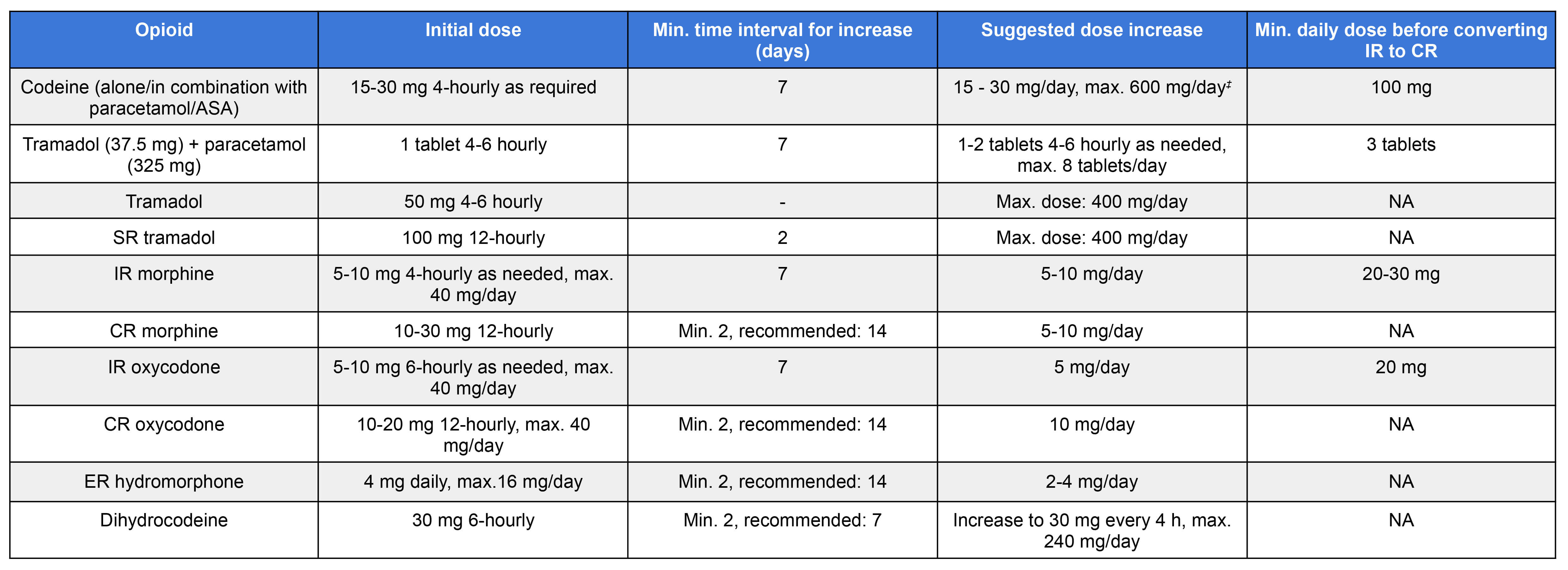
R = immediate release; CR = controlled release; ASA = acetylsalicylic acid; ER = extended release; SR = sustained release.
*Modified from the Canadian National Opioid Use Guideline Group (2010).[4]
†Due to a genetic polymorphism that influences the response to opioid analgesics, there is inter-individual variation in the doses required for adequate analgesia. Some patients will require considerably higher opioid doses than others.
‡Paracetamol dose should not exceed 3 g/day.
Click on image to enlarge
Concomitant medications
- Before prescribing an opioid, consider concomitant medications that have the potential for pharmacokinetic or pharmacodynamic drug interactions
- For patients taking benzodiazepines, consider a trial of tapering and discontinuation. If this is not possible, opioids should be initiated at lower doses and titrated more slowly
Elderly patients
- Prescribing opioids for elderly patients should take into account relevant age-related changes in pharmacokinetics and pharmacodynamics. Lower starting doses (50% of the usual dose), slower titration, longer dosing intervals and more frequent assessment are appropriate
- Opioids should be avoided in cognitively impaired patients living alone, unless ongoing supervision can be arranged
- Oxycodone and hydromorphone may be preferred to oral morphine in elderly patients, because they are less likely to cause severe sedation
Adolescent patients
- The potential for addiction is higher in young people, and opioids represent a hazard to adolescents
- Opioid use should be considered carefully for well-defined indications when non-opioid alternatives have failed
- Patients should be monitored frequently
Pregnancy and breastfeeding
- Opioids should not be used during pregnancy
- Patients who are pregnant or breastfeeding should be referred to a pain clinician
Psychiatric disorders
- Patients on COT have a higher prevalence of depression and other psychiatric conditions than the general population
- Due to diminished response, or enhanced perception of pain, or both, patients with depression or anxiety are less likely to benefit from opioids than those without psychiatric disorders
Addicted patients
- Patients with CNCP who are addicted to opioids should be referred to an experienced pain clinician. A multidisciplinary management approach is required, including a psychologist who has experience in treating addicted patients.
- Buprenorphine is a partial μ-receptor agonist with a long duration of action and is probably safer for opioid-addicted patients requiring COT
Monitoring
Clinicians should regularly reassess all patients on COT, with special attention to the ‘5 As’:
- Analgesia (pain relief)
- Activity (improvement in function)
- Adverse effects
- Affect (mood/ psychological comorbidities)
- Aberrant behaviour (problem drug use)
If necessary, compliance with therapy may be confirmed with urine screening and/or pill counting.
Dose escalation and switching to another opioid
When repeated dose escalations are required, the patient should receive a thorough physical and biopsychosocial assessment to determine the underlying reason. Increasing doses of COT may be indicative of:
- An increase in the intensity of the underlying pain condition (disease progression)
- Development of an additional painful condition
- Opioid tolerance
- Opioid-induced hyperalgesia
- Problem drug use/ abuse
When analgesia is inadequate despite opioid dose escalation, or where adverse effects are intolerable at higher doses, consider discontinuing COT and/or switching to an alternative opioid.
Switching to another oral opioid
Equianalgesic doses of alternative oral opioids are listed in Table 5. The new opioid should be initiated at 50% of the calculated equianalgesic dose. If converting from opioids other than morphine, calculate the equipotent morphine dose for the current analgesic and use this dose to convert to the new opioid.
Table 5: Equianalgesic doses for conversion from one oral opioid to another*,†
| Opioid | Equivalence to 30 mg morphine (mg) | Conversion to/ from oral morphine equivalent – multiply by | |
| to | from | ||
| Morphine | 30 | 1 | 1 |
| Codeine | 200 | 0.15 | 6.67 |
| Oxycodone | 20 | 1.5 | 0.67 |
| Hydromorphone | 6 | 5 | 0.2 |
| Dihydrocodeine | 180 | 0.16 | 6 |
| Tramadol | ~1:10‡ | - | - |
*Adapted from the Canadian National Opioid Use Guideline Group (2010).[4]
†If converting from opioids other than morphine, calculate the equipotent morphine dose for the current analgesic and use this dose to convert to the new opioid. The new opioid should be initiated at 50% of the calculated equianalgesic dose.
‡Morphine dose equivalence not established, but approximates to 1:10 of morphine to tramadol.
Switching from an oral to a transdermal opioid
Patients with chronic stable pain may be switched from an oral to a transdermal opioid patch. Table 6 shows approximate equipotent analgesic doses for conversion from oral morphine to transdermal fentanyl or buprenorphine. If dose titration is required to achieve pain control, the strength (opioid dose) of the patch may be increased, or a combination of lower strength patches may be applied at different places to achieve pain control.
The fentanyl patch may be titrated every 72h and buprenorphine patch every 3-5 days.
Buprenorphine is a partial opioid receptor agonist; therefore withdrawal symptoms may be experienced in patients who have developed physical dependence on opioids. In overdose it is only partially reversed by naloxone.[6]
Table 6: Approximate equipotent doses for conversion from oral morphine to transdermal opioids

*Adapted from the Canadian National Opioid Use Guideline Group (2010).[4]
† Conversion rate is 150:1,[6] e.g. 120 mg morphine over 24 h: 120 ÷ 150 = 0.8 mg fentanyl; 0.8 × 1 000 = 800 μg fentanyl over 24 h = 33.3 μg /h. Round up or down to the
appropriate patch. ‡ Formulations include 12, 25, 50, 75 and 100 μg/h patches, but the 12 μg/h patch is generally used for dose adjustment rather than initiation of fentanyl
treatment.
§ Adapted from the British Pain Society (2010).[2]
¶ Conversion rate is 75 - 100:1.[2,6] The conversion rate used here is based on 75:1, e.g. 30 mg morphine over 24 h: 30 ÷ 75 = 0.4 mg buprenorphine; 0.4 × 1 000 = 400 μg
buprenorphine over 24 h = 16.6 μg/h. Round up or down to the appropriate patch.
Click on image to enlarge
Breakthrough pain
Breakthrough pain is defined as infrequent short episodes of increased pain occurring on a background of stable well-controlled pain. It must be differentiated from incident pain associated with a particular movement, posture or activity, and additional diagnostic testing or consultation may be necessary to identify its aetiology or precipitating factors.
In patients on continuous opioid therapy who experience breakthrough pain, as-needed IR opioids may be useful for rescue analgesia. However, benefits and potential risks should be carefully considered before prescribing the as-needed rescue opioid and suitability of non-opioid drug therapies and non-pharmacological treatment options should be investigated first.
When regular rescue doses are required, the maintenance opioid dose should be up-titrated by adding the extra dose per day required for breakthrough pain.
For example, a patient receiving oral morphine 10 mg 4-hourly and requiring rescue doses for breakthrough pain (10 mg) three times daily, will be converted to a new daily dose as follows:
(Maintenance: 10 mg × 6) + (Breakthrough: 10 mg × 3) = 90 mg daily
Once pain control is stable, this dose may be administered as:
- IR oral morphine 15 mg every 4h, or
- An equivalent dose of 12-hourly long-acting morphine twice daily plus appropriate doses of IR morphine for breakthrough pain
Because of their long half-life and prolonged time to reach steady state, transdermal opioids are not appropriate as rescue therapy for breakthrough pain.
Long-term opioid prescribing
When a trial of opioid has been successful, treatment may be continued until:
- The underlying painful condition resolves
- The patient receives a definitive pain-relieving intervention (e.g. joint replacement)
- The patient no longer derives benefit from opioid treatment
- The patient develops intolerable side-effects, or
- There is evidence of addiction, tolerance, dependence or opioid-induced hyperalgesia
Discontinuing opioids
- When discontinuing an opioid, the dose should be slowly reduced by approximately 10% per day or per week
- Dose should be tapered more slowly in patients who are anxious about discontinuing COT and in those who are suspected of being physically dependent on opioids
- When one-third of the original dose is reached, reduce the rate of tapering to a half or less of the initial rate
- If the patient experiences withdrawal symptoms or an increase in pain during tapering, discontinue dose reduction and consider increasing the current dose
Adverse effects of opioid therapy
Fear of adverse effects should not interfere with appropriate use of COT in patients who need it, and they should be reassured that side-effects are manageable.
Common adverse effects
Treatment-related side-effects are common on initiation of opioid therapy and patients should be advised about the likelihood of their occurrence before starting treatment. The most frequent adverse events include:
- Constipation
- Nausea
- Somnolence
- Itching
- Dizziness
With the exception of constipation and pruritus, which are often persistent, tolerance usually develops within a few days of continuous dosing. Management approaches for emergent side-effects are listed in Table 7. If side-effects are intolerable and the dose of the current treatment cannot be reduced, it may be beneficial to switch to an alternative opioid.
Table 7: Common opioid-related adverse effects and their management
| Adverse effect | Management |
| Nausea/ vomiting | Anti-emetic therapies (oral or suppository); it is advisable to concurrently prescribe a prophylactic anti-emetic for a few days when initiating opioid therapy |
| Constipation | Increase fluid and fibre intake; stool softeners; laxatives |
| Pruritus | Antihistamine |
| Sedation, clouded mentation | Pharmacological therapies are not recommended |
Respiratory depression
Respiratory depression is seldom a problem associated with the use of opioids for chronic pain, except where there are major changes in opioid dose, formulation or route of administration, or with accidental overdose. Care should be taken when initiating or titrating opioids in patients taking other sedative medications and in those with pre-existing disorders of respiratory control, such as obstructive sleep apnoea, who may be at higher risk for respiratory depression.
Opioid toxicity and withdrawal
Patients, caregivers and family members of patients on opioid therapy should be made aware of the clinical features of opioid toxicity, which indicate urgent referral to medical care. The dose at which this may occur is variable depending on comorbidities (particularly renal and hepatic insufficiency) and concomitant drug use, including both prescription and OTC medicines.
Opioid withdrawal symptoms may occur with abrupt discontinuation, rapid dose tapering, or administration of an opioid antagonist. Treatment of acute withdrawal includes administration of intravenous fluids, glucose, α-2 adrenoceptor agonist drugs (e.g. clonidine) and antispasmodic medicines for abdominal cramps. Small doses of opioids may also be given to improve symptoms.
Symptoms associated with toxicity or withdrawal are listed in Table 8.
Table 8: Clinical features of opioid toxicity and withdrawal
| Symptoms | |
Toxicity |
- Pinpoint pupils - Sedation (falling asleep during conversation or activity) - Slow respiration - Visible cyanosis, e.g. lips, ears, nose (in severe cases) - Myoclonic jerks - Snoring when asleep - Agitation - Confusion - Vivid dreams, nightmares or hallucinations |
| In more severe cases: - Hypotension - Coma - Convulsions |
|
Withdrawal |
- Sweating - Mydriasis - Pilo-erection - Yawning - Abdominal cramps/ vomiting/ diarrhoea - Bone and muscle pain - Increase in usual pain - Restlessness - Anxiety - Rhinorrhoea - Lacrimation - Tremor |
Long-term effects
Endocrine effects
Long-term administration of opioids may have dose-dependent effects on both the hypothalamic-pituitary-adrenal axis and the hypothalamic-pituitary-gonadal axis, with consequent adrenal insufficiency and hypogonadism. Clinical symptoms include reduced libido, infertility and depression in women, and erectile dysfunction and decreased libido in men. Patients should be advised about these adverse effects before starting opioid therapy. If clinically indicated, referral to an endocrinologist for advice about hormone replacement therapy may be necessary.
Immunological effects
Both animal and human studies have demonstrated that opioids may have an immunosuppressive effect. The clinical relevance of these findings is unknown.
Opioid-induced hyperalgesia
Long-term use of opioids, especially at higher doses, may be associated with the development of hyperalgesia – an increased sensitivity or sensation of pain in the absence of overt opioid withdrawal. The pain of hyperalgesia is often more diffuse and less defined in quality than the pre-existing pain.
Hyperalgesia may be managed by gradually tapering and discontinuing COT.
Driving and working while on opioid therapy
Opioids may cause somnolence, clouded mentation, decreased concentration, inco-ordination or slower reflexes that may impair the patient’s ability to drive safely or to work safely with machines, on ladders, etc. Patients should be advised not to drive immediately, work under hazardous conditions or work with hazardous machinery after initiating or while titrating an opioid until a stable dose is established and they are certain that it does not cause sedation. Driving and hazardous work should also be avoided when taking opioids with alcohol or other drugs that could produce an added sedative affect.
Opioids and problematic drug use
The prescription of opioids may result in problematic drug use. The likelihood of this occurring is influenced by a number of social, psychological and health-related factors.
Terms relating to problematic drug use are defined in Table 9.
Table 9: Terms relating to problematic drug use
| Term | Explanation |
| Addiction | A primary, chronic, neurobiological disease with genetic, psychosocial and environmental factors influencing its development and manifestations; characterised by behaviours that include one or more of the following: - Impaired control over drug use - Compulsive use - Continued use despite harm - Craving |
| Problematic drug behaviour | Behaviour outside of the boundaries of the treatment plan agreed upon by the doctor and patient at the start of therapy (e.g. opioid agreement) |
| Physical dependence | A state of physiological adaptation manifested by a drug class-specific withdrawal syndrome that can be produced by abrupt cessation, rapid dose reduction, decreasing blood level of the drug or administration of an antagonist |
| Pseudo-addiction | Drug-seeking behaviours such as drug hoarding, requests for additional prescriptions or increased doses in patients with inadequate treatment These behaviours may be mistaken as signs of addiction, but occur in an attempt to obtain better pain relief and cease when pain is controlled |
| Tolerance | Reduced analgesic effect for an equivalent dose or requirement of an increased dose to achieve the same effect |
Although the need for increasing doses is not always indicative of opioid abuse (See: Dose escalation and switching to another opioid), some of the behaviours that may suggest problem drug use include:
- Earlier prescription seeking
- Claims of lost medication
- Intoxication
- Frequent missed appointments
- Use of other scheduled drugs or opioids from other sources
- Stealing or borrowing drugs, or forging prescriptions
- Overwhelming focus on opioid issues
- Resistance to change of therapy, despite evidence of adverse drug effects
- Aggressive complaining about the need for more drugs
Concerns about problem drug use should prompt referral to specialised multidisciplinary pain and addiction services.
At each return visit to the clinician and before the prescription of additional opioids, a full biopsychosocial assessment should be repeated on every patient to ensure that the prescription is necessary and appropriate. COT should not be initiated without this commitment from the patient and their primary healthcare provider.