Opportunistic Diseases
Please click on the link below to access the most up-to-date version of this guideline. The content on this page is currently being updated to align with the latest publication. Always check the version number at the bottom of the screen to confirm which version you are using. Click here to access the Adult Hospital Level Chapter 10: HIV_and_AIDS_with_supporting_NEMLC_Report_Reviews_2025-9-Versio
Please click on the link below to access the most up-to-date version of this guideline. The content on this page is currently being updated to align with the latest publication. Always check the version number at the bottom of the screen to confirm which version you are using.
Tuberculosis preventive therapy (TPT)
Opportunistic infection prophylaxis, with cotrimoxazole
Candidiasis of oesophagus/ trachea/ bronchi
Cryptococcosis:
Cytomegalovirus (CMV)
Cystoisosporiasis
Mycobacteriosis - disseminated non-tuberculous
Pneumocystis pneumonia
Cerebral toxoplasmosis
TUBERCULOSIS PREVENTIVE THERAPY (TPT)
Z29.2 + (B24)
Patients with HIV infection at any CD4 count are more susceptible to TB infection than HIV-uninfected patients. TPT is an effective intervention for reducing the incidence of TB in HIV-infected patients.
Eligibility
All HIV-infected patients, irrespective of CD4 count, tuberculin skin test status, and ART status.
Exclusions
- Suspected or confirmed TB
- Painful peripheral neuropathy
- Liver Disease
- Alcohol use disorder
- Previous MDR- or XDR-TB
Note:
Exclude TB prior to initiating TPT by screening for the following:
- Cough (any duration)
- Weight loss
- Fever
- Night sweats
- Do not initiate TPT in patients if any of the above is present. These patients require further investigation for active TB.
Ideally start TPT together with ARVs:
- TPT, e.g.:
- Isoniazid, oral, 300 mg daily for 12 months.
- Educate patients on the symptoms of hepatotoxicity (nausea, vomiting, yellow eyes, brown urine, and pain in right upper quadrant) associated with TPT.
LoE:IIbxxxii
Note:
For adults and adolescents initiating a DTG-containing ART regimen, isoniazid daily for 12 months is the preferred regimen. For patients who are already virally suppressed on a DTG-based regimen, a weekly combination of isoniazid (900mg if weight >30 kg) plus rifapentine (900mg if weight >30 kg) for three months may be preferred. Do not use rifapentine-containing TPT in patients on protease inhibitor-based ART, or in women on hormonal contraceptives. [See the therapeutic interchange database for details regarding the rifapentine-containing TPT regimen].
LoE:IIbxxxiii
ADD
- Pyridoxine, oral, 25 mg once daily for the full duration of the TPT regimen.
- Instruct patient to present early if any of these symptoms arise.
- Patients should be followed up monthly for the first 3 months.
NOTE:
For pregnant women:
- Defer TPT until after delivery.
- Ensure that routine screening against TB is conducted at each antenatal visit.
LoE:IIbxxxiv
OPPORTUNISTIC INFECTION PROPHYLAXIS, WITH COTRIMOXAZOLE
Z29.2 + (B24)
DESCRIPTION
Primary prophylaxis reduces the probability of developing many infections, e.g.:
- Pneumocystis pneumonia
- bacteraemia
- toxoplasmosis
- cystoisosporiasis
- bacterial pneumonia
Indications for primary prophylaxis:
- WHO Clinical stage III or IV.
- CD4 count <200 cells/mm3.
LoE:IIaxxxv
MEDICINE TREATMENT
Prophylaxis
- Cotrimoxazole, oral, 160/800 daily.
LoE:IIaxxxvi
Note:
Discontinue prophylaxis once the CD4 >200 cells/mm3 (as measured at the routine CD4 count done at 1 year on ART). If the CD4 count was >200 cells/mm3 when cotrimoxazole was commenced (e.g. patients with TB), continue for 6 months.
LoE:IIIbxxxvii
CANDIDIASIS OF THE OESOPHAGUS/TRACHEA/ BRONCHI
B20.4
DESCRIPTION
Mucosal candidiasis involving the oesophagus/trachea/bronchi is AIDS-defining (WHO clinical stage 4). Oesophagitis is by far the commonest manifestation.
Clinical features: symptoms of pain or difficulty on swallowing. Oral thrush is present in most patients.
GENERAL MEASURES
Maintain adequate hydration.
MEDICINE TREATMENT
- Fluconazole, IV/oral, 200 mg daily for 14 days.
- The usual route is oral but give IV if patient unable to swallow or is vomiting.
- An early relapse should be treated with a 4-week course of fluconazole, using a similar dose as above.
- If no response to fluconazole, collect sample to confirm diagnosis of candidiasis (perform fungal MC&S).
Note:
Primary or secondary fluconazole prophylaxis for mucosal candidiasis is not recommended.
CRYPTOCOCCOSIS
Algorithm for the presentation, diagnosis and management of cryptococcal disease among HIV-Infected persons
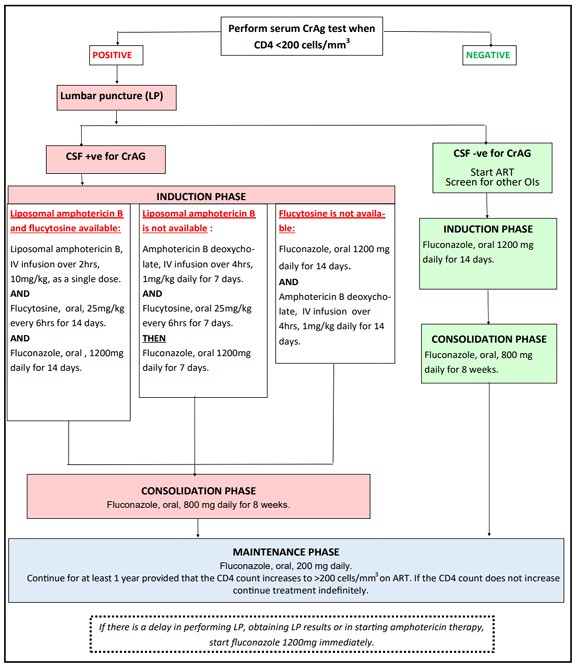
Click on image to enlarge
Adapted from: Govender NP, Meintjes G, Mangena et al. Southern African HIV Clinicians Society guideline for the prevention, diagnosis and management of cryptococcal disease among HIV-infected persons: 2019 update. S Afr J HIV Med 2019;20(1):a1030. https://doi.org/10.4102/sajhivmed.v20i1.1030
Figure: Algorithm for the prevention, diagnosis and management of cryptococcal disease among HIV-infected persons
CRYPTOCOCCOSIS, CSF CRAG NEGATIVE
(B45.0-3/B45.7-9) + B20.5
DESCRIPTION
- All ART-naïve patients with CD4 <100 cells/mm3 should have cryptococcal antigen (CrAg) test done on serum, plasma or whole blood (unless they had a diagnosis of cryptococcal infection).
- This is performed as a reflex test on the patient’s CD4 sample if it is <100 cells/mm3. If the CD4 count is between 100 and 199, a separate sample should be sent for CrAg testing.
- If the CrAg test is positive, all patients should have a lumbar puncture, regardless of whether symptoms of meningitis are present, since asymptomatic cryptococcal meningitis may be present. Confirm cryptococcal meningitis by testing for CSF CrAg.
LoE:IIaxxxviii
MEDICINE TREATMENT
If cryptococcal meningitis is excluded by negative CSF CrAg:
- Commence ART immediately - See: Antiretroviral therapy.
LoE:IIIaxxxix
Induction phase
- Fluconazole, oral 1200 mg daily for 14 days.
Consolidation phase
Follow with:
- Fluconazole, oral, 800 mg daily for 8 weeks.
Maintenance phase
- Fluconazole, oral, 200 mg daily.
- Continue for at least 1 year provided that the CD4 count increases to > 200 cells/mm3 on ART. If the CD4 count does not increase continue treatment indefinitely.
LoE:IIIbxl
CAUTION:
- Fluconazole is potentially teratogenic when used during the 1st trimester, but pregnant women should be counselled that the benefits of fluconazole likely outweigh the risks in the management of cryptococcosis.
- All pregnant women <20 weeks gestation exposed to fluconazole should have an ultrasound scan to detect congenital abnormalities.
LoE:IIIbxli
- Although fluconazole is excreted into breast milk at concentrations similar to maternal plasma concentrations, the dose that the infant is exposed to with doses <400 mg is similar to the dose used in systemic treatment in infants. The benefits will likely outweigh the risks, even with higher doses, though this can be discussed with a specialist.
LoE:IVbxlii
CRYPTOCOCCOSIS MENINGITIS
B20.5 + (B45.1 + G02.1*)
DESCRIPTION
Cryptococcal meningitis is the commonest manifestation of disseminated cryptococcosis in patients with advanced HIV. Severe headache is common due to raised intracranial pressure.
Diagnosis
Confirmed on lumbar puncture.
GENERAL MEASURES
- Therapeutic lumbar puncture is indicated to lower pressure in symptomatic patients and should be done with pressure monitoring.
- Remove sufficient CSF (maximum 30 mL) to lower pressure to 50% of the opening pressure but not less than 20 cm H2O.
- Continue daily therapeutic lumbar puncture until there is clinical improvement.
MEDICINE TREATMENT
Induction phase
If liposomal amphotericin B and flucytosine are available:
- Liposomal amphotericin B, slow IV infusion over 2 hours, 10 mg/kg in dextrose 5%, single dose.
LoE:IVbxliii
AND
- Flucytosine, oral 25 mg/kg 6 hourly for 14 days (see flucytosine weight-based dosing table below).
- Flucytosine requires dose adjustment in renal failure (see Appendix II for preventing, monitoring and management of toxicity).
LoE:IIaxliv
AND
- Fluconazole, oral 1200 mg daily for 14 days o Fluconazole requires dose adjustment in renal failure.
If liposomal amphotericin B is not available:
- Amphotericin B deoxycholate, slow IV infusion, 1 mg/kg daily in dextrose 5% over 4 hours for 7 days.
- Ensure adequate hydration to minimise nephrotoxicity (see Appendix II for preventing, monitoring and management of toxicity).
AND
- Flucytosine, oral 25 mg/kg 6 hourly for 7 days (see flucytosine weight-based dosing table below).
- Flucytosine requires dose adjustment in renal failure (see Appendix II for preventing, monitoring and management of toxicity).
THEN (i.e. days 8-14 of induction phase):
- Fluconazole, oral 1200 mg daily for 7 days.
LoE:IVbxlv
If flucytosine is not available:
- Fluconazole, oral 1200 mg daily for 14 days.
LoE:IIaxlvi
AND
- Amphotericin B deoxycholate, slow IV infusion, 1 mg/kg daily in dextrose 5% over 4 hours for 14 days.
- Ensure adequate hydration to minimise nephrotoxicity. (see Appendix II for preventing, monitoring and management of toxicity).
Consolidation phase
Follow with:
- Fluconazole, oral, 800 mg daily for 8 weeks.
LoE:IIIaxlvii
Maintenance phase
- Fluconazole, oral, 200 mg daily.
LoE:Iaxlviii- Continue for at least 1 year provided that the CD4 count increases to >200 cells/mm3 on ART. If the CD4 count does not increase, continue treatment indefinitely.
- Commence ART 4–6 weeks after starting antifungal therapy. See Section 10.1: Antiretroviral therapy.
LoE:IIIaxlix
Note:
Adjunctive corticosteroids have been shown to be detrimental.
LoE:Ial
Flucytosine weight-based dosing:
| Weight | 6 hourly dosing |
| 30-39 kg | 750 mg 6 hourly |
| 40-49 kg | 1000 mg 6 hourly |
| 50-59 kg | 1250 mg 6 hourly |
| 60-69 kg | 1500 mg 6 hourly |
| 70-79 kg | 1750 mg 6 hourly |
Table: Flucytosine weight-based dosing
REFERRAL
- Focal neurological signs – CT scan required to exclude other pathology e.g. toxoplasmosis.
- Persistent raised intracranial pressure despite daily therapeutic lumbar puncture.
CRYPTOSPORIDIOSIS DIARRHOEA
A07.2 + (B20.8)
DESCRIPTION
Chronic diarrhoea due to Cryptosporidium parvum. Disease lasting >4 weeks is AIDS-defining (WHO clinical stage 4).
GENERAL MEASURES
Rehydration with oral rehydration solution (ORS).
MEDICINE TREATMENT
There is no specific antimicrobial therapy for cryptosporidiosis. As with other opportunistic diseases it responds well to ART.
Antimotility agents are partially effective, e.g.:
- Loperamide, oral, 4 mg initially, followed by 2 mg as required up to four times daily.
CYTOMEGALOVIRUS (CMV)
B20.2
DESCRIPTION
CMV disease outside the reticulo-endothelial system is an AIDS-defining illness (WHO clinical stage 4).
CMV disease is seen in patients with CD4 counts <100 cells/mm3.
The commonest manifestations are:
- retinitis,
- GIT ulceration,
- pneumonitis, and
- polyradiculitis.
GIT and other organ involvement must be diagnosed on biopsy.
CNS disease must be diagnosed by PCR of CSF.
The diagnosis of CMV retinitis should be confirmed by an ophthalmologist.
Note:
CMV serology (IgM and IgG), antigenaemia (pp65), or PCR on blood are not helpful in the diagnosis of CMV disease in HIV-infected adults.
MEDICINE TREATMENT
- Valganciclovir is the treatment of choice, but this agent is toxic and expensive and should only be used by a specialist familiar with its use.
- To prevent recurrent disease commence patients on ART as soon as possible after initiating valganciclovir (See Antiretroviral therapy).
- Maintenance therapy is only applicable to CNS disease and retinitis.
- Monitor FBC regularly during therapy. Avoid other medicines associated with bone marrow suppression, particularly zidovudine.
Biopsy-proven GIT disease and pneumonitis
- Valganciclovir, oral, 900 mg 12 hourly for the first 3 weeks, if available. Specialist initiated.
OR
If unable to tolerate oral medication:
- Ganciclovir, IV, 5 mg/kg 12 hourly for 14 days (Specialist initiated).
CNS disease
Initial treatment:
- Valganciclovir, oral, 900 mg 12 hourly for the first 3 weeks (Specialist initiated).
OR
If unable to tolerate oral medication:
- Ganciclovir, IV, 5 mg/kg 12 hourly for 14 days. Specialist initiated.
Maintenance treatment:
Only patients with a good clinical response should be considered for maintenance.
- Valganciclovir, oral, 900 mg daily until CD4 count rises to >100 cells/mm3 on ART, if available. Specialist initiated.
Note:
Maintenance treatment is not indicated unless there has been a relapse.
REFERRAL/CONSULTATION
Specialist or tertiary
All patients.
CYSTOISOSPORIASIS
A07.3 + (B20.8)
DESCRIPTION
Diarrhoea due to Cystoisospora belli. Disease lasting >4 weeks is AIDS-defining (WHO clinical stage 4).
GENERAL MEASURES
Rehydration with oral rehydration solution (ORS).
MEDICINE TREATMENT
- Cotrimoxazole 160/800 mg, oral, 2 tablets 12 hourly for 10 days.
OR
If allergic to cotrimoxazole:
- Ciprofloxacin, oral, 500 mg 12 hourly for 10 days.
Secondary prophylaxis:
Continue for at least 6 months and until CD4 count increases to >200 cells/mm3 on ART
- Cotrimoxazole 160/800, oral daily.
MYCOBACTERIOSIS - DISSEMINATED NON-TUBERCULOUS
B20.0
DESCRIPTION
Disseminated infection due to non-tuberculous mycobacteria, usually Mycobacterium avium complex.
Diagnosis must be by culture from sterile sources, e.g. blood, tissue or bone marrow. Note that culture from a single sputum specimen is not adequate to make the diagnosis as this often reflects colonisation rather than disease.
Non-tuberculous mycobacteria can cause limited pulmonary disease, which is diagnosed if the sputum culture is positive repeatedly and there is a worsening pulmonary infiltrate.
Disseminated disease is AIDS-defining (WHO clinical stage 4).
MEDICINE TREATMENT
- Azithromycin, oral, 500 mg daily.
AND
- Ethambutol, oral, 15–20 mg/kg daily.
LoE:IIIali
Treatment can be stopped when treatment has been continued for at least 12 months AND the CD4 count has increased to >100 cells/mm3 on ART.
PNEUMOCYSTIS PNEUMONIA
B20.6
DESCRIPTION
Interstitial pneumonitis due to Pneumocystis jirovecii (formerly carinii). AIDS-defining illness (WHO clinical stage 4).
MEDICINE TREATMENT
All patients:
- Cotrimoxazole 80/400 mg, oral, 6 hourly for 21 days.
- <60 kg three tablets
- ≥60 kg four tablets
Monitor FBC and potassium when on high dose therapy.
OR
If vomiting:
- Cotrimoxazole, IV, 6 hourly for 21 days.
- <60 kg 240/1200 mg
- ≥60 kg 320/1600 mg
For hypoxic patients (PaO2 < 70 mmHg [<9.33 kPa], A-a gradient >35, or sats <92%):
- Oxygen by face mask or CPAP as necessary.
AND
- Corticosteroids (intermediate-acting) e.g.:
- Prednisone, oral, 80 mg daily for 5 days, then taper over 14 days. (Refer to Appendix II for for an example of a dose reduction regimen).
Cotrimoxazole intolerance and desensitisation
- Attempt desensitisation in patients with a history of cotrimoxazole intolerance, unless this was life-threatening, e.g. Stevens-Johnson syndrome. See Erythema Multiforme, Stevens Johnson Syndrome, Toxic Epidermal Necrolysis.
- Unless rash is severe or associated with systemic symptoms, continue treatment with careful observation for deterioration.
- Desensitisation should be attempted using cotrimoxazole suspension 240 mg/5ml. Dilute the suspension appropriately and consult with your pharmacist if necessary. DO NOT administer antihistamines or steroids.
Desensitisation of cotrimoxazole
| Time (hours) | Cotrimoxazole dose (mL of 240mg/5mL suspension |
| 0 | 0.0005 |
| 1 | 0.005 |
| 2 | 0.05 |
| 3 | 0.5 |
| 4 | 5 |
| 5 | Two single strength tablets (each tablet = 80/400 mg) followed by full dose |
Table: Desensitisation of cotrimoxazole
Alternatively, in case of intolerance and unsuccessful desensitisation:
- Clindamycin, oral, 600 mg 8 hourly for 21 days.
AND
- Primaquine, oral, 15 mg daily for 21 days.
- Exclude G6PD deficiency before initiating therapy.
- Primaquine is only available via the section 21 application process.
OR
If primaquine is not available, consider:
- Clindamycin, oral, 600 mg 8 hourly for 21 days.
AND
- Dapsone, oral, 100 mg daily for 21 days.
Secondary prophylaxis
Continue for at least 6 months and until CD4 count increases to >200 cells/mm3 on ART.
- Cotrimoxazole 160/800 mg, oral daily.
Alternatively, in case of intolerance to cotrimoxazole:
- Dapsone, oral, 100 mg daily.
REFERRAL/CONSULTATION
Specialist or tertiary
Intolerance to second line regimen.
CEREBRAL TOXOPLASMOSIS
B58 + (B20.8)
DESCRIPTION
Intracranial space-occupying lesions, with ring contrast enhancement on imaging, due to Toxoplasma gondii. AIDS-defining illness (WHO clinical stage 4).
The diagnosis of toxoplasmosis is very unlikely if either the serum toxoplasma IgG is negative or the CD4 count is > 200 cells/mm3.
Diagnosis is confirmed by a clinical response to therapy, which occurs in 7–14 days. CT scan improvement usually occurs within 14–21 days. Interpreting the response to therapy may be difficult if steroids have been given concomitantly. Steroid therapy should only be given for life-threatening peri-lesional oedema.
MEDICINE TREATMENT
- Cotrimoxazole 160/800, oral, 2 tablets 12 hourly for 28 days, followed by 1 tablets 12 hourly for 3 months.
Secondary prophylaxis
Continue for at least 6 months and until CD4 count increases to > 200 cells/mm3 on ART.
- Cotrimoxazole 160/800 mg, oral, 2 tablets daily.
See cotrimoxazole desensitisation.
REFERRAL/CONSULTATION
Specialist or tertiary
Intolerance to cotrimoxazole.
Note:
Attempt desensitisation first (See Pneumocystis pneumonia).
Standard Treatment Guidelines and Essential Medicines List for South Africa, Adult Hospital Level, 2020-2024_Version 2.1_09 December 2024
Chapter 10 HIV and AIDS_10.2 Opportunistic Diseases
Drugs mentioned
ICD-10 codes
- A07.2Cryptosporidiosis
- A07.3Isosporiasis
- B20.0HIV disease resulting in mycobacterial infection
- B20.2HIV disease resulting in cytomegaloviral disease
- B20.4HIV disease resulting in candidiasis
- B20.5HIV disease resulting in other mycoses
- B20.6HIV disease resulting in Pneumocystis jirovecii pneumonia
- B20.8HIV disease resulting in other infectious and parasitic diseases
- B24Unspecified human immunodeficiency virus [HIV] disease
- B45.0Pulmonary cryptococcosis
- B45.1Cerebral cryptococcosis
- B45.2Cutaneous cryptococcosis
- B45.3Osseous cryptococcosis
- B45.7Disseminated cryptococcosis
- B45.8Other forms of cryptococcosis
- B45.9Cryptococcosis, unspecified
- G02.1Meningitis in mycoses
- Z29.2Other prophylactic chemotherapy