Oral Amoxicillin-Clavulanate Dosing Guidance for Children >3 Months with Normal Renal Function
KEY POINTS TO REMEMBER - Oral amoxicillin-clavulanate exists in various formulations of varying amoxicillin-to-clavulanate ratios (liquid – 14:1 & 4:1; tablet – 7:1) - Medication errors may occur if the different formulations are not considered. - Look up the amoxicillin dose in the tables below against the patient’s weight for the various formulations, given the specific indic
KEY POINTS TO REMEMBER
- Oral amoxicillin-clavulanate exists in various formulations of varying amoxicillin-to-clavulanate ratios (liquid – 14:1 & 4:1; tablet – 7:1)
- Medication errors may occur if the different formulations are not considered.
- Look up the amoxicillin dose in the tables below against the patient’s weight for the various formulations, given the specific indication.
Oral amoxicillin-clavulanate dosing guidance for children >3 months with normal renal function
Amoxicillin-clavulanate is a commonly prescribed antibiotic for paediatric bacterial infections with multiple formulations of varying amoxicillin-to-clavulanate ratios (liquid – 14:1 & 4:1; tablet – 7:1) and dosing regimens.
Currently there are several formulations of oral amoxicillin-clavulanate available at Tygerberg Hospital (TBH). The differences in dosing guidelines and formulations increases the risk of medication errors, particularly in paediatric patients.
This bulletin aims to provide clear, standardised dosing guidance tailored for children >3 months at TBH with normal renal function.
Dosing and dose interval should be guided by the following:
- Indication – What is the indication for amoxicillin/clavulanate?
- Formulation prescribed – What formulation has been prescribed (liquid or tablet)?
- Adverse effects – Consider the upper limit of clavulanate dose (<10 mg/kg/day or 250 mg/day) to minimise gastrointestinal adverse effects.
ALWAYS indicate the formulation when you prescribe amoxicillin-clavulanate to ensure that nursing and pharmacy staff dispense and dose correctly.
Table 1: Available LIQUID formulations
| Formulation | Dosing interval | Dose of amoxicillin per day in patients with normal renal function |
| 4:1 125 mg/31 mg per 5 mL |
8-hourly orally | 45-75 mg/kg/day* divided in 3 doses |
| 4:1 250 mg/62.5 per 5 mL |
||
| 14:1 600 mg/42.9 mg per 5 mL |
12-hourly orally | 80-90 mg/kg/day* divided in 2 doses |
| *Calculate the daily dose based on the amoxicillin component and on actual weight, then divide the daily dose to determine the dose to be given per the recommended dosing interval. Weight banded dosing is provided in Tables 3, 4, and 5 below. Additional amoxicillin can be prescribed if higher amoxicillin doses are needed. Do not the clavulanate dose limit of 10 mg/kg/day or 250 mg, as gastrointestinal side effects will increase with no efficacy benefit. | ||
Table 2: Available TABLET formulations
| Formulation | Dosing interval | Dose of amoxicillin per day in patients with normal renal function |
| 7:1 875 mg/125 mg per tablet |
12-hourly orally | 40-45 mg/kg/day* divided in 2 doses |
| *Note: 45 mg/kg/day of the 7:1 formulation has the same amount of clavulanic acid as 90 mg/kg/day of the 14:1 formulation. - Additional amoxicillin can be prescribed if higher amoxicillin doses are needed. - Do NOT use the 2:1 tablet formulation (250 mg/125 mg tablets) in children <40 kg. |
||
The 4:1 (or 7:1) formulation should be prescribed, including for UTIs, expect for the following indications where the 14:1 (high-dose) formulation is recommended:
- Pneumonia (only indicated in selected children as per the TBH guideline)
- ENT-related infections:
- Otitis media (amoxicillin only is first choice in uncomplicated otitis media)
- Sinusitis
- Orbital and preorbital cellulitis
USE THE TABLES 3, 4, & 5 BELOW TO PRESCRIBE WEIGHT-BANDED DOSES WHERE POSSIBLE
Table 3: Weight-banded dosing for 4:1 formulation (125 mg/31 mg per 5 mL or 250 mg/62.5 mg per 5 mL):
| Weight (kg) |
mL per dose 3 THREE times a day (8-hourly) (15-25 mg/kg/dose) |
||
| 125 mg/31 mg per 5 mL | 250 mg/62.5 mg per 5 mL | Amoxicillin/dose (mg) of either formulation | |
| 3-3.9 | 2.5 | 1.3 | 62.5 |
| 4-4.9 | 3 | 1.5 | 75 |
| 5-6.9 | 4 | 2 | 100 |
| 7-8.9 | 6 | 3 | 150 |
| 9-10.9 | 8 | 4 | 200 |
| 11-13.9 | 10 | 5 | 250 |
| 14-16.9 | 12 | 6 | 300 |
| 17-24.9 | 15 | 7.5 | 375 |
Table 4: Weight-banded dosing for 14:1 (high-dose) liquid and 7:1 tablet formulations:
| Weight (kg) | 14:1 formulation 600 mg/42.9 mg per 5 mL |
|
| mL TWICE a day (12-hourly) | Amoxicillin/ dose (mg) | |
| 3-3.9 | 1 | 120 |
| 4-4.9 | 1.5 | 180 |
| 5-5.9 | 2 | 240 |
| 6-6.9 | 2 | 240 |
| 7-7.9 | 2.5 | 300 |
| 8-8.9 | 3 | 360 |
| 9-9.9 | 3 | 360 |
| 10-10.9 | 4 | 480 |
| 11-11.9 | 4 | 480 |
| 12-12.9 | 4.5 | 540 |
| 13-13.9 | 5 | 600 |
| 14-14.9 | 5 | 600 |
| 15-15.9 | 5.5 | 660 |
| 16-16.9 | 6 | 720 |
| 17-17.9 | 6 | 720 |
| 18-18.9 | 7 | 840 |
| 19-19.9 | 7 | 840 |
| 20-24.9 | 7.5 | 900 |
| 25-29.9 | 10 | 1200 |
| 30-39.9 | 12.5 | 1500 |
| *This is the usual dose, if additional amoxicillin is needed, add as amoxicillin-only tablets. | ||
| Weight (kg) | 7:1 formulation 875 mg/125 mg tablet |
|
| mL TWICE a day (12-hourly) | Amoxicillin/ dose (mg) | |
| 17-17.9 | 1 | 875 |
| 18-18.9 | 1 | 875 |
| 19-19.9 | 1 | 875 |
| 20-24.9 | 1 | 875 |
| 25-29.9 | 1 | 875 |
| 30-39.9 | 2 | 1750 |
| *This is the usual dose, if additional amoxicillin is needed, add as amoxicillin-only tablets. | ||
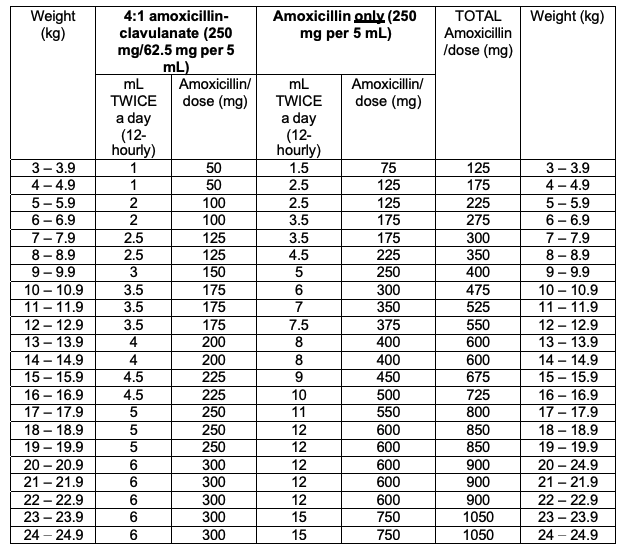
What should you do if the 14:1 (high-dose) formulation is not available but indicated?
- Approximate the dose of the 14:1 (high-dose) formulation by adding amoxicillin to the 4:1 amoxicillin-clavulanate formulation.
Table 5: Weight-banded dosing for 4:1 (250 mg/62.5 mg per 5 mL) formulation with additional amoxicillin to approximate the 14:1 (high-dose) formulation:
Click on image to enlarge
Contributors: Prof H Rabie, Dr H Finlayson, Dr R van Rensburg, Dr K Pretorius, Dr M Alghamdi, Prof E Decloedt, Dr V Pillay-Fuentes Lorente
Division of Clinical Pharmacology, Department of Medicine
Department of Paediatrics
Faculty of Medicine and Health Sciences
Stellenbosch University
Therapeutics Bulletin_Newsletter, January 2025