Organisation of Services
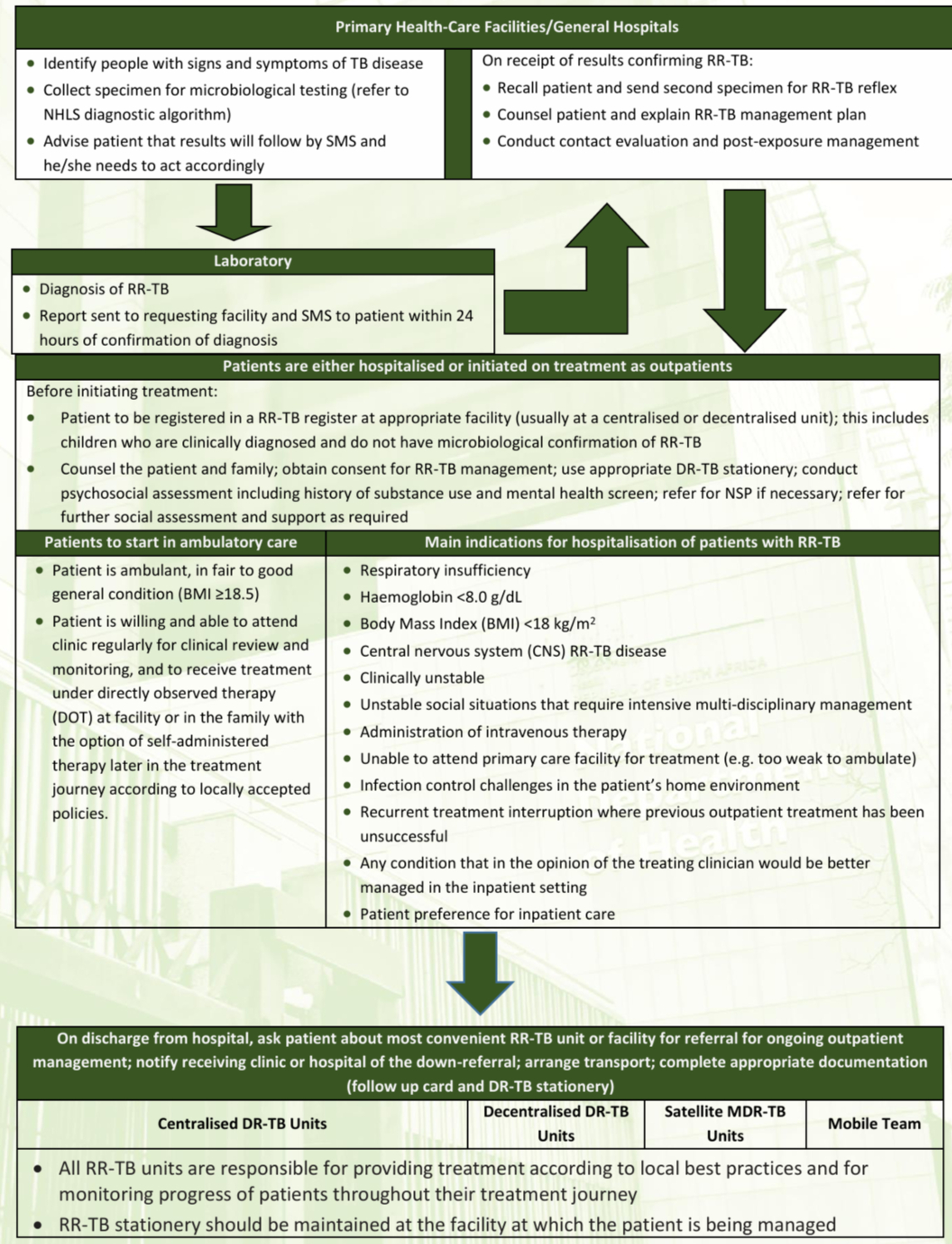
Patient Flow (Adapted from the policy framework on MDR-TB treatment) Most of the RR-TB care and services should be provided in the outpatient setting according to the National decentralization plan which aligned with our policy framework on decentralized and deinstitutionalized management of multidrug-resistant tuberculosis [10] . Children do not need to be treated by central sites and can
Patient Flow (Adapted from the policy framework on MDR-TB treatment)
Most of the RR-TB care and services should be provided in the outpatient setting according to the National decentralization plan which aligned with our policy framework on decentralized and deinstitutionalized management of multidrug-resistant tuberculosis [10]. Children do not need to be treated by central sites and can be managed closer to home where there are health care staff comfortable with the care of children.
Persons with clinical indications for hospitalization should be admitted for care at the discretion of their healthcare providers. The length of hospitalization should be based on the reason for admission and resolution of the condition(s) that led to hospitalization. It is not necessary to wait for smear or culture conversion prior to discharge from hospital.
Nurses who have been trained to prescribe second-line TB treatment should continue to initiate uncomplicated patients on RR-TB treatment, as a 2018 programme review showed that patients treated via Nurse Initiated management of MDR-TB (NIMDR) had comparable outcomes to those initiated on treatment by medical officers. Nurses should receive support from medical officers in the management of complicated patients.
Both the NCAC and the PCACs should continue to be used to provide input on the management of persons with more complicated RR-TB. The PCACs can advise on toxicity management, initial regimen selection in more complicated patients, and end-of-life care. The NCAC’s input should be sought on the management of complicated patients (e.g. central nervous system (CNS), XDR-TB), patients in need of rescue regimens, and the care of children with severe RR-TB. The NCAC should also be informed of pregnant women being treated for RR-TB, although permission to initiate treatment is not required. A TB pregnancy registry will be developed to record and monitor outcomes of patients treated for RR-TB during pregnancy.
Patient Flow (Adapted from the policy framework on MDR-TB treatment) [10]
Click on the image to enlarge.
National Department of Health Clinical Management of Rifampicin-Resistant Tuberculosis, September 2023
Organisation of Services