Paediatric Pain Management
Paediatric Pain Management
Non-pharmacological pain management strategies: Physical & psychological
Pain assessment tool - behavioural: Nips score - neonates
Pain assessment tool - behavioural: FLACC score - 2 months old - 16 years
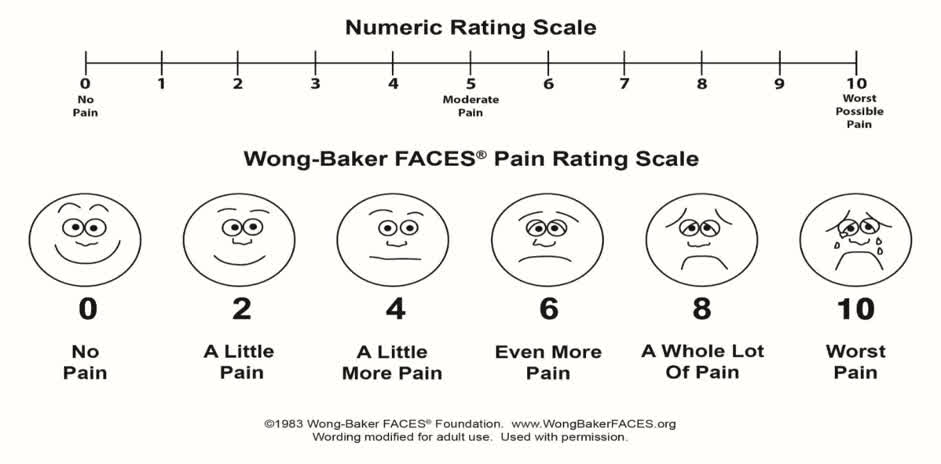
Pain assessment tool - self report: >7 years old
Pain management according to severity
This clinical guideline aims to:
- Improve the management of pain in children by:
- Reducing the time to administration of analgesia
- Promoting safe administration of appropriate analgesia
- Encouraging escalation of management where necessary
Key points to remember:
- Children are only able to verbalise ‘pain’ at 5 years, and their self-report is still unreliable.
- Know the pharmacokinetics and pharmacodynamics of the drugs that you are prescribing.
- Even if patients are being starved for theatre they can get oral analgesia.
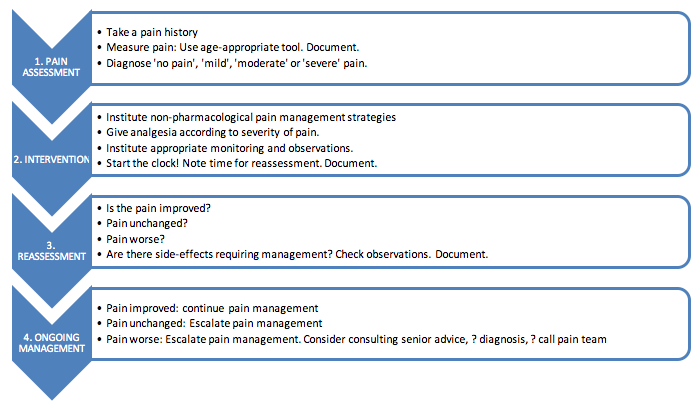
Non-pharmacological pain management strategies: physical & psychological
PHYSICAL:
- Neonates: swaddling, breastfeeding, 25% sucrose, sucking
- Cuddling
- Immobilise/splint fractures
- Dress burns or bleeding wounds that may cause distress
- Create a child-friendly environment
PSYCHOLOGICAL:
- Explanation – explain what is happening, what is about to happen, and reassure child & parent
- Distraction – play, music, TV, reading
PAIN ASSESSMENT TOOLS:
- Use a pain assessment tool (see below) to diagnose no pain, mild, moderate or severe pain:
- 0 = NO PAIN
- 1 - 3 = MILD pain
- 4 - 7 = MODERATE pain
- 8 - 10 = SEVERE pain
- Once the assessment has been made, document the pain ‘score’ and initiate the appropriate level of treatment.
PAIN ASSESSMENT TOOL – BEHAVIOURAL: NIPS SCORE - NEONATES
| NEONATAL INFANT PAIN SCALE | |||
| NPS | 0 POINT | 1 POINT | 2 POINTS |
| FACIAL EXPRESSION | RELAXED | CONTRACTED | |
| CRY | ABSENT | MUMBLING | VIGOROUS |
| BREATHING | RELAXED | DIFFERENT THAN BASAL | |
| ARMS | RELAXED | FLEXED/STRETCHED | |
| LEGS | RELAXED | FLEXED/STRETCHED | |
| ALERTNESS | SLEEPING/CALM | UNCOMFORTABLE | |
PAIN ASSESSMENT TOOL - BEHAVIOURAL: FLACC SCORE - 2 MONTHS OLD – 16 YEARS
| 0 | 1 | 2 | |
| Face | No particular expression or smile | Occasional grimace/frown; withdrawn or disinterest [Appears sad or worried] | Consistent grimace or frown; frequent/constant quivering chin, clenched jaw [Distressed-looking face; expression of fright or panic] |
| Legs | Normal position or relaxed | Uneasy, restless, tense [Occasional tremors] | Kicking, or legs drawn up [Marked increase in spasticity, constant tremors or jerking] |
| Activity | Lying quietly, normal position, moves easily | Squirming, shifting back and forth, tense [Mildly agitated (e.g., head back and forth, aggression); shallow, splinting respirations, intermittent sighs] | Arched, rigid, or jerking [Severe agitation head banging; shivering (not rigors); breath holding, gasping or sharp intake of breath; severe splinting] |
| Cry | No cry (awake or asleep) | Moans or whimpers, occasional complain [Occasional verbal outburst or grunt] |
Crying steadily, screams, or sobs; frequent complaints [Repeated outbursts, constant grunting] |
| Consolability | Content, relaxed | Reassured by occasional touching, hugging, or "talking to"; distractible | Difficult to console or comfort [Pushing away caregiver, resisting care or comfort measures] |
*Revised descriptors for children with disabilities shown in brackets.
PAIN ASSESSMENT TOOLS – SELF REPORT: > 7 YEARS OLD
PAIN MANAGEMENT ACCORDING TO SEVERITY:
See below for dosing.
MANAGEMENT OF MILD PAIN:
- Non-pharmacological pain management strategies
- Simple analgesia: Paracetamol
- +/- NSAID: Ibuprofen
- Or Diclofenac
MANAGEMENT OF MODERATE PAIN:
- Non-pharmacological pain management strategies
- Simple analgesia: Paracetamol
- + NSAID: Ibuprofen
- Or Diclofenac
- + Opioid: S/L: Tilidine
- OR PO: Morphine syrup
- OR Intranasal: Fentanyl
- OR Tramadol IV
MANAGEMENT OF SEVERE PAIN:
- Non-pharmacological pain management strategies
- Simple analgesia: Paracetamol
- + NSAID: Ibuprofen
- Or Diclofenac
- + Opioid IV: Morphine
- OR Opioid Intranasally (no IV access): Fentanyl
AND ASK…?
- Is the pain ongoing or expected to last > 12 hours?
- Consider PCA or opioid infusion – call on-call pain anaesthetist.
- Consider calling on – call pain anaesthetist to provide regional anaesthesia where appropriate.
FORMULARY:
Sucrose 25%:
- Administer 0.2-0.5ml onto the front of the neonate/infant’s tongue
- If using a pacifier, apply to the pacifier.
- Give 2 minutes prior to a painful procedure
- Analgesic effect lasts 5-8 minutes
Paracetamol:
- PO: 20mg/kg 4-6 hourly (max 90mg/kg/day)
- PR: 30mg/kg 6 hourly
- IV: Neonates or < 10kg – 10mg/kg 6 hourly
- Older – 15mg/kg 6 hourly
NSAIDs:
- Ibuprofen syrup: 7.5-10mg/kg 8 hourly (>3 months old)
- Diclofenac PR: 1mg/kg 8 hourly (>6 months old)
Opioids:
- Tilidine:
- 1mg/kg/dose 4-6 hourly. 1 drop = 2.5mg
- Weight / 2.5 = number of drops.
- Decant dose into a syringe. Don’t ‘pour’ into the child’s mouth.
- Morphine:
- Per Os: Morphine syrup 0.2-0.4mg/kg/dose 4-6 hourly.
- IV: < 6 months old: Morphine 0.02mg/kg/dose
- > 6 months old: 0.04mg/kg/dose
- > 50kg: 2mg
- Can be dosed at 0.1mg/kg BUT the safety of titration is lost
- Titrate at 15 minute intervals until comfortable then dose 4-6 hourly.
- Intranasal Fentanyl:
- 1st Dose: 1.5mcg/kg
- 2nd Dose: 0.5mcg/kg after 10 minutes
- Technique: Use 1ml syringe + MAD (Mucosal Atomiser Device)
- The patient should be reclining at 45 degrees and the syringe should be held horizontally and the contents expelled into the nares in one rapid dose.
- Do not ask patient to sniff.
- Doses of 1 mL (50 micrograms) or more should be divided between nares.
- Observe in Casualty for 20 minutes after dose.
- Suitable for discharge one hour after dose if responding appropriately
- Tramadol:
- IV: 1mg/kg 4-6 hourly
MONITORING:
- All patients receiving opiates MUST have the following monitored AND documented:
- Heart rate
- Oxygen saturation via CONTINUOUS saturation monitoring for 1st 15 minutes.
- Respiratory Rate
- Level of consciousness
- Pain score
- Frequency of monitoring: Observe closely for 15 minutes after administering opioid dose. Then do observations every 30 mins for the 1st hour. Thereafter, observations can be documented 2 hourly.
- There must be a nurse available to respond to the monitor, initiate management and escalate care appropriately.
- Resuscitation equipment should be readily available, checked and in working order.