Pain Control
Description Pain management General and supportive measures Non-medicine pain management strategies ICD-10 code: R52.9 DESCRIPTION Pain is an unpleasant sensory and emotional experience associated with, or resembling that associated with, actual or potential tissue damage, or described in terms of such damage. Pain is an inherent part of the pathology of most medical and surgical diseases.
General and supportive measures
Non-medicine pain management strategies
ICD-10 code: R52.9
DESCRIPTION
Pain is an unpleasant sensory and emotional experience associated with, or resembling that associated with, actual or potential tissue damage, or described in terms of such damage.
Pain is an inherent part of the pathology of most medical and surgical diseases. Children are especially vulnerable to poor pain management, largely due to underestimation of pain severity (by clinicians and parents). This frequently results in inappropriate management of pain, e.g. paracetamol only for management of moderate or severe pain, and not using opioids when indicated.
Acute pain is of sudden onset, is felt immediately following injury, is severe in intensity, but is usually short-lasting. It arises from tissue injury which stimulates nociceptors, and generally disappears when the injury heals.
Chronic pain is continuous or recurrent pain that persists beyond the expected normal time of healing. Chronic pain may begin as acute pain and persist for long periods, or may recur due to persistence of noxious stimuli or repeated exacerbation of an injury. Chronic pain may also arise and persist in the absence of identifiable pathophysiology or medical illness. Chronic pain can negatively affect all aspects of daily life, including physical activities, school attendance, sleep patterns, family interactions and social relationships and can lead to distress, anxiety, depression, insomnia, fatigue or mood changes, such as irritability and negative coping behaviour. As pain is an outcome of an interaction of many factors, a holistic approach to the child and family is required.
Good pain management involves 6 steps:
- A high index of suspicion that pain is present.
- Accurate pain assessment that is developmentally appropriate, using scoring tools.
- Making an assessment of pain severity – mild, moderate or severe.
- Initiating non-pharmacological pain management strategies.
- Timely administration of analgesia, appropriate for the severity of pain.
- Reassessment within an appropriate time period, and ongoing care.
Pain assessment
Evidence-based practice supports the routine use of pain scoring tools for pain assessment. These tools enable a more accurate pain diagnosis, which serves to guide appropriate pain management.
Accurate assessment of pain severity can be achieved through:
- Self-report: This is only possible for children aged 5–7 years and older.
- Behavioural tools: There are various composite tools that can be utilised for children who are preverbal, or cognitively impaired. The correct tool is one that is developmentally appropriate and can be used consistently.
Physiological variables such as heart rate, blood pressure, and respiratory rate are unreliable indicators of the presence or absence of pain.
Choose an appropriate pain assessment tool depending on the child’s age and cognitive development. This facilitates the quantification of pain, which is then used to diagnose mild, moderate, or severe pain.
Neonates: Behavioural pain assessment tool (Table 1)
This tool is used in neonates and infants up to 2 months of age. The patient is observed for one minute and each parameter scored. The maximum score is 7. The score is tallied, and a diagnosis of pain severity is made (see below).
Table 1: Neonatal Infant Pain Scale (NIPS)
| NEONATAL INFANT PAIN SCALE (NIPS) | |||
| 0 | 1 | 2 | |
| Facial expression | Relaxed | Contracted | |
| Cry | Absent | Mumbling | Vigorous |
| Breathing | Relaxed | Different than basal | |
| Arms | Relaxed | Flexed/ stretched | |
| Legs | Relaxed | Flexed/ stretched | |
| Alertness | Sleeping/ calm | Uncomfortable | |
Infants and children (2 months to 18 years old): Behavioural pain assessment tool (Table 2)
This tool can be used in children aged 2 months to 18 years and includes descriptors for cognitively impaired children. The clinician assigns a score to each parameter, and tallies a score out of 10. The final score is used to diagnose mild, moderate, or severe pain, which must be treated accordingly (see below).
Table 2: Revised FLACC Tool (R-FLACC)
| Revised FLACC Tool (R-FLACC) | |||
| 0 | 1 | 2 | |
| Face | No particular expression/ smile. | Occasional grimace/ frown; withdrawn or disinterested. Appears sad/ worried. | Constant grimace/ frown, quivering chin, clenched jaw. Looks distressed, expression of fright/ panic. |
| Legs | Normal position or relaxed. | Uneasy, restless, tense. Occasional tremors. | Kicking or legs drawn up, spasticity, constant tremors, jerking. |
| Activity | Lying quietly, normal position, moves easily. | Squirming, shifting back and forth, tense, mildly agitated. Shallow, splinting respirations, intermittent sighs. | Arched, rigid, jerking. Severe agitation. Breath-holding, gasping, sharp intake of breath. Severe splinting. |
| Crying | No cry (awake/ asleep). |
Moans or whimpers, occasional complaint, verbal outburst/ grunt. | Crying steadily, screams, sobs. Frequent complaints/ outbursts, constant grunting. |
| Consolability | Content, relaxed. | Reassured by occasional touching, ‘talking to’, hugging. Distractible. | Difficult to console/ comfort. Pushing away caregiver or comfort measures. |
Self-reporting pain assessment tools: The gold standard of pain assessment is self-report. Consider using self-report tools from > 5 years. If the child is unable to self-report, use R-FLACC.
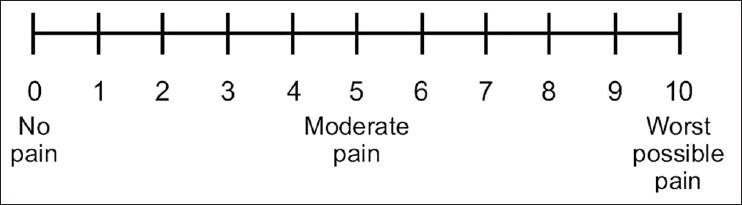
Numerical Rating Scale (Figure 1)
The Numeric Rating Scale (NRS) (Figure 1) assigns a number to their level of pain. Ask the child: ‘From one to ten, if one is very little pain and ten is the worst pain you could imagine, how bad is your pain now?’
Figure 1: Numeric Rating Scale (NRS)
Click on image to enlarge
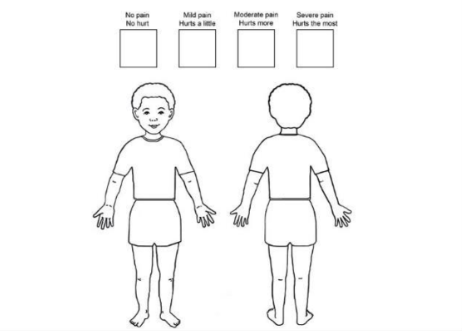
Self-reporting pain assessment tool – Eland Colour Tool (Figure 2)
After discussing with the child several things that have hurt or caused the child pain in the past:
- Present the child with four crayons or markers of different colours.
- Using the term that the family and child use to describe hurt or pain (the word ‘pain’ is used in these instructions), ask the following questions and, after the child has answered, mark the appropriate square on the tool:
- Of these colours, which colour is most like the worst pain you have ever had, or the worst pain anybody could ever have?
- Which colour is almost as much pain as the worst pain, but not quite as bad?
- Which colour is like a little pain?
- Which colour is like no pain at all?
3. Show the four colours to the child in order, from the colour chosen for the worst pain to the colour chosen for no pain.
4. Ask the child to colour within the body outlines in the places where it hurts on their own body, using the colours chosen to show how much it hurts.
5. When finished, ask if this is a picture of how it hurts now or how it hurt earlier. Be specific about what earlier means by relating the time to an event, for example, at lunch or in the playroom.
Note:
Ask the child what their favourite colour is before starting and remove that one from the group of colours, as you don’t want them to associate pain with this colour.
Figure 2: Eland Colour Tool
Click on the image to enlarge
Assess pain severity
Use the pain assessment tools to make a diagnosis of no pain, mild, moderate or severe pain. For neonates/infants use the NIPS:
- 0–2 points = no pain.
- 3–4 points = moderate pain.
- > 4 points = severe pain.
For R-FLACC and NRS:
- 0 = no pain.
- 1–3 = mild pain.
- 4–7 = moderate pain.
- 8–10 = severe pain.
Once the severity of pain has been diagnosed, initiate the appropriate level of management.
PAIN MANAGEMENT
After assessing and scoring pain, proceed to pain management according to severity. Optimal pain control includes managing baseline pain (usually associated with the pathology), and pain associated with procedures. Always include non-pharmacological pain management strategies. Anxiety, fear, and pain in children are intricately linked. Addressing these is important in managing pain adequately and holistically.
Principles of pain management in children (aligned with the World Health Organization)
- Each child deserves a pain management strategy that is tailored to his/her physical, physiological, emotional and social needs.
- Give analgesia ‘by the clock’. Prescribe scheduled analgesia and avoid dosing ‘as necessary’ or pro re nata (PRN) as far as possible. If PRN dosing is used, ensure that the caregiver remains present and is sufficiently empowered to request analgesia if in pain, and that this request will be attended to by nursing staff.
- Give analgesia by the most appropriate route. Intermittent intramuscular injections are distressing to children and are less effective in achieving pain control than other routes of administration. Their use is strongly discouraged.
- Treat pain according to severity – mild, moderate or severe. To diagnose pain severity, always use pain scoring tools. This will direct appropriate pain management.
GENERAL AND SUPPORTIVE MEASURES
- Discuss pain management with the family, including the child, as developmentally appropriate.
- Address all factors that may contribute to pain and associated symptoms, e.g. family stress, anxiety and sleep deprivation. Address parental/caregiver anxiety.
- As far as possible, minimise separation of the child from the parent/ caregiver.
- Ensure that child is comfortable, e.g. nappy is clean and dry, child is fed.
NON-MEDICINE PAIN MANAGEMENT STRATEGIES
| Type of intervention | Examples of evidence-based interventions |
| Contextual | Cluster procedures to reduce handling and allow rest |
| Physical | Breastfeed, non-nutritive sucking (dummy/pacifier), Kangaroo Mother Care/parental holding (not restraint), facilitated tucking, 24% sucrose, massage, containment, aromatherapy, keep warm. Ice for acute injuries with significant swelling. Immobilise/splint fractures. Cover burns or bleeding wounds. |
| Cognitive | Explain procedures, allow music, provide appropriate reassurance, educate on pain mechanisms, encourage mindfulness, distraction, imagery, favourite toy, music therapy. |
| Emotional | Caregiver presence, structured caregiver involvement (provide guidance), caregivers voice, clinician voice calm, soothing, positive affirmations, active reassurance. Parental involvement and interaction should be actively encouraged and should be an integral part of care. |
| Environmental | Reduce noise, dim lights, set monitor alarms. Use incubator covers/sheets to decrease light levels as appropriate for each baby. Create a child-friendly environment. |
The oral administration of sucrose is a safe and effective form of analgesia for short-duration procedures and may be given for repeated procedures. It is effective in neonates and infants up to 18 months of age. The dose is 0.05– 0.5 mL. Technique for using sucrose:
- Two minutes prior to the painful procedure or to settle the neonate in pain, administer a small amount of the dose, about one drop, onto the neonate’s tongue using a pacifier or syringe. If necessary, repeat giving a drop of sucrose onto the infant’s tongue during the procedure.
- Use the smallest amount of sucrose to provide pain relief, and if necessary, administer in small drops until the maximum recommended volume is achieved.
- Sucrose is more effective if given in conjunction with non-nutritive sucking using a pacifier.
- Comfort measures, such as facilitated tucking, rocking, skin-to-skin care and swaddling, may be used in conjunction with the sucrose during the procedure.
Standard Treatment Guidelines and Essential Medicines List for South Africa Paediatric Hospital _2023, 5th edition_Updated July 2024
Chapter 20: Pain Control, 20.1. Pain Control
- Click here for 20.1.1.1 Acute Pain
- Click here for 20.1.1.2 Persistent/ Chronic Pain (Non-Cancer Pain)
- Click here for 20.1.1.3 Cancer Pain